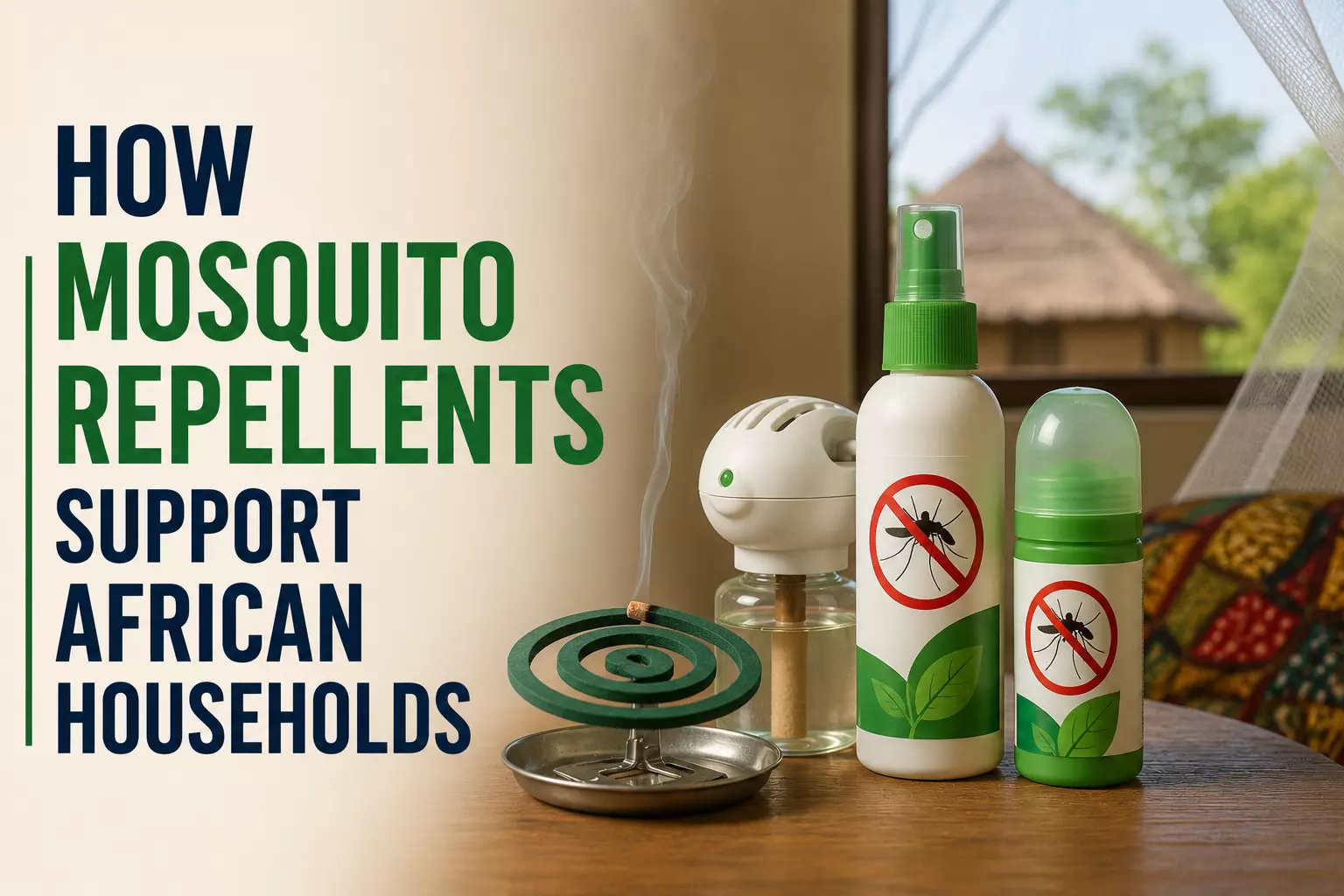
How Mosquito Repellents Support African Households
Mosquito repellents remain important household products across Africa, where warm climates, seasonal rainfall, standing water, and dense urban settlements can increase mosquito exposure. Repellents are used in homes, workplaces, schools, shops, farms, and outdoor spaces to reduce bites and improve everyday comfort.
They also support broader preventive behaviour in regions where mosquito-borne diseases continue to affect public health and household spending.
A published study by MarkNtel Advisors reports that the Africa mosquito repellent sector was valued at USD 1.12 billion in 2025.
It is projected to grow from USD 1.17 billion in 2026 to USD 1.52 billion by 2032, registering a CAGR of around 4.46% during 2026–32. Nigeria accounts for nearly 25% share, while coils hold about 35% in 2026.
Disease Prevention Strengthens Product Relevance
Mosquito repellents are closely linked with disease-prevention behaviour because mosquitoes can transmit malaria, dengue, chikungunya, yellow fever, and other infections.
Although repellents do not replace medical care, treated nets, indoor residual spraying, or public-health programs, they can reduce personal exposure during evening, nighttime, and outdoor activities.
The World Health Organization notes that malaria remains a major public-health concern in Africa, with prevention depending on integrated vector-control tools and community-level action.
This context supports recurring demand for mosquito-control products that households can use directly, particularly during rainy seasons and in areas with high mosquito density.
Coils Remain Widely Used
Mosquito coils hold a leading product position because they are affordable, easy to use, and familiar to many households. They are commonly used in bedrooms, verandas, shops, and semi-open spaces where electricity access may be inconsistent or where plug-in devices are less practical.
Their low upfront cost supports use among price-sensitive consumers.
However, usage conditions matter. Coils should be placed safely, kept away from children and flammable materials, and used in spaces with adequate ventilation.
Consumers increasingly compare coils by burn duration, smoke level, fragrance, effectiveness, and price. Manufacturers that reduce smoke intensity while maintaining affordability may appeal to households seeking practical protection with better indoor comfort.
Adults Represent the Largest End Users
Adults account for the largest end-user share because they make most household purchase decisions and often face mosquito exposure during work, travel, outdoor social activity, and evening routines.
Farmers, traders, construction workers, transport operators, security personnel, and informal workers may spend long periods outdoors, increasing the need for accessible repellent options.
Adult consumers also purchase products for wider household use, including children and elderly family members. This makes safety communication important.
Labels should clearly explain application instructions, age suitability, storage guidance, and precautions. Products designed for family use must balance effectiveness with comfort, scent preference, skin tolerance, and affordability.
Nigeria Leads Regional Demand
Nigeria holds the largest share due to its large population, tropical climate, urban expansion, and persistent mosquito-control needs.
Demand is supported by both household use and institutional settings such as schools, hospitality facilities, offices, and small businesses. Products that are affordable, widely distributed, and available in convenient pack sizes are especially relevant in this environment.
Nigeria’s role also reflects broader demand across West Africa, where mosquito exposure is shaped by rainfall patterns, water storage practices, drainage conditions, and urban density. Retailers in such locations must maintain consistent availability of coils, aerosols, creams, mats, vaporisers, and treated products during peak mosquito seasons.
Product Formats Are Diversifying
Mosquito repellent demand is no longer limited to coils. Aerosol sprays, creams, lotions, roll-ons, plug-in vaporisers, mats, patches, incense sticks, and spatial repellents are becoming more visible across urban and semi-urban households. Each format serves a different use case depending on location, income level, electricity access, ventilation, and consumer preference.
The CDC’s Yellow Book explains that DEET, picaridin, oil of lemon eucalyptus, PMD, IR3535, and 2-undecanone are among recognised repellent active ingredients. This reinforces the importance of ingredient transparency, correct application, and product selection based on intended use rather than fragrance or packaging alone.
Urbanisation Supports Household Consumption
Urban expansion creates conditions that can increase mosquito breeding when drainage, waste management, and water storage are not properly controlled. Informal settlements, construction sites, open containers, blocked drains, and stagnant water can contribute to mosquito presence.
In these environments, repellents become part of routine household protection, especially when structural mosquito control is limited.
Urban consumers also have access to more product choices through supermarkets, pharmacies, convenience stores, open markets, and e-commerce platforms.
This supports competition among domestic and imported brands. Packaging, price promotions, product visibility, and trusted retail access influence purchasing decisions, particularly for frequently used household items.
Read: Business Travel to Uganda: A Practical Guide for
Affordability Shapes Brand Preference
Price remains a major factor because mosquito repellents are repeat-purchase products. Many households need protection daily or seasonally, making affordability central to product selection. Low-cost coils and small sachet formats can help consumers manage recurring expenses while maintaining access to basic protection.
At the same time, middle-income urban consumers may choose aerosols, electric vaporisers, skin-applied repellents, or low-smoke formulations for convenience and comfort. This creates a segmented landscape where both value products and premium formats can grow, depending on household income, lifestyle, and retail availability.
Safety and Education Remain Important
Consumer education is essential because misuse can reduce effectiveness or create avoidable risks. Skin-applied repellents must be used according to label instructions, while indoor products require safe placement and ventilation.
Households should also combine repellents with environmental measures such as removing standing water, using window screens, and sleeping under appropriate nets where recommended.
WHO has also highlighted spatial repellents and other vector-control innovations as part of ongoing efforts to reduce mosquito exposure. Such developments may gradually influence product innovation across African countries, especially where households seek longer-lasting and easier-to-use protection.
Outlook for Mosquito Repellents in Africa
Demand for mosquito repellents in Africa is expected to remain supported by disease-prevention awareness, seasonal mosquito exposure, urbanisation, population growth, and recurring household consumption. Coils will continue to hold a strong position because of affordability and familiarity, while sprays, creams, vaporisers, and newer spatial formats will expand choice.
Future development will depend on safe formulations, clear labelling, retail reach, affordability, product innovation, and public-health awareness.
Brands that combine effective protection with accessible pricing, responsible usage guidance, and reliable distribution will remain important to household mosquito-control routines across Africa.