How Laser Scans Unlock Precision in BIM Modeling
Architecture and construction are industries where precision is everything. A measurement off by a fraction of an inch can cascade into costly delays, wasted materials, and structural headaches down the line. For decades, teams relied on manual measurements and 2D drawings, methods prone to human error. But as technology advances, the margin for error is shrinking—thanks largely to the integration of Building Information Modeling (BIM) and laser scanning.
These two technologies, powerful on their own, create a formidable toolset when combined. By capturing the physical world in microscopic detail and translating it into a digital environment, architects and engineers can design with unprecedented accuracy. This article explores how the synergy between laser scanning and BIM is redefining precision in design and construction.
Understanding Building Information Modeling (BIM)
Building Information Modeling, or BIM, is more than just 3D modeling. It is a process for creating and managing information on a construction project across its entire lifecycle. While traditional CAD drawings focus on the physical appearance of a building (lines and shapes), BIM focuses on the data behind the design.
A BIM model is a digital representation of the physical and functional characteristics of a facility. It serves as a shared knowledge resource for information about a facility, forming a reliable basis for decisions during its lifecycle—from earliest conception to demolition.
Key Characteristics of BIM
- Information-Rich: Every object in a BIM model carries data (dimensions, material type, cost, manufacturer).
- Collaborative: Multiple disciplines (architects, structural engineers, MEP engineers) can work on the same model simultaneously.
- Lifecycle Management: The model evolves with the building, aiding in maintenance and renovation long after construction ends.
The Role of Laser Scanning
If BIM is the digital brain, laser scanning is the digital eye. Also known as LiDAR (Light Detection and Ranging), 3D laser scanning is a non-contact technology that digitally captures the shape of physical objects using a line of laser light.
Capturing Reality
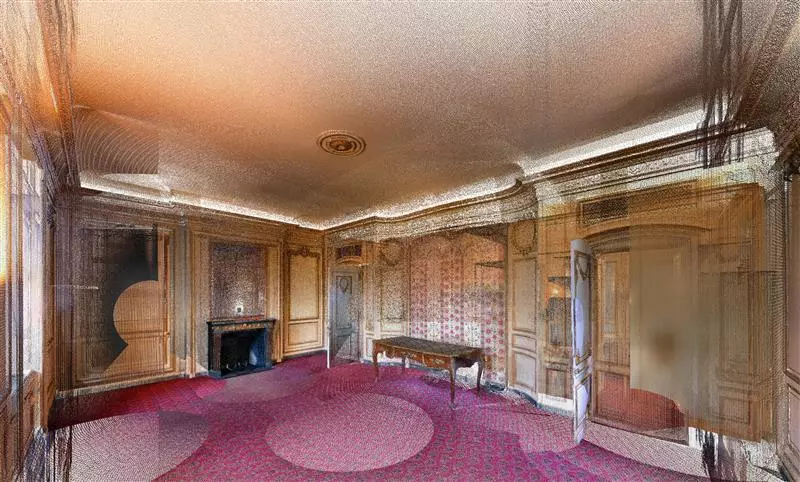
Scanners emit millions of laser beams per second. When these beams hit a surface—a wall, a pipe, a beam—they bounce back to the scanner. The device measures the time it takes for the light to return, calculating the precise distance.
The result is a "point cloud," a dense collection of millions of data points that represent the exact geometry of the scanned environment.
This technology is particularly vital for renovation and retrofit projects. Instead of relying on outdated as-built drawings (which are rarely accurate), designers can capture the current, actual state of a building.
Read: Why Choose an F-theta Lens for Laser Marking and
Integrating Laser Scans into BIM
The process of moving from a physical site to a digital model is often referred to as "Scan-to-BIM." This workflow bridges the gap between the existing conditions and the design environment.
1. Data Acquisition
A surveyor sets up laser scanners at multiple positions around a site to capture every angle. These individual scans are then "registered" or stitched together to form a complete, unified point cloud of the building.
2. Processing and Modeling
The point cloud data is imported into BIM software (like Revit or ArchiCAD). At this stage, the data is just a mass of dots. Specialized scan to BIM modeling services are often employed to interpret this data. Modelers trace over the point cloud, replacing the dots with intelligent BIM objects—turning a cluster of points into a recognized wall, window, or HVAC duct.
3. Validation
The resulting 3D model is overlaid against the original point cloud to verify accuracy. This ensures that the digital twin matches the physical reality within millimeters.
Why Laser Scans Improve BIM Precision
The shift from manual surveying to laser scanning offers tangible benefits that directly impact the quality and efficiency of a project.
Unmatched Accuracy
Manual measurements are subject to human error, inaccessible areas, and simple oversight. A laser scanner doesn't get tired or skip a measurement. It captures everything within its line of sight with millimeter-level accuracy. This precision eliminates the "field verification" trips often needed when digital models don't match site conditions.
Clash Detection
One of the most significant advantages is the ability to detect clashes before construction begins. In a retrofit project, new mechanical systems must fit within existing constraints. By overlaying the design model onto the scan of the existing structure, engineers can see immediately if a new duct hits an existing beam. Resolving these conflicts digitally is significantly cheaper than resolving them with a jackhammer on site.
Efficiency in Complex Environments
For historical buildings or complex industrial facilities with intricate piping, manual measurement is nearly impossible. Laser scanning captures complex geometries instantly. Companies like Chudasama Outsourcing Service specialize in converting these complex datasets into usable models, allowing architects to work with difficult structures without simplifying or guessing.
Real-World Applications
The theoretical benefits of Scan-to-BIM are clear, but the practical applications show its true value.
- Historical Preservation: When restoring a heritage building, maintaining the original aesthetic is crucial. Laser scans capture the subtle sags in floors or the leaning of walls that occur over centuries, allowing architects to design renovations that accommodate these irregularities rather than fighting them.
- Industrial Retrofitting: In manufacturing plants, downtime equals lost revenue. By scanning a facility, engineers can prefabricate new equipment off-site with the confidence that it will fit perfectly upon installation, minimizing the shutdown period.
- Facility Management: For large campuses or hospitals, having an accurate as-built model derived from laser scans allows facility managers to locate assets, plan maintenance, and manage space effectively without needing to physically inspect every room.
Embracing the Future of Design
The integration of laser scanning and BIM represents a fundamental shift in how we approach the built environment. It moves the industry away from assumptions and approximations toward certainty and precision.
For architects, engineers, and construction professionals, adopting these technologies is no longer just a competitive advantage; it is becoming standard practice. Whether utilizing internal teams or partnering with experts like Chudasama Outsourcing Service, leveraging the Scan-to-BIM workflow ensures that designs are rooted in reality, reducing risk and paving the way for smoother, more efficient construction projects.
The future of design is not just about what we can imagine, but how accurately we can understand what already exists. Laser scanning provides that understanding, and BIM provides the platform to build upon it.