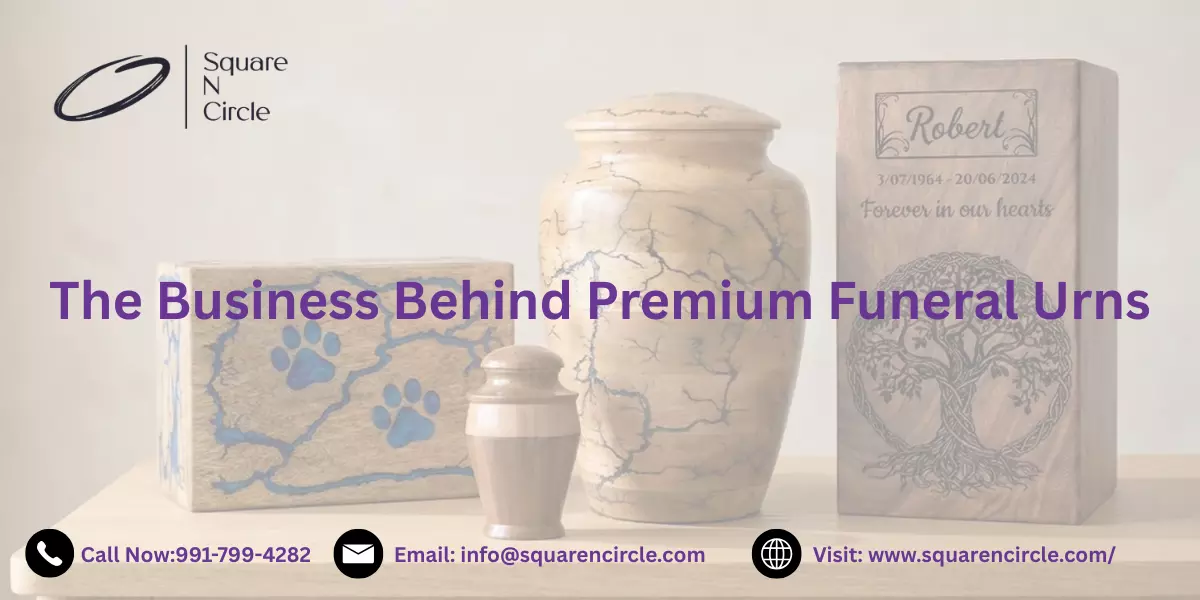
How Funeral Urns Are Redefining Memorial Retail
A procurement manager in Ohio once rejected an entire container over a lid that wouldn't seal flush after six weeks at sea. That single defect ended a three-year supply contract.
This is what buyers sourcing Funeral Urns rarely get warned about — the sample piece tells you almost nothing about what lands on unit 4,000. If you're evaluating Funeral Urns Manufacturers for wholesale, export, or private label, the real test isn't the showroom piece. It's what a factory does when nobody's watching the fortieth batch.
Memorial retail has quietly stopped being a niche category. Funeral homes, distributors, and e-commerce brands are now stocking wider urn ranges than they did five years ago — brass beside biodegradable, keepsake beside companion, all under one SKU list.
Buyers who used to order from a single catalog now need a partner who can produce across materials without the quality dropping on the third one.
The Spec Detail Most Buyers Skip
Urn sizing isn't guesswork, though plenty of first-time buyers treat it that way. The industry standard is one cubic inch of capacity per pound of body weight, which is why most adult urns land in the 200 to 220 cubic inch range. Miss that spec and you've either shipped a container of urns too small for standard adult remains or one that looks disproportionate on a shelf.
Material Categories Worth Knowing
- Brass and bronze — solid, engraving-friendly, the traditional choice for burial and display.
- Aluminium — lighter, corrosion-resistant, cheaper to freight for international lots.
- Wood and marble — higher perceived value, slower production cycles.
- Ceramic and glass — decorative appeal, needs reinforced export packaging.
- Biodegradable (salt, sand, cardboard) — the fastest-growing category, driven by green burial demand.
Here's the detail most RFPs leave out: sealing method. A screw-threaded lid behaves differently in humid transit than a friction-fit one, and that's exactly where the Ohio-style rejection happens. Ask your supplier which sealing method they use per material — not just "is it sealed."
What Actually Separates a Real Supplier From a Risky One
Anyone can claim quality. Here are five things worth checking before you sign, and what a bad answer sounds like for each.
- Batch consistency across 500+ units. Bad answer: "Every piece is handmade so they'll vary slightly." That's charming for a boutique gift shop. It's a liability for a wholesale contract where retailers expect uniform SKUs.
- Defect and return policy in writing. Bad answer: "We'll handle it case by case." That's not a policy — it's a negotiation you'll lose after the shipment has already landed and the goodwill has evaporated.
- Export documentation experience. Bad answer: vague reassurance with no mention of Incoterms. If a supplier can't tell you whether they work EXW, FOB, or DDP without checking, they haven't shipped enough volume to be reliable at scale.
- Material sourcing transparency. Bad answer: "Premium materials" with no specifics. Ask which alloy, which wood grade, which biodegradable base — vague language here usually means inconsistent sourcing.
- Customization turnaround for private label. Bad answer: no clear timeline. Laser engraving and packaging redesign are routine requests; a supplier without a standard lead time for them hasn't done it often.
Why Buyers Choose Structured Manufacturing Over Ad Hoc Sourcing
- Reduced return risk. Consistent tolerances mean fewer rejected batches and fewer arguments with your own retail customers.
- Protected margins. Predictable per-unit costs across large orders protect the pricing you've already promised your buyers.
- Faster reorder cycles. A manufacturer with standing capacity doesn't force you to requote every season.
- Private label flexibility. Laser engraving, custom packaging, and brand-specific finishing let distributors sell under their own name without building a factory.
- Compliance handled upstream. Export-grade packaging and documentation prevent customs delays that eat into delivery windows.
- Material breadth from one vendor. Sourcing brass, wood, and biodegradable urns from a single manufacturer cuts your supplier management overhead significantly.
Sourcing From India: What the Geography Actually Buys You
India's craft manufacturing base — particularly in wood finishing and metal engraving — gives Funeral Urns Manufacturers in India an edge that's hard to replicate in fully automated facilities elsewhere.
Handwork on brass and wood urns is still cost-competitive here in a way it simply isn't in most Western manufacturing hubs, and that gap widens as labor costs rise elsewhere.
That said, geography is a supply chain decision, not just a nice sourcing story.
Buyers working with Funeral Urns Suppliers in India should factor in sea freight timelines of four to six weeks to North America and Europe, which means reorder planning has to happen earlier than it would with a domestic vendor. It's a tradeoff, not a shortcut — cost efficiency in exchange for planning ahead.
About Square N Circle
We didn't start out making urns. Square N Circle was founded in 2008 as a manufacturer of drapery hardware and wood-based components, and that early discipline in precision woodworking and finishing systems is still the backbone of how we run production today.
In 2022, after an internal capability review, we made a deliberate move into cremation urns and memorial products — not as a side line, but as a core export category.
Since that expansion, we've produced more than 27,000 cremation urns for buyers ranging from low-MOQ new brands to institutional clients needing large-scale volume.
We stopped offering a particular thin-gauge aluminium finish in 2023 after two international buyers reported denting during transit despite reinforced packaging — we redesigned the wall thickness instead of arguing about it. That's the kind of adjustment you only make when you're the one fielding the complaint calls.
We manufacture in brass, aluminium, wood, marble, ceramic, and biodegradable materials, with private labeling, laser and hand engraving, and export packaging built for EXW, FOB, and DDP terms. You can see our full production range in our cremation urns and memorial products catalog.
Read: Best Funeral Bouquets to Honor a Loved One's Memory
Get a Quote That Actually Reflects Your Order
Send us your target material, quantity, and destination port, and we'll respond within 48 hours with pricing and a realistic production timeline — not a placeholder estimate. Our MOQ starts at low volumes for new brands testing a product line and scales into full container loads for distributors.
Email your specs or request a sample kit through our contact page, and we'll walk you through sizing, sealing method, and customization options before you commit to a bulk order.
The Bottom Line
Choosing between Funeral Urns Manufacturers isn't really about who has the prettiest catalog photos. It comes down to whether a supplier can hold tolerance across a thousand units, document their process, and answer hard questions without stalling.
As memorial retail keeps expanding into wider materials and more personalized products, the manufacturers who survive will be the ones who treated consistency as the product, not an afterthought.
FAQs
1. What is the standard capacity for an adult funeral urn?
Most adult urns run 200 to 220 cubic inches, based on the one-cubic-inch-per-pound rule. If a supplier quotes you a flat "standard size" without asking about the deceased's weight range, push back — it's a sign they're not thinking about fit.
2. What should I look for in Funeral Urns Distributors before signing a bulk contract?
Ask for batch consistency data, a written defect policy, and proof of export documentation experience. Honestly, if a distributor can't produce a sample defect report from a past batch, that's worth pausing over.
3. Are biodegradable funeral urns durable enough for shipping?
They require different handling than metal or wood — salt and sand-based urns especially need reinforced, moisture-controlled packaging. Not every supplier packages them correctly, which is a real cause of transit damage in this category.
4. MOQ for wholesale sourcing of urns?
Min. Order Quantities are different for each manufacturer and for different material. Reasonable no of minimum order quantity usually is lower for new product line to test market demand. So you should ask rather than assume In general, no of minimum order quantity for wood and marble is higher than metal.