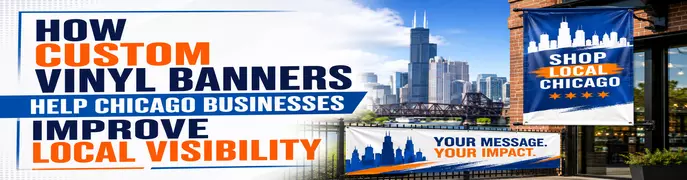
How Custom Vinyl Banners Help Chicago Businesses Improve Local Visibility
Walk down any commercial strip in Chicago like Milwaukee Avenue, Devon, or the storefronts lining Lincoln Square, and you'll notice something in common.
The businesses that catch your eye almost always have one thing working in their favor: a sign or banner that actually says something, clearly, from a distance. In a city where foot traffic and drive-by visibility can make or break a small business's month, that kind of signage isn't decoration. It's a working part of the marketing plan.
Custom vinyl banners have become one of the more practical tools Chicago business owners reach for when they need to be seen.
They're not flashy in the way a digital ad campaign is, but they do something digital ads can't: they exist in the physical space where your actual customers are walking, driving, or waiting in line for coffee.
This article looks at why that matters, how these banners are made, and what business owners should think about before ordering one.
Why Local Visibility Still Matters in a Digital-First City
It's tempting to assume that if a business has a solid website and a few social media followers, physical visibility is optional.
Chicago's neighborhood-driven commercial culture says otherwise. Many customers still decide where to eat, shop, or get a service done based on what they see on their actual route — not on what shows up in search results.
A few reasons local, physical visibility keeps pulling weight:
- Chicago's weather swings mean seasonal businesses (holiday markets, summer festivals, pop-up shops) need signage that can go up fast and come down just as fast.
- Neighborhood commercial corridors are dense, and a banner is often the fastest way to stand apart from three other businesses on the same block.
- Not every customer arrives through a search engine. Plenty just walk or drive past and decide in the moment.
This is where banners quietly do their job. They don't need a click. They just need eyes.
What Makes Custom Vinyl Banners Effective for Marketing
A banner earns its keep when it's readable, durable, and placed somewhere people actually pass by. Custom vinyl banners tend to check those boxes better than paper signage, foam board, or temporary window clings, mainly because of the material itself.
Vinyl holds ink well, resists tearing, and doesn't wilt the first time it rains — which, in Chicago, is a real consideration more months than not. Beyond durability, the "custom" part matters just as much.
A banner built around a specific storefront, a specific promotion, or a specific event tends to perform better than a generic template, simply because it's saying something relevant to the person walking by right now.
Businesses commonly use them for:
- Grand openings and re-openings after renovations
- Seasonal sales or limited-time promotions
- Event signage at farmers markets, festivals, or trade shows
- Storefront branding when a permanent sign isn't practical or affordable yet
- Directional signage pointing customers to an entrance, parking, or a temporary location
None of this is groundbreaking marketing theory. It's closer to common sense, but common sense executed well is still uncommon.
How Vinyl Banner Printing Actually Works
For anyone who hasn't ordered one before, vinyl banner printing is more straightforward than it sounds. Most shops use large-format digital printers that apply ink directly onto a vinyl sheet, which is then finished with reinforced edges (usually hemmed) and metal grommets for hanging.
The general process looks something like this:
- A design is created or submitted, usually in a high-resolution digital file.
- The file is checked for print sizing, bleed, and color accuracy, since colors on a screen don't always match what prints.
- The design is printed onto the vinyl material using UV-resistant or solvent-based inks, depending on how long the banner needs to hold up outdoors.
- The banner is trimmed, hemmed, and fitted with grommets or other hanging hardware.
The whole thing can often be turned around quickly, which is part of why vinyl remains a go-to option for businesses that need signage on short notice, a last-minute event, a sudden weather-related closure notice, or a promotion that needs to launch by the weekend.
How to Choose a Vinyl Banner That Actually Works for Your Business
This is where a lot of business owners either get it right on the first try or end up ordering a second banner because the first one didn't quite do the job. A few practical questions tend to sort this out early.
Where will it hang? A banner mounted against a brick wall has different wind and mounting needs than one strung between two poles at an outdoor event. This affects both the material weight and the grommet placement.
How long does it need to last? A banner for a one-weekend event doesn't need the same durability as one meant to hang through a Chicago winter. Heavier-weight vinyl and UV-stable inks matter more for anything left outside for months at a time.
What has to be legible from a distance? Banners are read in seconds, often from a moving car. Oversized text, short phrases, and high-contrast colors generally outperform dense paragraphs of information.
Is the branding consistent? A banner that matches a business's existing colors and logo does more for recognition over time than a one-off design that doesn't resemble anything else the business uses.
Getting these basics right before placing an order tends to matter more than any fancy design trick.
Read: Dubai's Best Print Shop Near Me – Business Cards, Flyers
Outdoor Banner Materials Worth Knowing About
Not all vinyl is the same, and the differences show up mostly in how a banner holds up outdoors over time. A few common options:
- 13 oz. Vinyl: A standard, versatile weight used for most everyday outdoor signage; a good balance of cost and durability.
- 18 oz. Vinyl: Heavier and more tear-resistant, better suited for banners that will be exposed to wind, repeated handling, or long-term outdoor placement.
- Mesh vinyl: Perforated to let wind pass through, which reduces the chance of tearing on fences, scaffolding, or other high-wind locations.
- Backlit vinyl: Designed for illuminated signage, often used for storefront displays that need to be visible after dark.
None of these are "better" across the board; it really comes down to where the banner will hang and for how long. A business hanging a banner on a fence near a busy intersection has very different needs than one displaying a banner just inside a storefront window.
Where Chicago Businesses Actually Use Them
It's worth grounding this in real, everyday use rather than abstract marketing language. Around Chicago, banners tend to show up in fairly predictable but effective places: restaurant patios announcing summer hours, retail storefronts marking a seasonal sale, contractors marking a job site, and nonprofit organizations promoting a neighborhood fundraiser or block event.
Local service providers like landscapers, movers, and cleaning companies also lean on banners at trade shows or community events where a booth needs to be identifiable at a glance. In each case, the banner isn't replacing other marketing. It's filling a specific, physical gap that a website or social post simply can't reach.
Custom Vinyl Banner Printing as Part of a Local Marketing Strategy
For business owners weighing whether this is worth the investment, it helps to think of vinyl banners as one piece of a broader local visibility strategy rather than a marketing effort on their own. They work best paired with consistent branding, a clear message, and placement somewhere people naturally pass by.
Businesses researching print options locally often come across resources like BannerFreaks Vinyl Banners Printing Chicago, which outlines material choices, sizing, and finishing options relevant to Chicago's climate and commercial settings.
Understanding those specifics ahead of time makes it easier to order a banner that actually fits its intended use, rather than guessing and hoping it holds up.
Final Thoughts
Custom vinyl banners aren't a trend. They're a practical, low-friction way for Chicago businesses to stay visible in a city where foot traffic, weather, and neighborhood competition all play a role in whether a customer notices you or walks past.
The businesses that get the most out of them tend to treat the process the same way they'd treat any other marketing decision: know where it's going, know how long it needs to last, and keep the message simple enough to read in a few seconds.
Done well, a banner doesn't need to shout. It just needs to be there, legible and well-placed, doing its quiet job while everything else in the business runs.