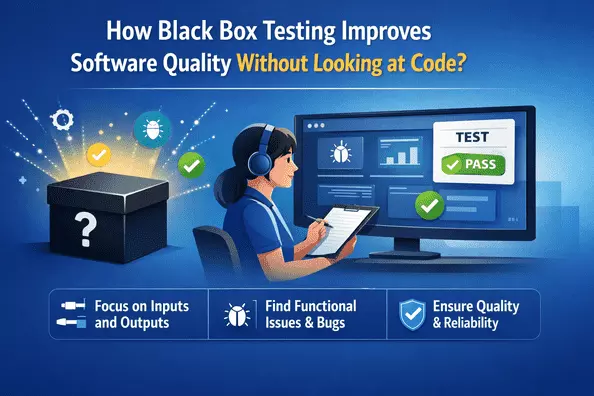
How Black Box Testing Improves Software Quality Without Looking at Code?
Software quality assurance relies on multiple testing strategies to ensure that applications function correctly. One of the most effective approaches is black box testing.
Unlike other methods, black box testing focuses on validating software behavior without requiring access to the underlying code. This makes it especially useful for QA teams who need to test from a user’s perspective.
What Is Black Box Testing?
Black box testing is a functional testing approach that examines the system’s inputs and outputs. Testers interact with the application through its interface, feeding in data and observing results.
The internal workings of the code are not considered.
The goal is to verify that the system behaves as expected, meets requirements, and handles edge cases properly. By focusing on functionality rather than implementation, black box testing helps teams catch defects that might otherwise go unnoticed.
Why Black Box Testing Matters
Modern applications are complex. Even well-written code can produce unexpected outcomes when different modules interact. Black box testing adds value by:
- Validating user workflows: Ensures that end-to-end processes work as intended.
- Detecting functional defects: Finds errors in calculations, data handling, and system responses.
- Ensuring requirement compliance: Confirms that features meet documented specifications.
- Identifying edge cases: Reveals behavior under unusual or invalid inputs.
Because it evaluates the system from the outside, black box testing often uncovers issues that code-focused testing misses.
Key Techniques in Black Box Testing
Several techniques make black box testing effective:
- Equivalence Partitioning: Divides inputs into groups that are expected to produce similar behavior, reducing the number of tests while covering all scenarios.
- Boundary Value Analysis: Focuses on edge cases at the extremes of input ranges, where defects are more likely to occur.
- Decision Table Testing: Uses tables to map combinations of inputs to expected outputs, helping ensure thorough coverage.
- State Transition Testing: Tests how the system transitions between states based on events, useful for applications with complex workflows.
These techniques help QA teams structure black box tests, ensuring that critical functionality is thoroughly examined.
Black Box Testing in Regression and CI/CD
As applications evolve, regression testing ensures that existing functionality is not broken by new changes. Black box testing plays an essential role in this process:
- Integration with regression suites: Black box tests can be automated and incorporated into CI/CD pipelines, running alongside unit and integration tests.
- User-focused validation: While unit tests check individual components, black box testing confirms that features behave correctly from an end-user perspective.
- Early detection of release risks: Automated black box tests can highlight defects before deployment, reducing production incidents.
Teams at companies like Amazon and Netflix have used black box testing extensively in CI/CD pipelines to validate user-facing features and maintain product reliability.
Benefits of Black Box Testing for QA Teams
- Independent Testing Perspective: Testers don’t rely on code knowledge, enabling unbiased evaluation.
- Versatility Across Platforms: Works for web, mobile, APIs, and even hardware interfaces.
- Scalability with Automation: Black box tests can be automated using tools like Selenium, Appium, or Postman.
- Early Defect Detection: Helps catch functional and workflow issues before they impact users.
- Compliance Verification: Ensures that features meet legal, security, or industry-specific standards.
By integrating black box testing strategically, QA teams can improve software quality and reduce post-release issues.
Common Challenges
Despite its advantages, black box testing has limitations:
- Incomplete coverage: It may miss internal logic errors or untested paths.
- High test design effort: Requires careful planning to identify relevant input combinations and scenarios.
- Maintenance overhead: Automated black box tests need updates as interfaces or workflows change.
Addressing these challenges requires combining black box testing with other methods, like unit testing, integration testing, and exploratory testing.
Read: Why Every Password Manager Needs a Security Dashboard
Real-World Example
Consider a banking app. Unit tests verify that individual modules calculate balances correctly. Black box testing, however, evaluates the full workflow: logging in, transferring funds, and confirming transactions.
This testing identifies defects that could impact users, such as incorrect error messages or failed validations, which may not be caught by code-focused tests.
Final Thoughts
Black box testing is a cornerstone of effective QA because it evaluates software from the perspective that matters most—the user’s.
By focusing on inputs, outputs, and behavior rather than internal code, teams can identify functional defects, ensure compliance, and improve release confidence.
In modern CI/CD pipelines, black box testing complements unit and integration tests, providing a user-centered safety net that enhances software quality. For QA teams, mastering black box testing is essential for building reliable, user-friendly applications.