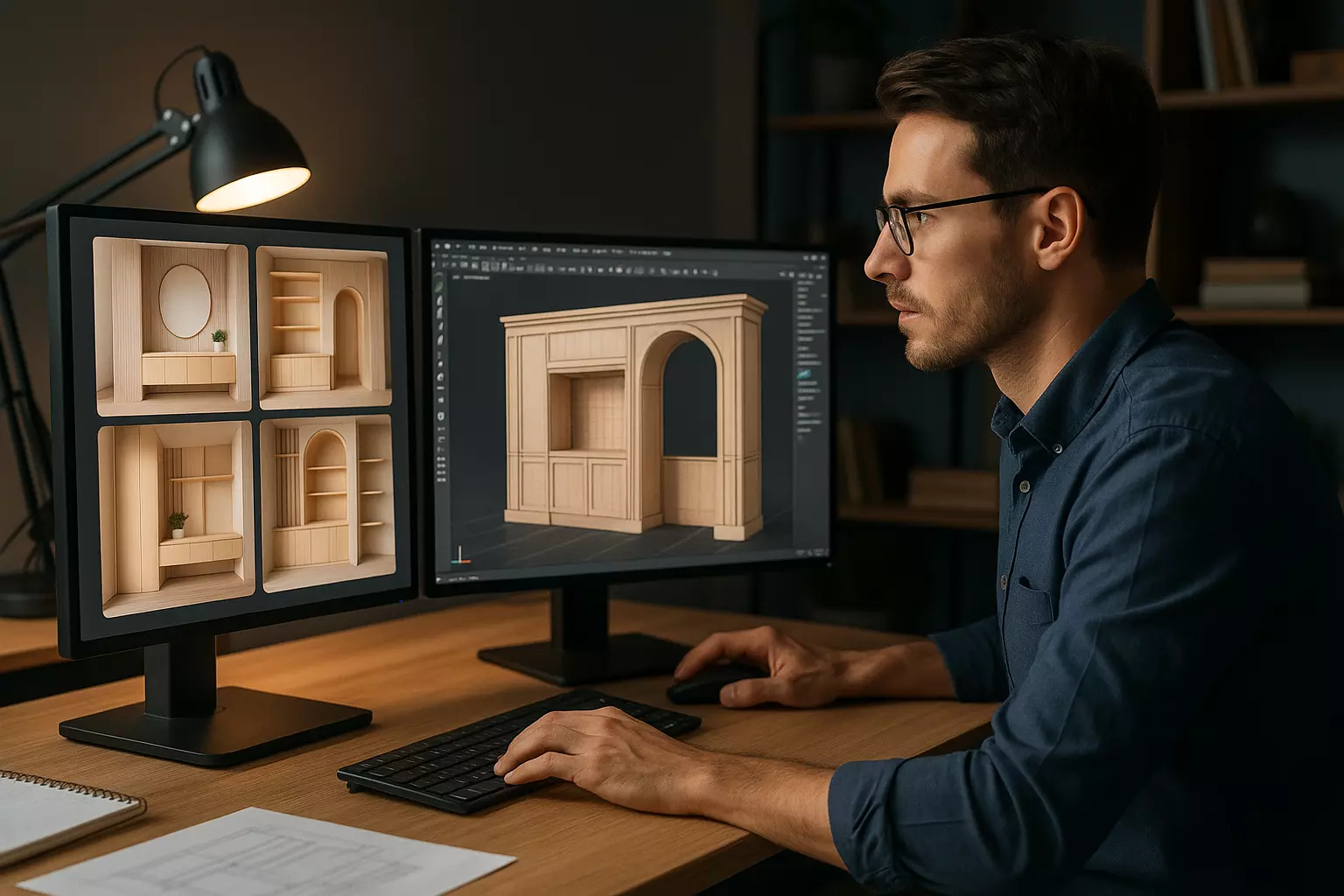
How AI & CAD Are Transforming Architectural Millwork and Design Workflows
The way we design and execute architectural millwork and design is changing fast. For business owners, architects, engineers, and tech decision-makers in the UK and beyond, understanding how artificial intelligence (AI) and advanced Computer-Aided Design (CAD) tools are disrupting the status quo isn’t just interesting it’s essential. In this post, we’ll explore the latest trends, challenges, and opportunities shaping architectural woodworking and design workflows today.
Why is AI gaining ground in architectural millwork and design?
AI is no longer a buzzword in design it’s becoming a core collaborator. According to the UK architecture sector bench-marking report, 41% of UK architects are already using AI in their projects, automating administrative tasks, streamlining design processes, and boosting efficiency.
Some of the ways AI is making an impact:
- Automating repetitive tasks: AI can now take over routine CAD work from dimensioning to generating joinery details freeing designers to focus on creativity.
- Generative design: Using AI-driven generative tools, teams can plug in parameters (like material limits, spatial constraints, sustainability goals) and generate hundreds of design options in minutes.
- Smart error detection: AI tools are beginning to detect clashes, inconsistencies, or inefficiencies in millwork CAD drawings before they become costly problems.
- Natural-language CAD: Emerging research (e.g., CADgpt) demonstrates that designers can use simple language prompts to generate 3D models, lowering the barrier for non-experts.
How are CAD and BIM workflows evolving in the UK’s millwork sector?
Building Information Modeling (BIM) is converging with CAD in ways that reshape how architectural millwork drafting services operate. Rather than working in silos, design, engineering, and fabrication are more integrated than ever.
- According to Urban Splatter, millwork drafting firms in the UK now rely on 3D CAD modeling combined with BIM, improving collaboration and reducing revisions.
- This integration helps with clash detection, cost forecasting, and real-time updating when a designer tweaks a cabinet or molding in the BIM model, everyone (engineers, fabricators, contractors) sees the change.
- Sustainability is baked in: some BIM-CAD workflows allow embedded carbon tracking, which means material choices in architectural millwork design can be evaluated for environmental impact.
What challenges are firms facing when adopting AI and CAD in millwork?
Despite the opportunities, adoption is not without friction.
- Skills gap
- Many drafting professionals are still learning to work with AI-enhanced CAD or BIM workflows. Finding individuals who are skilled in both high-precision millwork design and AI tools remains difficult.
- Costs
- Advanced CAD and BIM platforms (e.g., Revit, AutoCAD) require significant licensing and training expenditure.
- Data management
- Large BIM models with millwork details can be cumbersome keeping everything synchronized, shared, and version-controlled is a nontrivial task.
- Client perception
- Not all clients understand or value AI-based workflows. Educating them about digital twins, generative options, or AI-assisted layouts can be a hurdle.
- Regulation and standardization
- Ensuring that AI-generated or AI-assisted millwork designs comply with UK building regulations, fire safety, and joinery standards adds complexity.
What opportunities are emerging and which trends should business owners watch?
The integration of AI and CAD into architectural woodworking and design workflows is not just about cost savings it unlocks innovation and market differentiation.
Read: Web-to-Print Software: Transforming the Future of Printing
Key opportunities:
- Faster iteration and innovation
- Generative AI lets architects and millwork designers explore far more options in less time, experimenting with bespoke cabinetry, custom panels, or unique joinery patterns.
- Prefabrication and modular millwork
- With precise CAD and BIM models, more millwork components can be prefabricated offsite, reducing waste, accelerating delivery, and improving quality control.
- Digital twins for maintenance
- After installation, a digital twin of your architectural millwork can help monitor wear, maintenance needs, or performance (especially for high-use environments like commercial spaces).
- Immersive client engagement
- Using AR/VR integrated with CAD/BIM, clients can walk-through proposed millwork designs in real time, adjusting finishes, dimensions, or layouts on the spot.
- Sustainability incentives
- Since environmental impact is increasingly critical, AI-assisted material optimization and carbon-tracking in CAD/BIM workflows help firms align with green building goals.
How big is the market? And why is it worth investing in now?
Some numbers help paint the picture:
- The UK computer-aided design (CAD) market is projected to grow from approximately US$912 million in 2025 to US$1.56 billion by 2035, with a CAGR of 5.54%.
- The broader architectural services market in the UK is also expanding, with a projected 3.2% CAGR through 2030.
- In the woodworking and joinery space, trade bodies like the British Woodworking Federation (which represents joinery and architectural woodworking firms) provide a clear indication of the scale and professionalism in this sector.
These numbers suggest that investing in AI + CAD-driven design is not a niche play it aligns with macro trends, growing market demand, and long-term digital transformation in architecture and millwork.
What are some real-world examples or experiments showing AI + CAD in action?
- Generative AIBIM: In academic research, pipelines combining generative AI with BIM enable automatic generation of structural and millwork design, blending physical constraints with creative freedom.
- CADgpt: Tools like CADgpt integrate large language models so that designers can simply describe what they want (e.g., "a curved walnut bar cabinet with integrated lighting"), and the AI translates that into Rhino3D code or CAD scripts.
- Sketch-to-architecture: Another research project uses AI to turn free-hand sketches into full 3D architectural models feasible for early-stage millwork design concepts.
So, what should business owners, architects, and decision-makers do now?
- Audit your current workflows
- Look at your millwork design process: where are the bottlenecks? Inefficient detailing? Rework? Manual drafting? Identifying weak points helps you understand where AI + CAD could add most value.
- Pilot AI-enhanced tools
- Don't overhaul everything at once. Run a small, low-risk project with a generative design tool or natural-language CAD assistant. Learn what works, what doesn’t.
- Train your team
- Invest in training for CAD staff, architects, and engineers so they can use AI-enhanced tools confidently.
- Collaborate with specialized CAD firms
- If you don’t have in-house capability, consider outsourcing architectural millwork drafting services to a UK-based partner. Choose a firm familiar with BIM-CAD integration, millwork detail, and AI workflows.
- Communicate with clients
- Educate clients about the benefits of using AI-assisted design faster iterations, rich visuals, improved accuracy, lower waste to help them see the value.
What’s next and why the future is bright for architectural millwork design
AI and CAD are not just changing how we draw cabinets and moldings they’re reshaping the entire workflow of architectural millwork and design. From initial ideation, through detailed shop drawings, all the way to prefabrication and client sign-off, the fusion of generative AI and data-rich CAD/BIM ecosystems is transforming what’s possible.
For business owners and tech decision-makers in the UK and globally, embracing these trends means:
- Greater efficiency
- Reduced risk
- More creative freedom
- A competitive edge in a crowded market
- More sustainable, high-quality outputs
Final Thoughts
If you're looking to stay ahead in architectural woodworking and design, now is the time to lean into AI + CAD. Whether you’re an architect managing specifications, an engineer coordinating joinery, or a business owner thinking about your next investment, integrating these tools can unlock major value.
For teams that don’t yet have deep in-house expertise, working with a leading UK CAD design company that specialists in architectural millwork drafting services is a smart move. Such partners can help you introduce AI-enhanced workflows, ensure compliance with UK standards, and deliver detailed, high-fidelity millwork designs all while setting you up to compete in a more digital, efficient, and future-focused market.