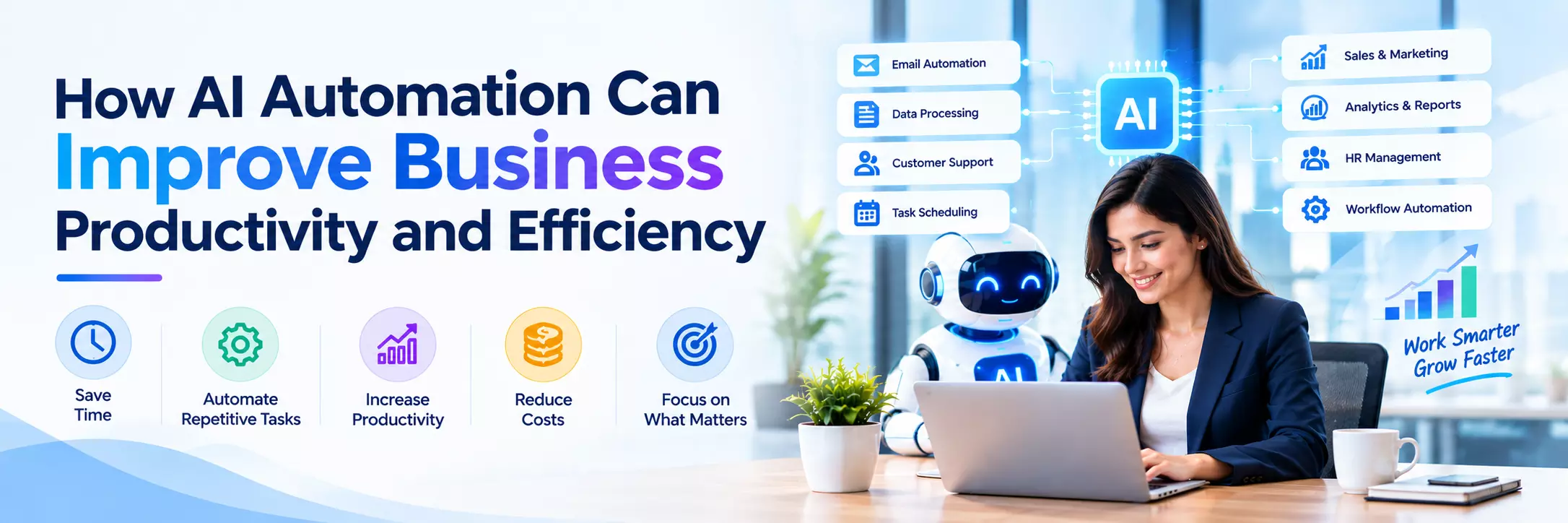
How AI Automation Can Improve Business Productivity and Efficiency
Businesses are constantly looking for better ways to improve productivity, reduce repetitive work, and deliver faster services. As business processes become increasingly digital, manual workflows can create unnecessary delays and consume valuable employee time.
AI automation is helping businesses address these challenges by combining artificial intelligence with automated workflows.
From customer support and marketing to sales, data processing, and internal operations, AI can help organizations automate suitable tasks and create more efficient business processes.
When implemented strategically, AI automation can allow employees to spend less time on repetitive activities and more time on work that requires creativity, collaboration, and decision-making.
What Is AI Automation?
AI automation refers to the use of artificial intelligence technologies to automate tasks, workflows, and business processes that traditionally require manual intervention.
Traditional automation generally follows predefined rules. AI-powered automation can work with more complex information and can use technologies such as machine learning, natural language processing, computer vision, and intelligent data processing.
For example, an AI-powered system can help a business:
- Process and categorize customer inquiries
- Extract information from documents
- Automate repetitive administrative tasks
- Analyze large amounts of business data
- Qualify potential leads
- Generate reports
- Support customer service teams
- Connect different business applications
The specific capabilities depend on the business requirements, available data, technology, and level of human oversight.
Why Is AI Automation Important for Businesses?
Many organizations still depend on employees to complete repetitive processes manually. These tasks may include entering information into systems, sending routine communications, organizing data, creating reports, or moving information between applications.
When these activities are repeated at scale, they can reduce overall productivity.
AI automation can help businesses streamline suitable processes and make everyday operations more efficient.
Some common business objectives include:
- Reducing repetitive manual work
- Improving process efficiency
- Increasing response speed
- Reducing avoidable errors
- Supporting employees
- Improving customer experiences
- Connecting business systems
- Creating scalable workflows
AI automation is not simply about replacing manual work. In many situations, its purpose is to augment employees by handling suitable repetitive processes while people remain responsible for decisions that require judgment and expertise.
How AI Automation Improves Business Productivity
1. Automating Repetitive Tasks
Employees often spend significant amounts of time performing repetitive activities.
For example, a team may manually copy information between spreadsheets, update CRM records, send routine emails, or categorize incoming requests.
AI automation can help streamline these activities so employees can focus on higher-value responsibilities.
2. Streamlining Business Workflows
Business processes often involve multiple applications and teams.
For example, a new customer inquiry may require information collection, lead qualification, CRM updates, sales notification, and follow-up communication.
AI workflow automation can connect these steps and reduce the need for employees to manually move information between systems.
This can make the overall workflow more consistent and efficient.
3. Improving Customer Support
Customer expectations for quick responses continue to increase.
AI-powered chatbots and virtual assistants can handle common questions, provide basic information, and guide customers through frequently requested processes.
When a request requires human expertise, the system can transfer the interaction to an appropriate employee.
This allows support teams to focus their time on more complex customer issues.
4. Supporting Sales Teams
Sales representatives often spend time on administrative activities instead of customer conversations.
AI automation can help with tasks such as:
- Lead qualification
- CRM data updates
- Follow-up reminders
- Customer segmentation
- Sales notifications
- Report generation
By reducing administrative work, sales teams can dedicate more time to relationship building and strategic sales activities.
5. Automating Data and Document Processing
- Businesses manage large volumes of invoices, applications, contracts, forms, and other documents.
- AI-powered systems can extract relevant information from documents and organize it for further processing.
- This can reduce repetitive data-entry activities and help teams process information more efficiently.
Read: AI Automation Explained: Benefits, Challenges, and the
AI Automation Use Cases Across Different Departments
AI automation can be applied across multiple business functions.
Marketing
Marketing teams can use AI automation for audience segmentation, campaign workflows, content assistance, lead nurturing, and performance analysis.
Human Resources
HR departments can automate parts of employee onboarding, interview scheduling, document collection, and employee support workflows.
Finance
Finance teams can use automation for invoice processing, document classification, reporting, and other structured financial workflows.
Customer Service
AI assistants can help answer frequently asked questions and route complex requests to the appropriate support team.
Operations
Operations teams can connect different systems and automate routine processes to improve workflow efficiency.
What Is AI Workflow Automation?
AI workflow automation focuses on using AI technologies to improve and automate complete business workflows rather than isolated tasks.
Consider a simple lead management process.
Without automation:
- A customer submits a form.
- An employee checks the submission.
- The employee enters information into the CRM.
- The lead is assigned manually.
- A follow-up email is sent.
- The sales team is notified.
With an automated workflow, these steps can be connected.
The system can capture the form submission, process the information, update the CRM, assign the lead, trigger communication, and notify the appropriate team.
Human involvement can remain part of the workflow wherever approval or judgment is required.
Benefits of AI Automation
Increased Productivity
Employees can spend less time on repetitive tasks and more time on strategic responsibilities.
Faster Processes
Automated workflows can process suitable tasks quickly and consistently.
Better Operational Efficiency
Connecting different systems can reduce unnecessary manual handoffs and repetitive data entry.
Improved Customer Experience
Faster responses and streamlined processes can help businesses provide a more consistent customer experience.
Scalability
Businesses can design automated workflows that support increasing workloads as operations expand.
Better Use of Employee Skills
When repetitive tasks are reduced, employees can focus more on problem-solving, creativity, customer relationships, and strategic work.
Challenges of Implementing AI Automation
AI automation can provide significant benefits, but businesses should also consider potential challenges.
Data Security
Organizations should understand what data is being processed and implement appropriate security controls.
System Integration
AI automation may need to connect with existing CRM, ERP, databases, communication tools, APIs, and other business systems.
Data Quality
AI systems depend on the quality of the information they process. Poor or incomplete data can affect automation results.
Human Oversight
Businesses should identify which tasks are appropriate for automation and where human review is necessary.
Change Management
Employees may need training and clear communication when new automated workflows are introduced.
How to Get Started With AI Automation
Businesses do not need to automate every process immediately.
A practical approach is to begin by identifying repetitive, time-consuming, and well-defined workflows.
Ask the following questions:
- Which tasks consume the most employee time?
- Which processes are repeated frequently?
- Where are employees manually transferring information?
- Which workflows regularly experience delays?
- Which tasks follow predictable rules?
- Where could automation improve customer experience?
After identifying suitable opportunities, businesses can prioritize workflows based on their potential business impact and implementation complexity.
Choosing the Right AI Automation Company
For complex projects, businesses may work with an AI automation Agnecy that can analyze existing processes and design technology around specific business requirements.
When evaluating an AI automation partner, consider:
- AI and automation expertise
- Software development capabilities
- Integration experience
- Data security practices
- Scalability
- Testing and quality assurance
- Technical support
- Industry understanding
A good automation strategy should focus on solving actual business challenges rather than implementing AI simply because the technology is available.
AI Automation and the Future of Business
AI automation is becoming an important part of modern digital transformation. As AI technologies continue to evolve, businesses can expect more connected workflows, intelligent assistants, automated decision support, and data-driven operations.
However, successful AI adoption requires more than technology. Organizations need clear objectives, quality data, secure systems, appropriate human oversight, and well-designed workflows.
Businesses that approach automation strategically can use AI to improve operational efficiency while allowing employees to focus on activities where human expertise adds the most value.
Conclusion
AI automation can help businesses improve productivity by reducing repetitive work, streamlining workflows, processing information efficiently, and supporting employees with intelligent technology.
From customer service and sales to marketing, HR, finance, and operations, organizations can identify many opportunities to introduce AI-powered automation into everyday processes.
The key is to start with clear business objectives and automate the right processes. With a thoughtful strategy, AI automation can become an important part of building efficient, scalable, and technology-driven business operations.
Devstringx Technologies helps businesses explore AI development, AI automation, custom software development, and digital transformation solutions designed around their specific business requirements.