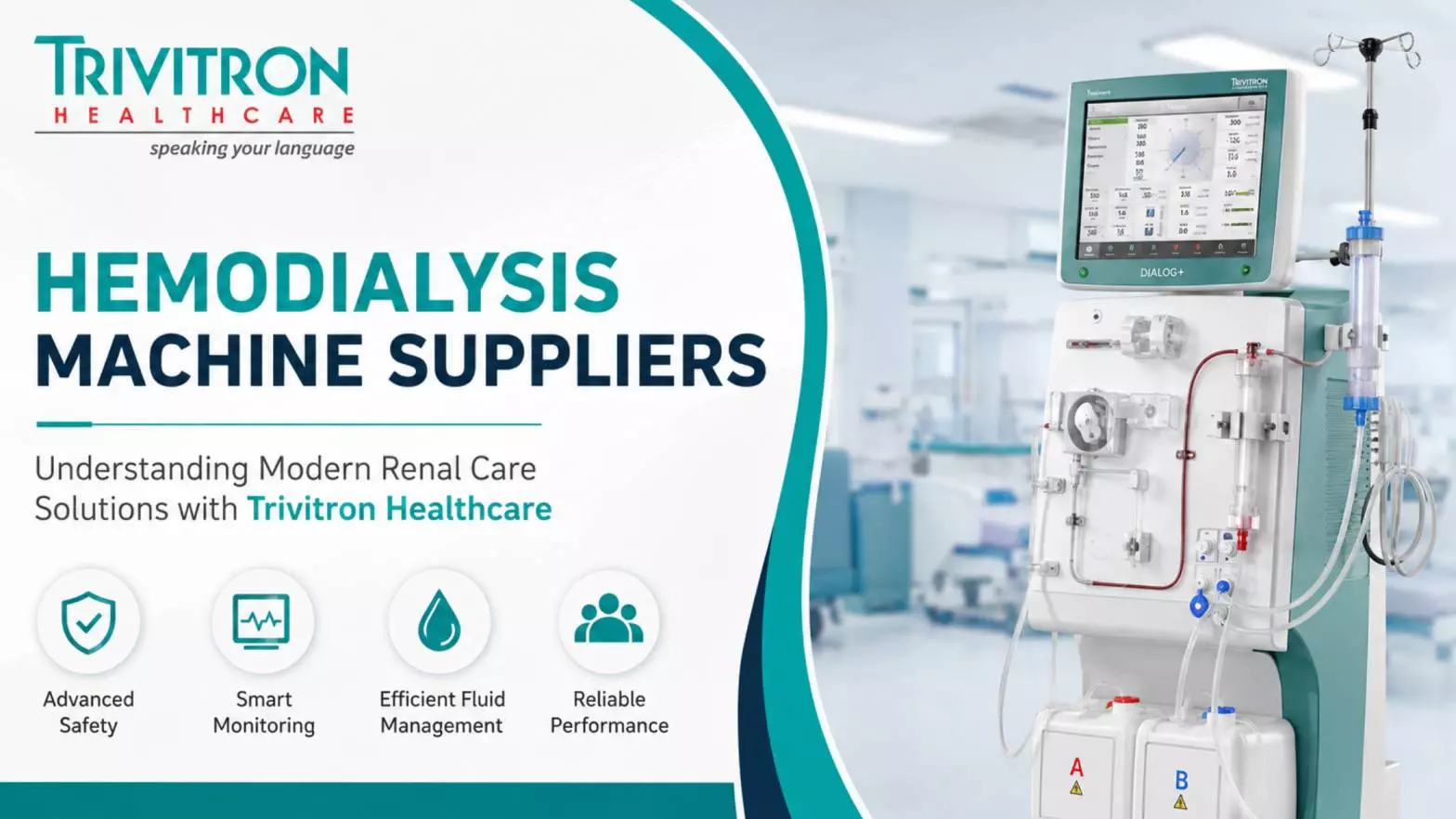
Hemodialysis Machine Suppliers: Understanding Modern Renal Care Solutions with Trivitron Healthcare
Kidney health plays an important role in maintaining the body's overall balance by removing waste products, excess fluids, and electrolytes from the bloodstream.
When the kidneys are no longer able to perform these functions effectively, dialysis can become an important part of renal care. Among the available renal replacement therapies, hemodialysis is widely used to support patients with advanced kidney failure.
Choosing appropriate dialysis equipment requires careful consideration of technology, reliability, patient safety, usability, and long-term service support.
This is where experienced hemodialysis machine suppliers can play an important role. Healthcare providers need equipment that can support consistent treatment while fitting smoothly into their clinical workflows.
Trivitron Healthcare provides medical technology solutions across different areas of healthcare, including renal care. Its portfolio includes dialysis equipment designed to support healthcare professionals in delivering dependable renal care services.
Understanding the Role of a Hemodialysis Machine
A hemodialysis machine is a medical device used during hemodialysis treatment to help remove waste products and excess fluid from a patient's blood.
During treatment, blood is circulated outside the body through a specialized extracorporeal circuit and passed through a dialyzer before being returned to During treatmnt, blood is circulated outside the body through a specialized extracorporeal circuit and passed through a dialyzer before being returned to the patient.
The dialysis machine manages and monitors important aspects of the treatment process. Depending on the system, these may include:
- Blood flow and dialysis fluid flow
- Treatment time
- Ultrafiltration and fluid removal
- Pressure monitoring
- Temperature management
- Conductivity monitoring
- Safety alarms
- Air detection and related protective mechanisms
The combination of these functions allows healthcare professionals to monitor treatment parameters and respond to potential issues during a dialysis session.
Modern dialysis systems are designed with a strong focus on safety and operational consistency. For hospitals and dialysis centres, equipment selection therefore involves more than simply comparing specifications.
Factors such as clinical requirements, ease of operation, maintenance support, and availability of technical assistance can also influence purchasing decisions.
Why Choosing Reliable Hemodialysis Machine Suppliers Matters
Dialysis is a recurring treatment for many patients, which means dialysis equipment can become an important part of a healthcare facility's daily operations.
For this reason, selecting experienced hemodialysis machine suppliers is an important consideration for hospitals, clinics, and specialized dialysis centres.
A reliable supplier can contribute to the overall equipment lifecycle through product support, installation guidance, technical assistance, and maintenance services.
When evaluating dialysis equipment suppliers, healthcare organizations can consider several factors:
1. Product reliability
Equipment should be designed for consistent clinical use and dependable performance.
2. Safety features
Monitoring systems and alarms can help healthcare professionals identify abnormal treatment conditions.
3. Ease of operation
An intuitive interface can help healthcare staff manage treatment parameters efficiently and reduce unnecessary complexity.
4. Service and technical support
Access to qualified technical assistance can help healthcare facilities address equipment-related issues and maintain operational continuity.
5. Training and installation support
Proper installation and user training can help clinical teams understand equipment functions and use the system appropriately.
6. Long-term scalability
Healthcare facilities may need equipment that can support their current requirements while allowing them to expand their renal care services over time.
Key Considerations When Selecting a Hemodialysis Machine
A dialysis centre's requirements can vary depending on patient volume, clinical protocols, available infrastructure, and staffing. Therefore, there is no single consideration that applies equally to every facility.
When comparing a hemodialysis machine, healthcare decision-makers may review the following areas:
Consideration
Why It Matters
Monitoring capabilities
Helps clinicians observe important treatment parameters
Alarm systems
Supports timely identification of potential treatment issues
User interface
Can improve ease of operation and workflow
Fluid management
Important for controlled ultrafiltration during treatment
Treatment flexibility
Helps accommodate different clinical requirements
Maintenance requirements
Supports long-term equipment management
Technical support
Helps healthcare facilities manage service needs
Training
Promotes appropriate equipment operation
Beyond technical specifications, hospitals should also assess the overall support ecosystem offered by the supplier.
Equipment that is supported by appropriate installation, training, preventive maintenance, and service assistance can provide greater operational value over its usable lifecycle.
Trivitron Healthcare and Renal Care Technology
Trivitron Healthcare is a medical technology company offering solutions across multiple healthcare segments. Its product portfolio covers areas such as medical imaging, diagnostics, critical care, newborn screening, and renal care.
Within renal care, dialysis equipment is an important component of the company's healthcare technology portfolio.
By providing specialized medical equipment, Trivitron Healthcare supports healthcare institutions looking to develop or strengthen their renal care capabilities.
For hospitals and dialysis centres, working with an established medical technology provider can simplify several stages of the equipment lifecycle from product evaluation and installation to training and after-sales support.
The right technology should complement the clinical team's workflow rather than introduce unnecessary complexity. For this reason, healthcare providers can evaluate both the capabilities of the equipment and the level of support available from the supplier.
Technology That Supports Efficient Dialysis Workflows
A modern hemodialysis machine is designed to bring multiple treatment monitoring and control functions together within a single system. This can help healthcare professionals manage dialysis sessions while keeping important treatment parameters under observation.
Some of the technology considerations healthcare facilities may evaluate include:
- Clear display of treatment information
- Automated monitoring of relevant parameters
- Integrated safety alarms
- Controlled fluid removal
- Adjustable treatment settings
- Patient and treatment monitoring functions
- User-friendly controls
- Maintenance and service accessibility
These capabilities can contribute to a more organized dialysis workflow. However, the appropriate configuration ultimately depends on the facility's clinical requirements, operating protocols, infrastructure, and professional guidance.
Building a Dependable Renal Care Environment
Successful dialysis services depend on more than equipment alone. The quality of renal care is influenced by clinical expertise, infection-control practices, treatment protocols, infrastructure, equipment maintenance, and patient monitoring.
Healthcare facilities can therefore approach dialysis equipment selection as part of a broader renal care strategy.
A practical evaluation may include:
- Assessing patient and treatment requirements
- Reviewing equipment specifications and safety systems
- Evaluating usability for dialysis professionals
- Checking installation and infrastructure requirements
- Understanding warranty and service arrangements
- Reviewing preventive maintenance support
- Confirming staff training requirements
- Considering long-term equipment availability and support
This broader approach can help healthcare organizations make informed technology decisions rather than selecting equipment based solely on individual features.
Choosing the Right Hemodialysis Machine Suppliers
The dialysis equipment market includes different manufacturers and technology providers, making supplier evaluation an important part of healthcare procurement.
Hospitals can compare product capabilities, service networks, technical expertise, training, maintenance arrangements, and overall lifecycle support before making a purchasing decision.
Experienced hemodialysis machine suppliers can provide value beyond supplying the equipment itself. Their role may extend across installation, commissioning, technical support, preventive maintenance, and product-related guidance.
For healthcare organizations, establishing a relationship with a dependable medical technology provider can help create a more structured approach to managing dialysis equipment throughout its operational lifecycle.
Conclusion
Renal care requires dependable technology, skilled healthcare professionals, and well-managed clinical processes.
A hemodialysis machine serves as an important component of dialysis treatment by supporting the controlled circulation and monitoring of blood and dialysis fluid during therapy.
For hospitals and dialysis centres evaluating renal care equipment, selecting experienced hemodialysis machine suppliers can be an important step toward establishing reliable equipment support and long-term operational continuity.
Product capabilities, safety features, usability, maintenance, training, and technical assistance should all be considered as part of the evaluation.
With its presence across multiple medical technology segments, Trivitron Healthcare offers renal care solutions designed to support healthcare institutions in their technology requirements.
By combining appropriate equipment with professional expertise, maintenance, and effective clinical practices, healthcare providers can build a more dependable environment for dialysis services and patient care.