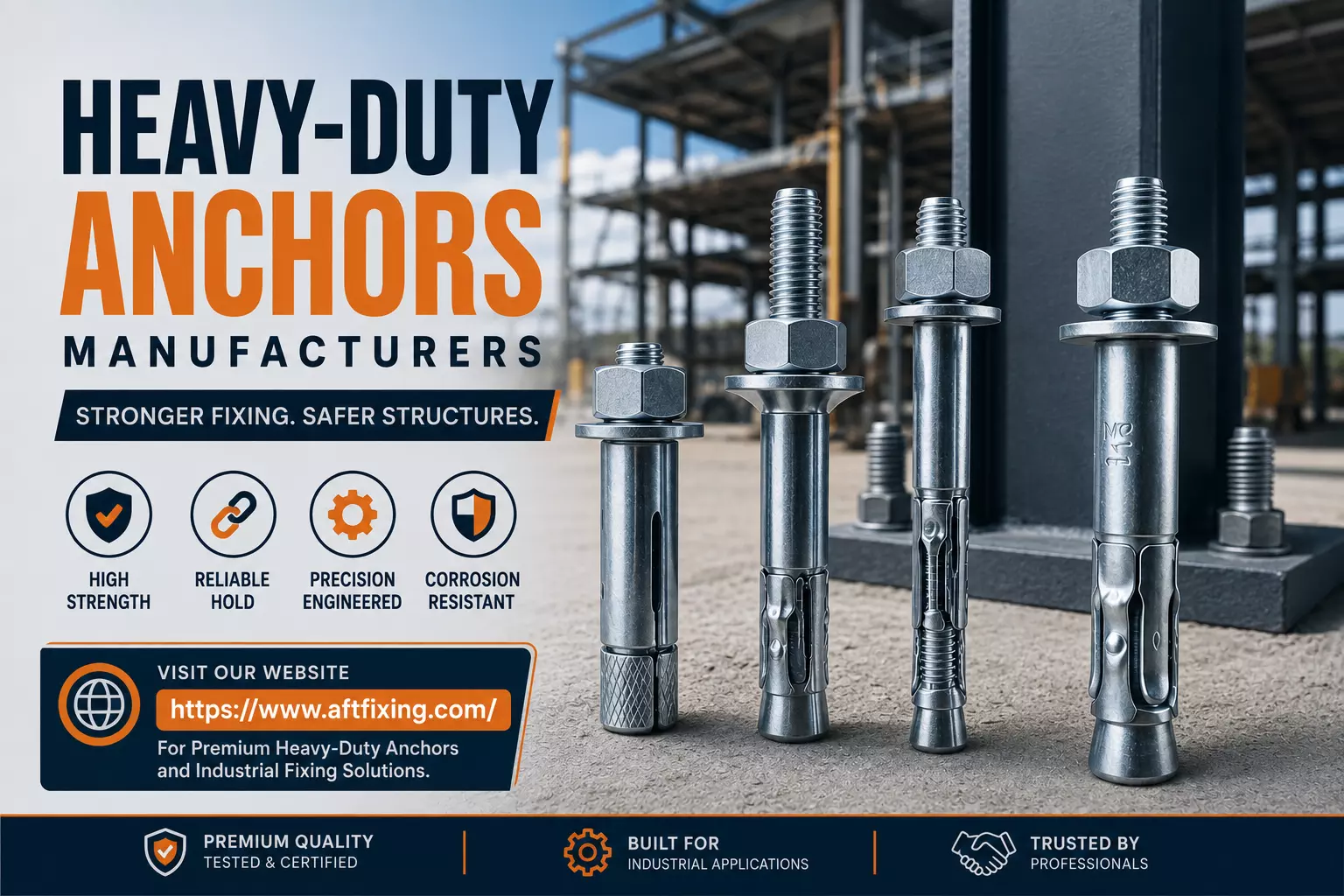
Heavy-Duty Anchors for Cracked Concrete
A crack 0.2mm wide doesn't look like a problem. It looks like a hairline in a slab that's already been poured, cured, and signed off.
Which is exactly why it causes trouble — most buyers spec heavy-duty anchors for "solid concrete" and never ask whether the anchor was tested for concrete that moves.
Under Indian code IS 456, reinforced concrete is allowed a crack width of up to 0.3mm under normal service loads. That means almost every RCC slab you're anchoring into should be treated as cracked concrete from day one.
Get this wrong, and you're not fixing a bracket — you're booking a callback six months out.
This is where Heavy-Duty Anchors Manufacturers either earn their reputation or lose a client for good.
The Spec Detail Most Buyers Skip
Heavy-duty anchors for cracked concrete aren't a single product — they're a category defined by how they're tested, not just how they look.
Mechanical vs Chemical Systems
Mechanical anchors — wedge, sleeve, and undercut types — physically expand or lock into the drilled hole.
Chemical anchors use resin to bond a threaded rod into the substrate. Both can be rated for cracked concrete, but only with the right certification behind them, not just a data sheet claim.
The Certification That Actually Matters
ETAG 001 testing grades anchors on a 1–12 option scale. Option 1 anchors are tested in both cracked and non-cracked concrete, and often under seismic categories C1 and C2.
An anchor without that testing — even one marketed as "heavy-duty" — hasn't proven it holds once a crack opens and closes under load. That's the detail most procurement sheets skip, and the one that decides whether the anchor survives year two.
Read: Heavy-duty anchors - permanent fastening solutions for
Benefits That Actually Protect Your Margin
- Fewer field failures. Anchors rated for cracked concrete hold pull-out strength as the slab shifts under thermal or load cycling — fewer emergency call-backs eating into your margin.
- Predictable procurement costs. Working with Heavy-Duty Anchors Suppliers in India who batch-test consistently means reorders don't need re-verification every time.
- Reduced liability exposure. For safety-critical fixings, certified anchors shift the burden of proof onto the manufacturer's test data if something is ever questioned.
- Faster project sign-off. Site engineers approve documented, certified products faster than "trust us" specs — which shortens your payment cycle.
- Multi-site consistency. Buying from one Heavy-Duty Anchors Manufacturers in India partner keeps fastener specs identical from Chennai to Chandigarh, instead of drifting batch to batch.
- Lower total cost of ownership. A slightly higher per-unit price on a correctly rated anchor is nearly always cheaper than a failed fixing's labour and downtime cost.
Why Location Is a Supply Chain Decision, Not Just an Address
Sourcing from Heavy-Duty Anchors Dealers in India based in the north cuts real time off delivery to Delhi-NCR, Punjab, Haryana, and Rajasthan project sites — and that matters more than it sounds.
AFT Fixing operates out of the HSIIDC Industrial Estate in Sonipat, Haryana, a location chosen specifically for its road access to the NCR construction corridor.
For Heavy-Duty Anchors Wholesalers in India managing multi-state distribution, that proximity to Delhi's logistics network shaves days off dispatch compared to sourcing from western or southern manufacturing hubs — a difference that shows up directly in project timelines when a site is waiting on a bulk order.
Conclusion
Cracked concrete isn't a rare site condition — under IS 456, it's the default assumption for any loaded RCC member.
Choosing Heavy-duty anchors rated and tested for that reality, from a manufacturer who can prove batch consistency, is what separates a fixing that lasts from one that becomes next year's site complaint.
The supplier you pick now is the one your project engineer will be calling in eighteen months, for better or worse.
Frequently Asked Questions
1. What makes an anchor suitable for cracked concrete rather than just "heavy-duty"?
Testing, not marketing language. It qualifies when tested under standards like ETAG 001 Option 1, which simulates crack opening and closing under load. A product labelled heavy-duty without that backing may still fail once real crack movement starts.
2. Are AFT's heavy-duty anchors manufactured in-house or outsourced?
In-house, at our Sonipat, Haryana facility, to IS and DIN specifications. We don't white-label from third-party units — that's how we control batch consistency.
3. What's the typical lead time for bulk orders from Heavy-Duty Anchors Wholesalers like AFT?
It depends on quantity and spec — stock orders move faster than a custom coating or size run. We'll give you an honest number once we see your spec sheet, not a placeholder promise.
4. Do you supply Heavy-Duty Anchors Dealers in India for resale, or only direct to contractors?
Both. We work with dealers and wholesalers across India for resale stock, and directly with contractors for project-specific orders.
5. Can heavy-duty anchors handle both cracked and non-cracked concrete, or do I need separate stock?
A properly certified Option 1 anchor covers both. That said, if your site has seismic exposure, confirm the C1 or C2 rating separately — not every cracked-concrete anchor carries it.