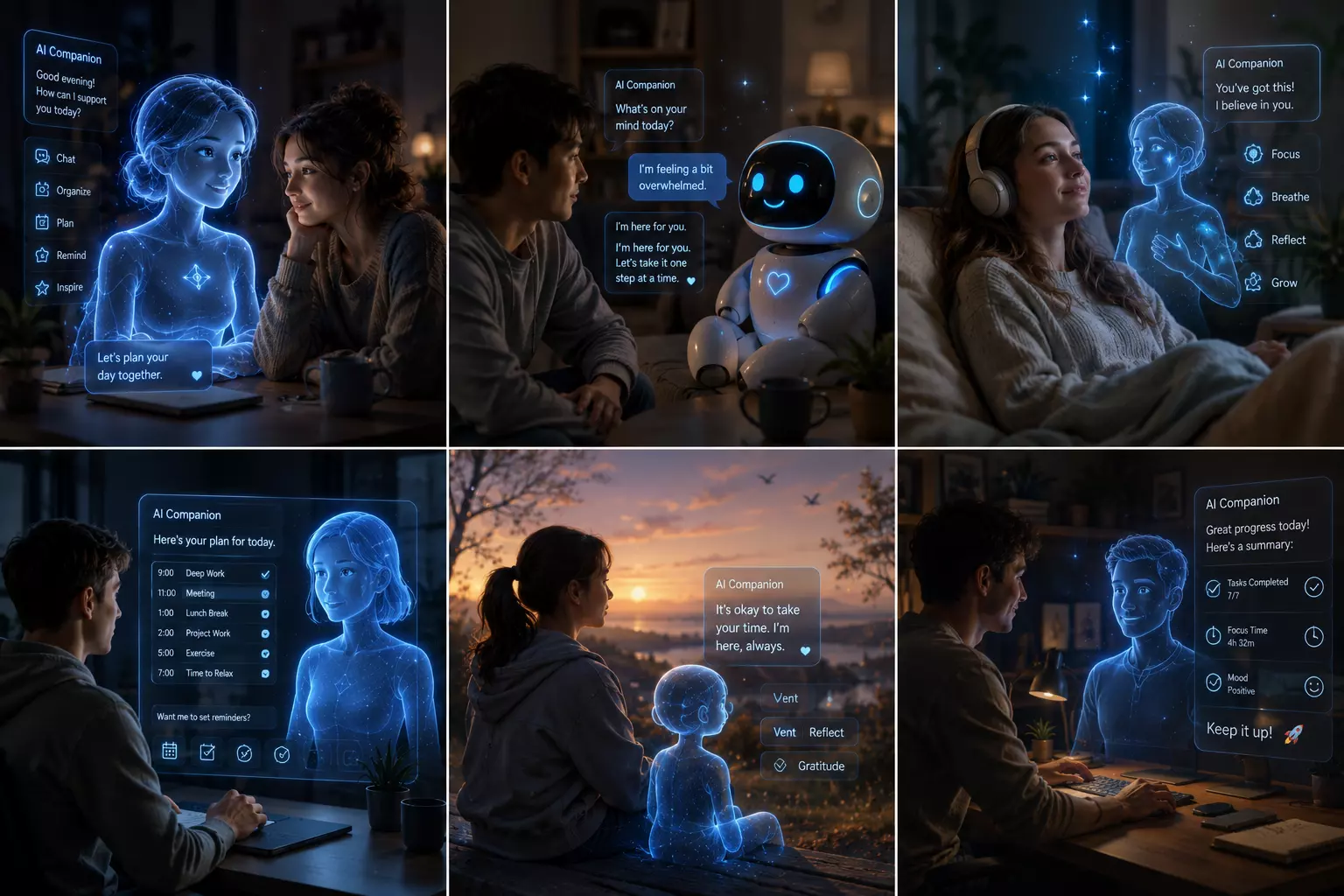
Growing AI Companion Adoption Signals Major Changes Across the Digital Economy
AI companions are moving from an experimental corner of consumer technology into a broader digital economy category.
People are using conversational AI for entertainment, personal conversations, creative roleplay, advice, reflection, and social interaction. At the same time, businesses are building products around persistent AI personalities, memory, voice interaction, personalization, and subscription models.
The change is significant because AI companions are not competing only with other software products.
They are increasingly competing for a share of the time people traditionally spend messaging friends, watching entertainment, browsing social platforms, or using other digital services.
AI Companions Are Becoming a New Consumer Technology Category
The growth of AI companions is closely connected to improvements in conversational AI. Earlier chatbots were mainly designed to answer questions.
Modern systems can maintain context, remember preferences, generate expressive responses, create images, speak naturally, and adapt their personality to individual users.
That combination changes the product experience.
Instead of opening an application only when a specific task needs to be completed, users can return because the interaction itself has become the product.
A conversation can continue across multiple sessions, while the AI develops a more consistent personality and remembers details from previous exchanges.
Personal AI Is Changing How People Spend Digital Time
The strongest change may not be the number of applications available. It is the amount of personal attention that these products can capture.
Traditional digital services usually provide content to users. Social networks provide feeds. Streaming services provide videos. Search engines provide information. AI companions add another layer: reciprocal interaction.
A user sends a message, receives a response, changes the direction of the conversation, and returns later to continue it. That creates a different engagement cycle.
An AI girlfriend product, for instance, can combine conversational memory, personality settings, voice, visual identity, and personalized interactions into one continuous experience. The same technical architecture can support friendship, coaching, entertainment, roleplay, or character-based storytelling.
Research from Kantar adds another indication of this broader movement. Its 2025 global study across more than 10,000 consumers in 10 markets found that 54% had used AI for at least one emotional or mental well-being purpose. Personal coaching or motivation accounted for 29%, while mental well-being support accounted for 25%.
These figures should not be interpreted as proof that AI is replacing human relationships. Instead, they show that consumers are becoming comfortable using conversational systems for personal forms of interaction.
That creates a new opportunity for product teams: designing AI that feels useful over weeks and months rather than only during individual sessions.
Read: How to Build Better AI Character Chats as a Complete
Personalization Is Becoming a Core Product Feature
Personalization is central to the AI companion economy.
A generic chatbot can answer the same question for thousands of people. A companion product can create a different experience for every user.
Personality selection, conversation history, preferred communication style, interests, voice, visual identity, and memory can all shape future interactions.
This changes the product development priority.
The objective is no longer only to make an AI model generate accurate responses. Product teams also need systems for memory management, user profiles, safety controls, prompt orchestration, recommendation engines, content moderation, and preference management.
New Monetization Models Are Emerging Around AI Relationships
AI companions also introduce different commercial possibilities.
Subscription plans are already common because frequent conversations create recurring demand. Premium users can receive longer conversations, stronger models, additional personalities, voice interaction, image generation, memory, or advanced customization.
The economics can become particularly attractive when a platform builds several layers of engagement around one account.
App figures data reported in 2025 showed that the top 10% of AI companion apps generated 89% of category revenue, while roughly 10% of apps had surpassed $1 million in lifetime consumer spending. Revenue per download also increased from $0.52 in 2024 to $1.18 in 2025.
That concentration suggests that simply launching another chatbot is unlikely to be enough. Product differentiation, retention, character quality, personalization, pricing, and distribution will matter heavily.
AI Companions Are Expanding Into the Wider Digital Economy
The commercial effects extend beyond companion applications.
AI companions can create demand for:
- AI model hosting
- GPU infrastructure
- Voice synthesis
- Image generation
- Character design
- Content moderation
- AI memory systems
- Mobile applications
- Payment infrastructure
- Subscription management
- Analytics
- Personalization engines
- AI safety systems
Consequently, the category can stimulate activity across several technology segments at once.
A company building an AI unrestricted generator does not necessarily need to train a foundation model from scratch. It can combine existing models with proprietary prompts, memory architecture, retrieval systems, user profiles, moderation layers, and specialized interfaces.
This lowers the technical barrier for start-ups while increasing competition.
For companies evaluating this market, xchar AI represents the type of branded experience that can be built around a personalized AI interaction rather than treating the chatbot as a simple utility.
The broader trend is toward products where personality, continuity, and engagement become part of the software itself.
Global Markets May Develop Different AI Companion Behaviours
The global opportunity will not look identical in every country.
Language is only the first difference. Local preferences can influence character design, onboarding, pricing, payment methods, content moderation, communication styles, and expectations around privacy.
A multilingual AI companion product therefore needs more than translated interface text. Search intent, character descriptions, onboarding messages, support content, and promotional pages should be localized for each target market.
This is also where product design becomes important. Text expansion can change button sizes and layouts, while right-to-left languages require different interface behaviour. Cultural preferences can also influence visual presentation and character personalities.
India is particularly notable in the broader AI adoption discussion. A Google-Kantar study involving more than 8,000 people across 18 Indian cities found that 75% of respondents wanted a daily growth collaborator.
Although that research covers generative AI more broadly rather than dedicated companion products, it indicates strong consumer interest in AI systems that can participate in recurring personal activities.
Privacy and Trust Will Shape Long-Term Adoption
The more personal an AI product becomes, the more important trust becomes.
Companion applications can process highly personal conversations, preferences, relationship discussions, creative requests, and behavioural information. Users therefore need clear explanations of what information is stored, how memory works, and what controls are available.
Kantar found that privacy and data security were the leading concerns around AI emotional-support applications, cited from 50% of global consumers in its study. Lack of genuine empathy followed at 43%, while potential emotional manipulation was cited at 32%.
This means privacy cannot be treated as a small settings-page issue.
A credible AI companion product should provide:
- Clear data retention policies
- Memory controls
- Account deletion options
- Transparent subscription terms
- Age-appropriate safeguards
- Strong content moderation
- Clear AI disclosure
- Secure data handling
Trust can become a competitive advantage as products move deeper into personal conversations.
The Next Competition Will Be About Experience, Not Just Models
- Foundation models will continue improving, but model quality alone will not determine which companion products retain users.
- The strongest products are likely to combine several elements:
- This creates an important distinction between an AI model and an AI product.
- A model generates the response. A product determines why the user returns.
- For start-ups, this means product development needs to focus on the full user journey. Character creation, first conversation, memory formation, personalization, notifications, subscriptions, and long-term retention all need to work together.
- xchar AI illustrates this product-oriented direction, where the branded experience can become as important as the underlying conversational technology.
What Comes Next for AI Companion Products?
- AI companions are likely to become more multimodal over time. Text will remain important, but voice, images, video, avatars, and real-time interaction can make conversations feel more immersive.
- Another major shift will come from agentic capabilities. A companion could eventually do more than converse. With appropriate permissions, it could organize information, manage reminders, recommend content, personalize experiences, or interact with other digital services.
- That could turn the AI companion from a conversation application into a broader personal interface.
- Still, growth will depend on responsible product design. Research from the 2026 Elon University survey shows both strong engagement and clear limits: 59% of AI companion users said they would rather have conversations with friends or family, while 11% preferred an AI companion for conversation.
- This distinction matters. AI companionship is growing, but the evidence does not suggest that human relationships are disappearing. Instead, AI is creating an additional digital relationship layer that some users find useful, entertaining, or emotionally meaningful.
Conclusion
Growing AI companion adoption signals a meaningful change in the digital economy. The category combines conversational AI, personalization, entertainment, social interaction, subscriptions, and emerging forms of digital identity.
The strongest opportunity is not simply to create another chatbot. It is to build a reliable, personalized experience that gives users a reason to return while maintaining transparency, privacy, and appropriate safeguards.