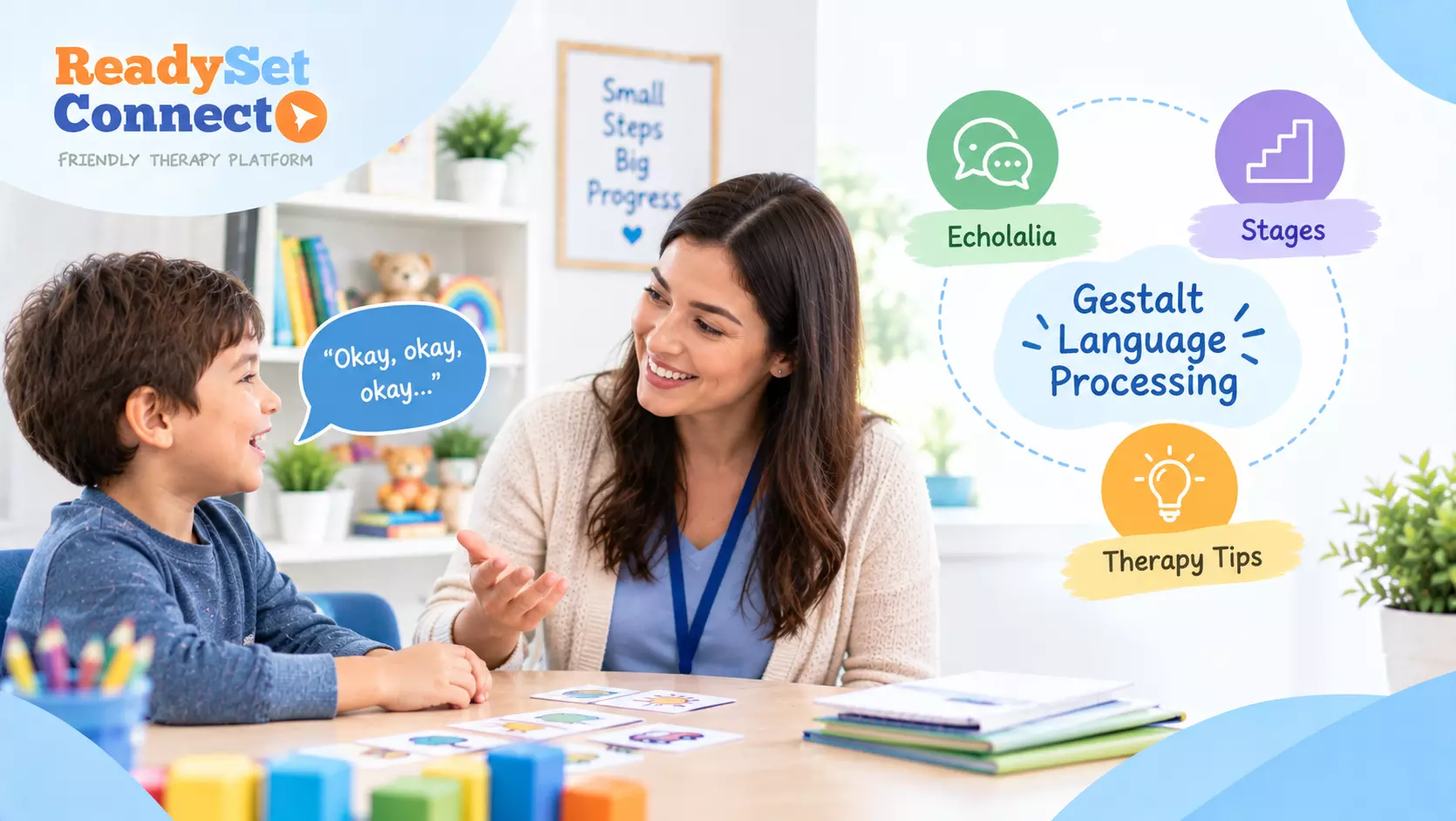
Gestalt Language Processing Explained: Echolalia, Stages and Practical Therapy Tips
If you work with young children who repeat phrases from shows, songs or conversations, you have probably met a gestalt language processor.
Gestalt language processing has become one of the most discussed topics in speech-language pathology, and for good reason. It changes how many clinicians understand echolalia and plan therapy. This guide gives you a clear overview and practical starting points.
What Is Gestalt Language Processing?
Most children learn language analytically, starting with single words and combining them into sentences. Gestalt language processors begin differently.
They acquire language in chunks, such as whole phrases, lines from a favorite video or things a caregiver often says. Over time, those chunks are broken into smaller parts and recombined into new, original sentences.
Echolalia: Communication, Not Just Repetition
Many gestalt language processors use echolalia in autism and in other neurotypes as a meaningful way to communicate. Immediate echolalia repeats what was just heard.
Delayed echolalia repeats something heard earlier, often with a specific meaning tied to a situation or feeling. A child who says a line from a movie when frustrated may be expressing an emotion, not reciting for fun.
Understanding this changes the clinician's response. Instead of discouraging the repetition, a therapist asks what the phrase might mean and how to build from it. For deeper practical guidance, see this course on echolalia, pronouns, questions and conversations.
How Language Typically Develops
Models of natural language acquisition describe a progression. Children begin with whole phrases, then start mixing and matching parts of those phrases, then isolate single words and finally build more flexible grammar.
The exact labels and stage numbers vary by source, but the movement from chunks to flexible sentences is the central idea.
Practical Therapy Tips
- Observe and collect: record the phrases a child uses and the situations where they occur.
- Honor the gestalts: respond with warmth and treat each phrase as meaningful.
- Model, don't quiz: use short, natural language and avoid rapid-fire questions.
- Offer phrases and routines: give chunks that match real needs and emotions.
- Coach caregivers: help families notice, respond to and expand gestalts at home.
Documenting Progress
Tracking gestalts takes a little structure. Note the phrase, its likely meaning, the context and how it changes over time.
Look for signs of mixing and recombining, which show development even when sentence length hasn't changed. Software that stores goals and session notes together makes these patterns easy to spot when you write reports.
Be a Critical Reader
Interest in this topic is high, and the research base is still growing. Keep reading peer-reviewed work, compare perspectives and be open about what remains uncertain. Treat frameworks as tools for thinking, not as rigid scripts, and individualize every plan.
Common Myths to Avoid
One myth is that every echolalic child is a gestalt language processor. Another is that scripts should always be left alone or always be shaped into something else.
Real children rarely follow a neat formula, so assessment should look at the full picture, including how the child uses language to connect, request and share feelings.
Another myth is that the approach replaces everything else a therapist knows. It works best as one lens inside a broader, individualized plan.
Working With Families
Families are often relieved when someone explains why their child repeats certain phrases. Offer clear language, short examples and a few simple ways to respond.
Invite parents to keep a small notebook or phone note of favorite phrases and the moments they appear. That record becomes useful data during your next session and strengthens the partnership between home and therapy.
Session Ideas to Try This Week
Pick one child and try a simple shift. Spend a session following their lead, noting every phrase they use and the situation around it. Respond warmly, model a short related phrase and watch what happens. Share the notes with the caregiver and ask what they recognize.
Small experiments like this build confidence faster than reading alone, and they give you real examples to bring to supervision or a peer group.
Continue Your Training
If you want a structured introduction, the course on gestalt language processing offers an on-demand way to learn at your own pace. Many clinicians also search for approved SLP CEU courses, and you can browse every ASHA CEU option in one place.
Ready to deepen your skills? Explore on-demand courses at ReadySetConnect and earn continuing education while you learn. Browse ASHA accredited courses today.
Frequently Asked Questions
What is gestalt language processing?
It is a way of acquiring language in whole chunks or phrases first, then breaking them into smaller parts to build original sentences.
Is echolalia always a sign of autism?
No. Echolalia occurs in many children and can be part of typical language development, though it is common in autistic communication.
Should I stop a child from using scripts?
Generally no. Scripts often carry meaning, and therapy can build from them instead of removing them.
Are there CEU courses on gestalt language processing?
Yes. On-demand courses are available, and you should confirm that credit is accepted by your board.
How can parents help at home?
Notice and respond to meaningful phrases, model short natural language and avoid constant testing questions.