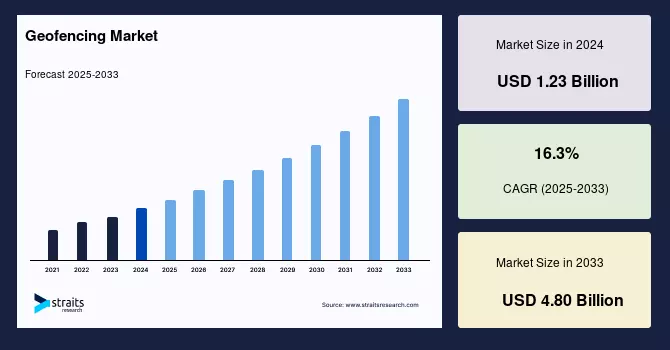
Geofencing Market Set to Grow Fivefold—From USD 1.23 Billion to USD 4.80 Billion by 2033
Introduction
Geofencing—the technology that defines a virtual boundary using GPS, RFID, Wi-Fi, or cellular data—is transforming how businesses engage with customers and optimize operations. Whether triggering promotional messages as a customer enters a store, enforcing safety around equipment, or managing fleet movement, geofencing is becoming integral across industries.
With the proliferation of mobile devices and demand for localized, real-time actions, this market is poised for explosive growth.
Market Overview
- 2024 Market Size: USD 1.23 billion
- 2025 Forecast: USD 1.43 billion
- 2033 Projection: USD 4.80 billion
- CAGR (2025–2033): 16.3%
The market is expected to more than triple over the forecast period, reflecting medium- to long-term adoption across sectors.
Key Market Drivers
Logistics & Transportation Efficiency
Fleet-based industries are turning to geofencing for dynamic tracking, route optimization, and real-time alerts—reducing loss, improving dispatch, and enhancing security.
Surge in Mobile Device Usage
Retail, delivery, and ride-sharing apps are deploying geofencing capabilities to send location-triggered offers, streamline order pickups, and enhance user experiences.
Market Challenges
Privacy — A Double-Edged Sword
Consumers are increasingly cautious about location tracking. Geofencing, perceived by some as intrusive, is prompting tougher privacy regulations and raising hurdles for adoption.
Market Opportunities
Advancing Core Technologies
Enhanced GPS accuracy, expansion of GNSS, IoT connectivity, and cloud-based platforms are opening new geofencing use cases—like alerting workers to hazards in industrial zones or securing restricted areas.
Regional Breakdown
- North America: Holds the largest share—fueled by strong logistics networks, mobile penetration, and enterprise familiarity with geofenced campaigns.
- Asia-Pacific: The fastest-growing region—spurring growth with mobile-first economies and expanding applications in smart manufacturing and ride-hail services.
- Europe: Steady growth region—adoption in retail and public sector contexts continues to rise.
- LAMEA: Emerging growth—driven by retail and fleet management uptake, particularly in GCC countries.
Market Segment Insights
- Components
- Solutions lead—tailored geofencing platforms are favored by large-scale adopters.
- Services, especially managed cloud-based offerings, are rising fast to support deployment and maintenance.
- Type
- Fixed geofencing (e.g. around buildings or sites) currently dominates due to its simplicity and maturity.
- Mobile geofencing is growing rapidly as apps push location-aware messaging to mobile users in real time.
- Application
- Transportation & Logistics leads, given the efficiency geofencing brings to fleet operations.
- Retail is rapidly scaling geofenced proximity marketing, especially during in-store campaigns.
- Technology Layer
- GPS anchors most geofencing systems—its ubiquity and accuracy make it essential.
- RFID is rising within warehouses and stores for precise in-store tracking and loss prevention.
Conclusion
The global geofencing market is on track for a dramatic rise—from USD 1.23 billion in 2024 to USD 4.80 billion by 2033, at a robust CAGR of 16.3%. Driven by mobile-first business models, logistics efficiency, technological improvements, and expanding industry use cases, geofencing is positioned to become a foundational component for both strategic operations and customer engagement.
Request sample:https://straitsresearch.com/report/geofencing-market/request-sample