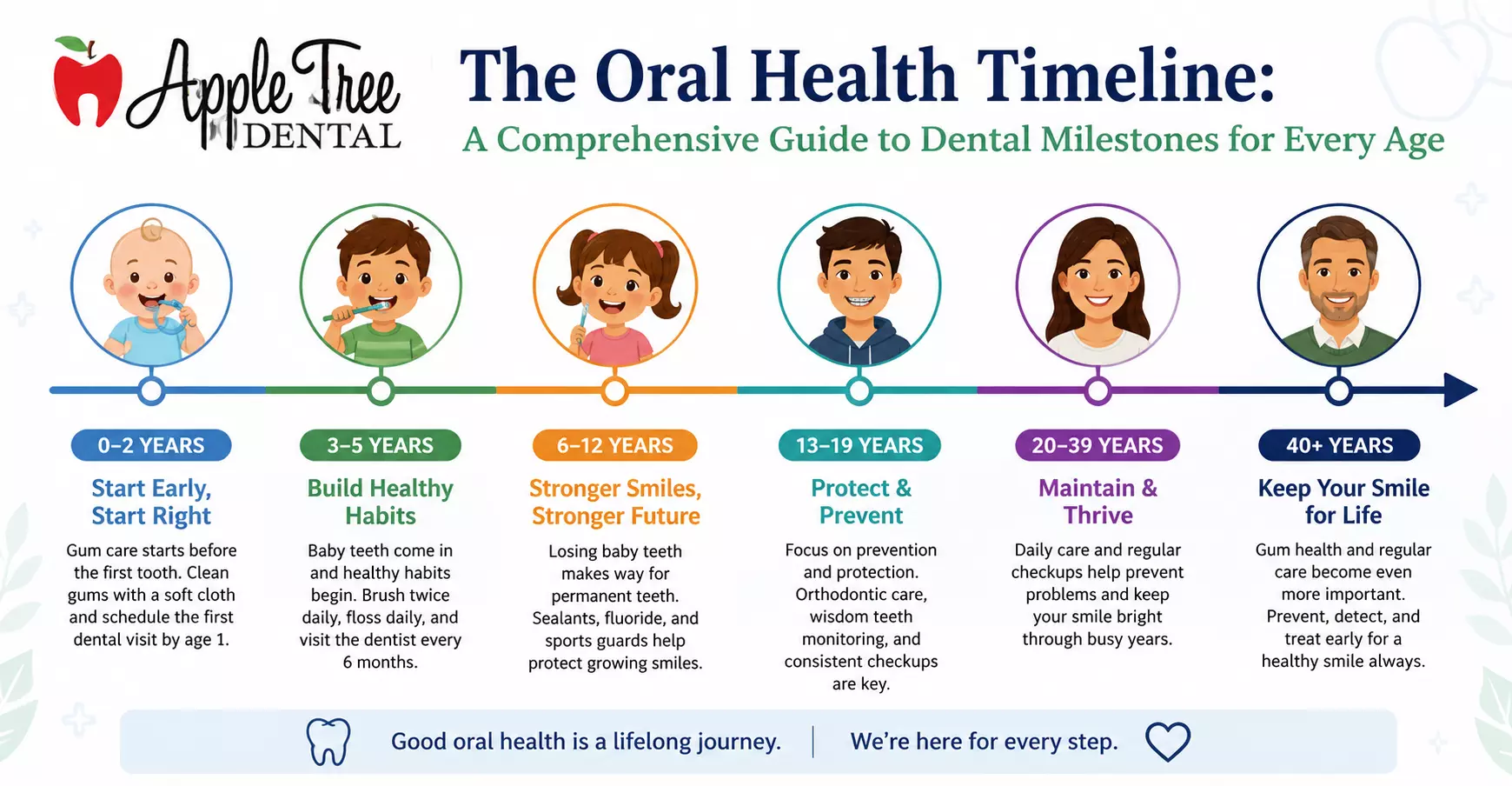
Generational Smiles: Navigating Oral Health Milestones Through Every Life Stage
Between soccer practices, board meetings, and daily household management, modern families are stretched thin. Healthcare appointments often become a logistical puzzle, especially when each family member requires a different specialist.
However, when it comes to oral health, viewing your family’s needs through a unified, generational lens isn’t just about scheduling convenience—it is a critical component of preventative healthcare.
Dental needs evolve drastically from infancy to the golden years. Understanding these distinct stages of oral development and maintenance can help you anticipate issues before they become painful or expensive.
This guide breaks down the critical dental milestones for every age group and explains why a centralized approach to your family’s oral health yields the best clinical outcomes.
The Early Years: Infancy and Toddlerhood (Ages 0-3)
It is a common misconception that because primary (baby) teeth eventually fall out, they require less meticulous care. In reality, primary teeth are the foundational blueprints for a child’s future smile.
They hold space for permanent teeth, aid in speech development, and are essential for proper nutrition.
First Tooth, First Visit
Pediatric dental authorities generally recommend that a child’s first dental visit should occur within six months of the eruption of their first tooth, or by their first birthday—whichever comes first.
This initial visit is rarely about complex procedures; it is a vital preventative step. Dentists use this time to assess the child’s oral and facial development, check for early signs of early childhood caries (often known as baby bottle tooth decay), and educate parents on proper infant oral hygiene.
Managing Early Habits
During the toddler years, habits such as thumb-sucking and prolonged pacifier use are common self-soothing mechanisms.
While perfectly normal in infancy, if these habits persist past the age of three, they can begin to alter the shape of the developing palate and the alignment of the emerging teeth.
Early intervention and gentle guidance from a dental professional can help mitigate the risk of severe bite issues later in life.
The Formative Years: Childhood and Adolescence (Ages 4-18)
As children grow, their mouths undergo rapid and continuous change. The transition from primary teeth to a permanent dentition is a critical window for preventative care and early structural intervention.
The Cavity Prevention Phase
Once the permanent molars erupt (typically around ages 6 and 12), they introduce deep grooves and fissures into the mouth that are notoriously difficult for children to clean with a toothbrush alone.
This is the prime time for the application of dental sealants—a thin, protective coating painted onto the chewing surfaces of the back teeth.
Combined with professional fluoride treatments, sealants act as a highly effective barrier against cavity-causing bacteria.
Orthodontic Evaluations and Sports Dentistry
By the age of seven, most children have a mix of primary and permanent teeth, making it the ideal time for an initial orthodontic evaluation.
Early assessment allows dentists to identify potential crowding, crossbites, or jaw discrepancies while the jaw is still actively growing, potentially reducing the need for invasive orthodontic work in the future.
Furthermore, for active teenagers, dental trauma is a significant risk. Custom-fitted athletic mouthguards provide vastly superior protection against concussions, fractured teeth, and soft tissue injuries compared to over-the-counter "boil and bite" alternatives.
Adulthood: Maintenance and Prevention (Ages 19-55)
For adults, the focus of dental care shifts from development to long-term preservation. The daily stresses of adulthood, combined with dietary habits and natural aging, present a new set of challenges for the oral cavity.
Periodontal Health and Systemic Connections
Gum disease (periodontal disease) is often referred to as a "silent" condition because it can progress painlessly for years. However, chronic inflammation in the gums is no longer viewed as an isolated dental issue.
Modern medical research has established strong links between severe periodontal disease and systemic health complications, including cardiovascular disease, poorly controlled diabetes, and even adverse pregnancy outcomes.
Regular periodontal charting and professional scaling are non-negotiable for holistic health.
The Impact of Stress: Bruxism
Adults frequently manifest stress through bruxism—the subconscious clenching and grinding of teeth, usually during sleep. Over time, bruxism can lead to severe enamel attrition, micro-fractures, and temporomandibular joint (TMJ) disorders.
Identifying the early wear patterns of grinding allows your dentist to prescribe a custom occlusal guard (night guard), preserving the structural integrity of your natural teeth.
The Golden Years: Senior Dental Care (Ages 55+)
Advances in modern dentistry mean that more adults are keeping their natural teeth for their entire lives. However, the senior years require specialized attention to adapt to biological changes and the side effects of overall medical care.
Managing Xerostomia (Dry Mouth)
One of the most common challenges for older adults is xerostomia, or chronic dry mouth. This is rarely a natural byproduct of aging; rather, it is a frequent side effect of many common prescription medications, including those for hypertension, depression, and cholesterol.
Saliva is the mouth’s natural defense mechanism, washing away food particles and neutralizing bacterial acids. A lack of saliva drastically increases the risk of rapid root decay.
Dental professionals can recommend specialized rinses, artificial saliva products, and increased fluoride protocols to counteract this vulnerability.
Restoring Function and Confidence
Even with excellent care, teeth undergo decades of wear and tear. The modern approach to restorative dentistry—utilizing advanced dental implants, precision-milled crowns, and modern partial dentures—
focuses on restoring full chewing capacity and aesthetic confidence, ensuring that seniors can maintain a nutrient-dense diet and an active social life.
Family Dentistry in London, Ontario: A Practical Guide
The Strategic Advantage of a Unified Care Provider
Navigating these distinct stages requires consistency. Instead of constantly searching for a "family dentist near me" every time a different family member has a specific issue, there is a profound clinical advantage to establishing a "dental home" for your entire household.
When a single clinical team treats parents and children, they gain invaluable insight into the family’s genetic dental history.
If a parent has a history of aggressive gum disease, congenitally missing teeth, or specific enamel deficiencies, the dentist knows exactly what to monitor in the child from a very early age.
Furthermore, centralizing your care streamlines communication, simplifies record-keeping, and fosters a deep, trust-based relationship between the patient and the provider.
For residents seeking a long-term healthcare partnership, choosing an established clinic for family dentistry London ensures that your family receives customized, continuous care tailored to their specific life stage, all under one roof.
Conclusion
Oral health is not static; it is a lifelong journey characterized by distinct biological phases. By understanding the specific needs of infants, adolescents, adults, and seniors, you can take a proactive approach to your family's health.
Committing to a unified dental care strategy ensures that as your family grows and changes, their smiles remain resilient, healthy, and bright.
About the Author
Apple Tree Dental is a premier dental practice dedicated to providing comprehensive, patient-centered care.
With a foundational philosophy rooted in education, preventative care, and advanced clinical techniques, Apple Tree Dental serves patients across all stages of life.
Their team of licensed dental professionals specializes in everything from pediatric early intervention to complex adult restorative procedures, making them a trusted authority in family dentistry London.
They are committed to fostering long-term patient relationships through transparent, evidence-based treatment planning in a comfortable, modern environment.