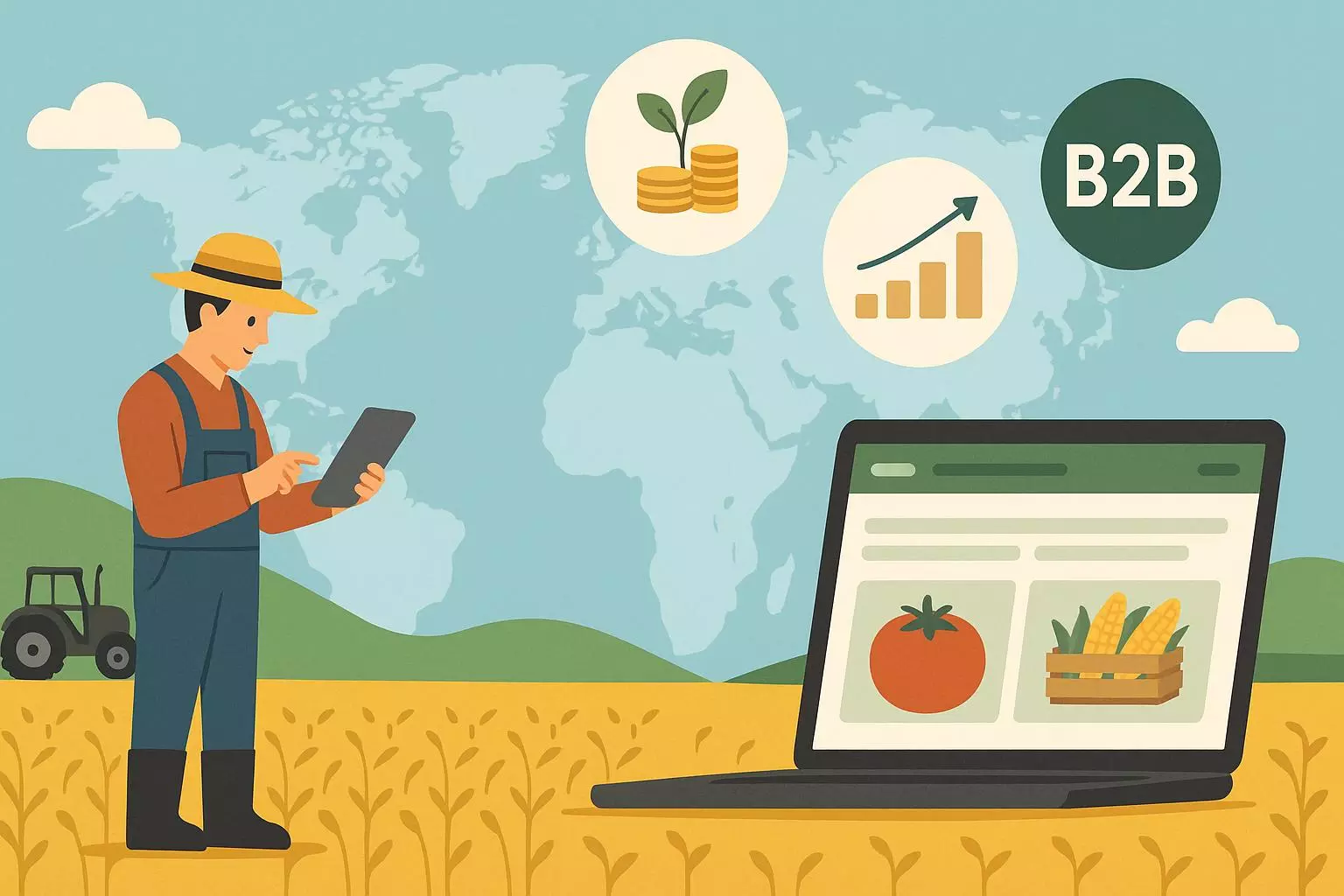
From Local to Global: Our Journey Through the Top Agri B2B Platforms
Agriculture today is not what it was even a decade ago. With the rise of digital connectivity and government-backed infrastructure, farmers and agri-entrepreneurs are now exploring trade opportunities that span regions—and even continents. Our own transformation, from a small local agri-business to a nationally connected supplier, came through active engagement with India’s evolving B2B ecosystem for agriculture.
Even while the private sector has contributed technology and tools, government-driven platforms have been crucial in effectively scaling agri-trade, particularly for small and medium-sized farmers like us. We chart our path across various platforms in this blog, emphasising the turning points, resources, and revelations that enabled us to develop sustainably.
Building a Business Rooted in Local Markets
There were only two crops and a few seasonal buyers at the start of our adventure. We used physical mandis to sell our produce, and we mostly relied on intermediaries for distribution. Our reach and pricing power were constrained because the entire business was centred on in-person trade.
These networks offered stability, but there wasn't much space for growth or profit optimisation. We lacked standardised storage systems, access to high-quality inputs, and real-time price discovery. We would lose money if a buyer cancelled. We had nothing to do if the mandi's pricing dropped.
It became evident that improved knowledge, more access, and defence against erratic market shocks were necessary if we were to expand.
Discovering Digital Infrastructure and Government Platforms
The shift started gradually when we began utilising dial-in facilities provided by agricultural departments and local Krishi Vigyan Kendra (KVK) advisory. However, exposure to India's digitalized agri-trade infrastructure was what really gave our company new opportunities.
We came to see that platforms created and maintained by governmental organisations were more than just vehicles for policy; they were genuinely valuable trade facilitators.
eNAM: Creating Price Transparency Across Mandis
When we enrolled on the National Agriculture Market (eNAM), the first significant change occurred. Physical wholesale mandis all over India are integrated into this government-run internet marketplace. We could now see real-time auction values for our crops in many states thanks to eNAM.
This altered the way we bargained with purchasers. We had information. Data also gave us assurance.
Additionally, consumers could rely on the products offered thanks to eNAM's quality grading and weighing methods. This decreased consumer reluctance and raised our percentage of successful sales.
Through eNAM, we learned:
- How price variation across states could be used to plan distribution
- When to store crops in warehousing for future sales
- What grades fetched the best price, and how to meet those standards
It also introduced us to assaying labs and formal warehousing systems, increasing our overall credibility as a supplier.
SFAC: From Local Harvest to National Supply Chains
We learned about the Small Farmers' Agribusiness Consortium (SFAC) shortly after our eNAM triumph. By connecting farmer producer organisations (FPOs) with institutional purchasers and agri-markets, this programme supports FPOs.
We gained more collective negotiating power when we joined a local FPO. We were exposed to long-term supply contracts, bulk purchase orders, and government tenders through SFAC.
We took part in a pulse procurement campaign one year that was funded by price support programmes offered by NAFED (National Agricultural Cooperative Marketing Federation of India Ltd.). For once, we functioned like a legitimate company with a guaranteed market, our payments were assured, and logistics were organised.
We learned from this experience how policy-backed trade may greatly lower company risks and the power of aggregation.
“If agriculture goes wrong, nothing else will have a chance to go right in the country.” – M. S. Swaminathan
A Turning Point: Reliable Input Sourcing Through Trusted Networks
As our sales grew, we needed reliable access to quality agri-inputs that could be delivered quickly and consistently. In one such phase, we discovered agribegri, an online agri marketplace that gave us access to certified seeds, bio-pesticides, and farm nutrients with transparent pricing and doorstep delivery.
This platform allowed us to reduce input costs while maintaining product consistency across harvest cycles, which in turn improved our output quality and made us more competitive in formal market listings.
Linking with NABARD and the Agri-Infrastructure Ecosystem
We needed infrastructure to manage greater orders and seasonal surpluses. cold storage. lines of sorting. packhouses.
We made contact with NABARD (National Bank for Agriculture and Rural Development) through government outreach initiatives. We were able to partially finance a small storehouse on our farm thanks to their financing programmes under the Agri Infrastructure Fund.
Read: Exploring the Best Rice Suppliers from India for Global
This straightforward structure had a significant impact. After harvest, we no longer hurried to sell. Before determining the ideal moment to sell, we may store, wait, and keep an eye on prices across eNAM or other procurement platforms.
Additionally, NABARD exposed us to agri-startups that offered guidance on basic mechanisation and storage temperature management.
Digital Literacy and the Role of Agri Clinics
In the past, many of us feared digital platforms simply because we weren’t confident using them. But through Agri Clinics and Agri Business Centres (ACABC), we received hands-on training in agri-entrepreneurship and digital tools.
They taught us to read soil health cards, track commodity price indexes, and even use government mobile apps like Kisan Suvidha and MKisan to stay updated.
Learning how to manage logistics, credit, and digital payments was perhaps more important than learning how to grow the crop itself. This shift helped us think like an enterprise.
Connecting with Buyers Beyond Borders
Some government platforms, such as APEDA (Agricultural and Processed Food Products Export Development Authority), direct producers towards exports, but the majority are national in scope.
We have started training under APEDA's export preparedness programmes, even though we haven't yet exported. They describe certifications that customers in the Middle East and Europe need, such as HACCP, BRC, and traceability standards.
They also assist in putting us in touch with exporters who are searching for high-quality produce to send in large quantities. Even if we don't now export, we are getting ready to do so in the future.
FAQs
What is eNAM and how does it help farmers?
eNAM is a pan-India online trading platform that integrates mandis to create a unified national market. Farmers can get real-time prices, connect with buyers beyond their local area, and ensure fair weighing and grading.
How can agribusinesses access government schemes?
Government schemes are available through portals like SFAC, NABARD, and Agri Infrastructure Fund. Registration with local agriculture departments or Krishi Vigyan Kendras can also connect you with these initiatives.
Is agribegri a government platform?
No, agribegri is a private agri-input marketplace. However, it supports government-approved and certified input products, which makes it reliable for farmers looking for consistent quality.
How can farmers benefit from NABARD?
NABARD offers low-interest loans, subsidies for infrastructure, and training for agri-entrepreneurs. Many of these are routed through cooperative banks or FPOs.
Can a small farmer really benefit from these platforms?
Yes. Even farmers with small landholdings can access digital markets, input platforms, and infrastructure support. Aggregation through FPOs further increases impact.
Growing Beyond Boundaries: A New Era for Agri Trade
What started as a small operation tied to physical mandis has now transformed into a dynamic, informed, and digitally-enabled business. We’ve learned that the real power in agriculture today lies in connection—whether to data, platforms, infrastructure, or networks of buyers and sellers.
The platforms may be digital, but the impact is real. Through initiatives like eNAM, SFAC, NABARD, and tools like agribegri, we now trade smarter, invest wisely, and plan ahead.
As agriculture continues its evolution, we believe the future belongs to those who embrace knowledge, networks, and national-level systems. With the right tools and platforms, even the smallest farmer can go global—without ever leaving their farm.