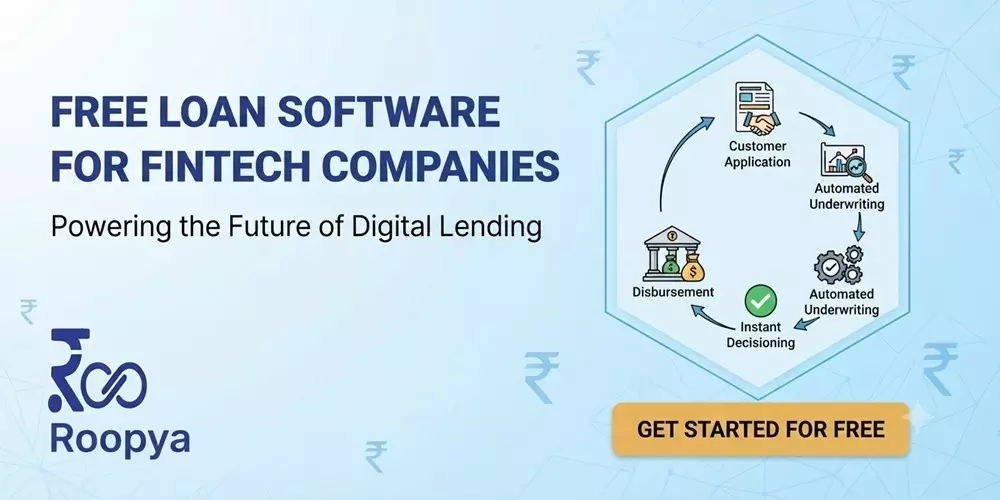
Free Loan Software for Fintech Companies: Everything You Need to Know Before You Launch
Starting a fintech lending business is one of the most exciting opportunities in Indian financial services today.
The addressable credit gap in India is estimated at over free-loan-software-for-fintech-companies ₹25 lakh crore, and technology is rapidly closing the distance between underserved borrowers and the capital they need.
But for a first-time fintech founder, one question comes up almost immediately: how do I get the right loan software without spending a fortune before I have even processed my first application?
The good news is that free loan software for fintech companies is not just a marketing promise. It is a real, legitimate entry point that several leading lending infrastructure providers — including Roopya — offer, because they understand that the best way to earn a long-term customer is to let them experience the platform's value before committing to paid plans.
This article is a complete, honest guide to what free loan software means, what it actually includes, where the limits are, and how to choose the right platform for your fintech company's growth stage and goals.
We have written this guide for fintech founders, NBFC compliance officers, lending product managers, and technology leads who want real information — not sales copy.
By the end, you will have a clear picture of what to look for, what questions to ask, and which platform is most likely to serve your needs at zero cost while positioning you for scale.
1. What Is Free Loan Software for Fintech Companies?
Free loan software refers to a lending technology platform that allows fintech companies to access core loan management and origination capabilities without paying upfront licence fees or subscription costs.
The 'free' model in lending software typically comes in one of three forms:
- Free Trial or Freemium Model: Full platform access for a limited period (14 to 90 days) or with usage caps, allowing you to test the platform thoroughly before committing.
- Pay-As-You-Use with Zero Upfront Cost: No monthly licence fee, no setup fee, no per-seat charge. You pay only when you actually process applications or disburse loans — meaning that if you are not yet live, you pay nothing.
- Open-Source Loan Software: Publicly available source code that you can self-host and customise. Free to use but requires significant technical resources to deploy, secure, maintain, and scale.
For most fintech companies — especially early-stage NBFCs and lending startups — the pay-as-you-use model with zero upfront cost is the most practical and valuable form of 'free'.
It gives you access to enterprise-grade infrastructure from day one, without financial risk, and scales naturally as your portfolio grows. This is the model Roopya uses.
It is important to be clear about what free loan software does not mean. It does not mean unlimited usage with no cost forever. It does not mean unsupported or low-quality software.
And it does not mean you should accept a platform with poor compliance, weak security, or limited integrations just because it is free. The best free loan software for fintech companies is genuinely enterprise-grade — it simply does not charge you until you are generating value.
2. Why Fintech Companies Need Specialised Loan Software
A fintech company entering the lending market is not just building a product — it is building a regulated financial operation.
The software that powers that operation is not a commodity; it is the core infrastructure on which credit decisions, customer experience, regulatory compliance, and risk management all depend.
Many early fintech founders underestimate this complexity and attempt to build loan management capabilities in-house using generic software — spreadsheets, CRM systems, or custom-built databases.
This approach creates serious problems:
- Regulatory Risk: RBI requires specific audit trails, KYC documentation, credit bureau reporting, and CERSAI filings. Generic software is not built for these requirements. A regulatory inspection of an under-equipped lender can result in penalties, corrective action, or licence cancellation.
- Credit Risk: Manual underwriting is slow, inconsistent, and biased. Without a structured Business Rule Engine and bureau integration, your credit decisions will be noisier and your portfolio riskier than they need to be.
- Operational Fragility: As loan volumes grow, manual processes break. A spreadsheet that worked for 50 loans a month becomes a crisis at 500. Specialised loan software is designed for volume and complexity from the start.
- Customer Experience: Borrowers in 2025 expect a fully digital, sub-15-minute application experience. Cobbled-together generic tools cannot deliver this without significant custom development investment.
- Integration Complexity: A lending operation requires dozens of integrations — credit bureaus, KYC providers, eSign platforms, payment gateways, accounting tools. Building and maintaining these integrations in-house is enormously expensive and time-consuming.
Specialised free loan software for fintech companies solves all of these problems. It gives you regulatory-ready infrastructure, structured credit workflows, pre-built integrations, and a borrower experience that competes with the best digital lenders — all at zero upfront cost.
Read: How to Get Instant Approval for Personal Loan (Without the
3. Key Features to Look for in Free Loan Software
Not all free loan software is created equal. When evaluating platforms, here are the capabilities that
genuinely matter for a fintech company:
3.1 No-Code Loan Application Builder
Your first borrower touchpoint is the loan application form. Free loan software should allow you to configure and deploy a fully branded, mobile-responsive digital application form without writing code.
This means your product and operations team — not your engineering team — can design, test, and launch application journeys independently.
Look for support for conditional logic (questions that appear based on earlier answers), document upload flows, and real-time field validation. Roopya provides 20+ pre-configured loan product journeys that can be deployed as-is or customised through a visual interface.
3.2 Automated KYC and Identity Verification
Manual KYC is both an operational bottleneck and a compliance risk. Free loan software worth using will come pre-integrated with Aadhaar eKYC, PAN verification, Digilocker, and video KYC (VKYC) providers.
The moment a borrower submits an application and provides consent, the KYC process should trigger automatically, complete in seconds, and feed verified identity data directly into the application record — with no human intervention and a complete audit trail.
3.3 Credit Bureau Integration
Access to real-time credit bureau data is non-negotiable for responsible lending. Your free loan software should support direct integration with all four major bureaus operating in India — CIBIL, Experian, CRIF, and Equifax.
Bureau pulls should be triggered automatically on application submission (with consent), and bureau reports should be parsed and structured for use in credit decisioning rules — not just stored as PDFs for manual review.
3.4 No-Code Business Rule Engine (BRE)
The Business Rule Engine is where your credit policy lives. A no-code BRE lets your risk and credit team configure eligibility criteria, underwriting rules, product parameters, and approval workflows through a visual interface — without involving engineers.
This matters enormously for a fintech company, because your credit policy will evolve continuously as you learn from your portfolio.
A BRE that requires developer involvement for every rule change becomes a bottleneck that slows down your risk management.
Roopya's BRE is fully self-configurable and includes a machine learning layer that identifies patterns in approvals and rejections to suggest policy improvements over time.
3.5 AI-Powered Document Processing
Bank statements, salary slips, GST returns, ITRs, and property documents are central to loan underwriting.
AI-powered OCR and NLP within your free loan software should be able to extract, validate, and analyse these documents automatically — computing net monthly income from payslips, identifying cash flow patterns from bank statements, detecting anomalies and potential fraud signals.
Manual document review is one of the highest-cost activities in a lending operation; automation here creates both cost savings and better risk outcomes.
3.6 Loan Lifecycle Management
Free loan software should not stop at origination. A complete lending platform manages the full loan lifecycle — from application through disbursement, repayment scheduling,
EMI collection, pre-closure, and closure. Look for amortisation schedule generation, automated payment reminders via SMS and WhatsApp,
integration with payment collection platforms (NACH, UPI, eMandate), and delinquency management workflows. Roopya's platform covers the complete lifecycle from origination to collections, all within a single unified system.
3.7 eSign and Digital Agreement Execution
Loan agreements must be signed, and for a digital-first fintech, that means eSign integration.
Free loan software should support Aadhaar OTP-based eSign or Digilocker-based eSign, delivering legally valid digital signatures without branch visits or courier costs.
The signed agreement should be automatically stored in the borrower's application record with a tamper-proof audit trail.
3.8 Regulatory Compliance Tools
Your loan software must help you stay compliant — not just at launch, but as regulations evolve.
Look for built-in features for consent management (Fair Practices Code), RBI reporting, credit bureau data furnishing, CERSAI filing support, and comprehensive audit logs.
A platform that is continuously updated for regulatory changes is far more valuable than one that requires you to track and implement compliance updates yourself.
3.9 Reporting and Analytics
Data is the competitive advantage of a fintech lender. Free loan software should offer dashboards and reports covering portfolio performance, application funnel metrics, credit decision outcomes, repayment behaviour, and operational efficiency indicators.
Advanced platforms like Roopya include AI-driven analytics that generate natural language insights — asking questions in plain English and receiving structured analysis instantly.
3.10 Open API Architecture
As your fintech company grows, you will want to integrate your loan software with your CRM, your accounting system, your partner platforms, and your proprietary data sources.
Free loan software with open REST API architecture gives you the flexibility to build these integrations without being locked into a vendor ecosystem. Roopya's open API architecture supports seamless integration with CRMs, ERPs, and third-party data providers.
4. Types of Fintech Companies That Benefit from Free Loan Software
Free loan software is not only for one type of fintech. Here is how different categories of fintech companies can benefit:
Early-Stage NBFCs and Lending Startups
A newly licensed NBFC with a fresh RBI certificate of registration faces a paradox: it needs enterprise-grade lending infrastructure to operate responsibly, but it has limited capital before its first loan is disbursed. Free loan software with zero upfront cost solves this perfectly.
Roopya's pay-as-you-use model means an early-stage NBFC pays nothing until it starts processing applications, and even then the cost is proportional to volume — not a large fixed overhead.
Embedded Finance Platforms
E-commerce companies, HR platforms, payroll providers, and gig economy apps increasingly want to embed lending products into their core user experience — offering credit at checkout, salary advances within a payroll portal, or working capital for seller-partners.
Free loan software with robust API architecture lets embedded finance platforms launch lending products without building core lending infrastructure from scratch.
DSA Networks and Loan Aggregators
Direct Selling Agent (DSA) networks and loan marketplaces need software to manage multi-lender applications, track agent performance, and ensure compliance across a distributed origination network.
Free loan software can serve as the technology backbone for a DSA operation without requiring the upfront investment that would make the business model unviable at early volumes.
Microfinance Institutions (MFIs)
MFIs operating in rural and semi-urban markets often have extremely tight operating cost constraints.
Free loan software that handles group lending workflows, JLG (Joint Liability Group) mechanics, and low-connectivity environments can dramatically improve MFI operational efficiency without adding to the cost burden.
Fintech Product Teams within Banks
Large banks increasingly operate internal fintech teams tasked with building digital lending products alongside the core bank.
These teams often have access to internal capital but face agility constraints — they cannot wait months for procurement and implementation cycles.
Free loan software that goes live in a day lets internal fintech teams test, iterate, and demonstrate results before committing to full enterprise procurement.
5. Roopya: The Best Free Loan Software for Fintech Companies in India
Roopya is a no-code lending infrastructure platform purpose-built for the Indian market.
It was designed from the ground up to solve the specific challenges facing Indian fintech companies — the regulatory complexity of the RBI framework, the diversity of borrower profiles, the patchwork of required third-party integrations, and the need to go from zero to live in the shortest possible time.
Here is why Roopya stands out as the leading free loan software option for fintech companies:
Zero Upfront Cost — Genuinely Free to Start
Roopya operates on a pure pay-as-you-use model. There are no setup fees, no monthly subscription charges, no per-seat licences, and no minimum commitment volumes.
A fintech company can onboard, configure its product journeys, integrate its required APIs, and complete end-to-end testing — all without spending a single rupee.
You only begin paying when you process live applications, and the cost scales proportionally with your volume. This makes Roopya genuinely free at the stage where most fintech companies need it most: before they have revenue.
1-Day Go-Live
Most legacy loan software implementations take six to twelve months — requirements gathering, system design, development, testing, UAT, and deployment.
Roopya eliminates this entirely. Pre-configured loan product journeys, plug-and-play API integrations, and a no-code setup interface mean that a fintech company can go from registration to processing live applications within 24 hours of onboarding. For a startup where speed-to-market is a survival variable, this is transformative.
300+ Pre-Integrated APIs Ready Out of the Box
Building a lending operation from scratch requires integrating with credit bureaus, KYC providers, eSign services, payment gateways, accounting tools, and banking APIs.
Doing this one integration at a time typically takes months and significant engineering cost.
Roopya ships with 300+ pre-built integrations — all four major credit bureaus (CIBIL, Experian, CRIF, Equifax), Aadhaar eKYC, PAN, Digilocker, VKYC, eSign platforms, NACH, UPI, eMandate, GST data providers, accounting systems, and more. On Roopya, your engineering team focuses on your product — not on integration plumbing.
Truly No-Code — Business Users Drive the Platform
Roopya's platform is designed to be operated by business and operations teams without requiring constant engineering support.
Credit policy changes, new loan product configurations, workflow modifications, and reporting customisations are all done through an intuitive visual interface. This matters enormously for fintech companies where the engineering team is always the scarcest resource.
With Roopya, your risk team changes underwriting rules without raising a ticket; your operations team configures workflows without waiting for a sprint; your product team launches new loan products without a six-week development cycle.
AI at Every Layer
Roopya is not just a workflow tool — it is an AI-powered lending infrastructure.
Document processing runs at 99%+ accuracy using intelligent OCR and NLP. The credit scoring engine incorporates alternative data and behavioural indicators beyond traditional bureau scores.
The Business Rule Engine uses machine learning to identify patterns in historical decisions and suggest policy improvements.
Fraud detection modules analyse application data in real time, flagging anomalous patterns before disbursement. Analytics runs on natural language — you ask a question in plain English and get a structured insight.
For a fintech company competing on the quality of its credit decisions, this AI layer is not a nice-to-have; it is a core competitive advantage.
20+ Pre-Configured Loan Product Journeys
Roopya ships with ready-to-use journeys for personal loans, business and SME loans, MSME credit, gold loans, home loans, auto loans, payday and salary advance loans, and microfinance products.
Each journey includes the application form, document checklist, KYC workflow, credit decision workflow, offer letter template, and eSign integration — pre-built and ready to customise.
A fintech company can pick the journey closest to its product, modify the parameters to match its credit policy, and go live the same day.
RBI-Compliant by Design
Roopya's platform is built around the RBI's regulatory requirements for digital lenders — Fair Practices Code compliance, digital consent management, KYC norms, PMLA requirements, credit bureau data furnishing, CERSAI integration, and comprehensive audit trails.
The platform is continuously updated as regulatory requirements evolve, so your compliance posture is always current without requiring manual tracking and implementation on your part.
Full Lifecycle — Origination Through Collections
Roopya is not just a loan application tool. It manages the complete lending lifecycle — loan origination, underwriting, sanction, disbursement, repayment management, collections, early warning signals, and portfolio analytics.
Operating on a single unified platform eliminates the data silos and integration complexity that come from stitching together separate tools for each lifecycle stage.
6. Free Loan Software vs. Building In-House: An Honest Comparison
Many fintech founders consider building their own loan software in-house. It is worth being direct about what that actually costs:
- Development Time: A basic loan origination system with bureau integration, KYC, eSign, and a BRE typically requires 12 to 18 months of development by a team of 5 to 8 engineers. That is before any testing, compliance review, or iteration.
- Development Cost: At market rates for experienced fintech engineers in India, this represents a minimum investment of ₹1.5 to ₹3 crore before you process a single loan. Many fintech startups do not have this capital.
- Maintenance Burden: Regulatory requirements change. Credit bureaus update their APIs. Payment providers deprecate older integration methods. Each change requires engineering resources to implement. A dedicated platform provider like Roopya absorbs this maintenance burden entirely.
- Compliance Risk: A home-built system is only as compliant as the team that built it knew to make it. RBI compliance requirements are complex, specific, and evolving. A missed audit trail, an incorrect consent flow, or a broken bureau reporting integration can have serious regulatory consequences.
- Time to Market: Every month of build time is a month your competitors — who chose a platform — are in market, learning from real data, and refining their credit policy.
The conclusion for most fintech companies is clear: using free loan software from a specialised provider gives you better infrastructure, faster time to market, lower risk, and zero upfront cost compared to building in-house.
The rare exceptions are large, well-capitalised fintechs with highly specialised requirements that no existing platform can meet — and even they typically start with a platform and customise from there.
7. How to Get Started with Free Loan Software on Roopya
Getting started with Roopya is designed to be fast and frictionless. Here is what the process looks like for a typical fintech company:
- Step 1 — Register and Onboard: Visit roopya.money and sign up. The onboarding process collects basic information about your organisation and lending product vision. There is no credit check, no legal agreement requiring weeks of review, and no upfront payment.
- Step 2 — Choose Your Loan Product Journey: Select from Roopya's 20+ pre-configured loan product journeys. If your product is a personal loan, choose the personal loan journey. If it is a business loan, select the business loan template. Each journey comes pre-built with all the components you need.
- Step 3 — Configure Your Credit Policy: Use the no-code BRE to input your eligibility criteria, bureau score cutoffs, income thresholds, employment filters, and product parameters. No engineering involvement required.
- Step 4 — Activate Your Integrations: From Roopya's integration library, activate the third-party services you need — CIBIL, Aadhaar eKYC, eSign, payment gateway, and any others. Each activation is configuration-driven, not code-driven.
- Step 5 — Test End-to-End: Use Roopya's sandbox environment to run complete test applications through your configured journey — from form submission through KYC, bureau pull, credit decision, offer generation, and eSign.
- Step 6 — Go Live: Once testing is complete, flip the switch to production. Your lending operation is live. You will not be charged until you process real applications.
8. Common Questions Fintech Companies Ask About Free Loan Software
In conversations with fintech founders and lending product teams, a few questions come up consistently:
'Is free loan software secure enough for a regulated lending operation?'
Yes — if you choose a reputable provider. Roopya is built on enterprise-grade cloud infrastructure with data encryption in transit and at rest, role-based access controls, comprehensive audit logging, and regular security assessments.
The platform is designed to meet the data security requirements of a regulated NBFC or bank. Do not accept a free loan software platform that cannot clearly articulate its security architecture and compliance posture.
'Will I be locked in? What if I want to switch?'
This is a fair concern with any software platform. Roopya's open API architecture means your data is always accessible and exportable. There is no proprietary data format that makes switching prohibitively complex.
That said, once a lending operation is running smoothly on a platform, the practical cost of switching is real — not because of artificial lock-in, but because of the operational disruption involved. Choose a platform you are confident in for the long term.
'What happens to pricing as I scale?'
Roopya's pay-as-you-use model means pricing scales with volume. As your application volumes grow, your Roopya costs grow proportionally — but so do your revenues.
Unlike fixed-cost platforms that penalise small volumes and reward large ones, a usage-based model aligns the vendor's incentives with your success.
'Can free loan software handle the volumes we expect to reach?'
Roopya's cloud infrastructure is designed for horizontal scale. The platform currently handles lending operations for multiple lenders across a wide range of volumes.
Whether you process 100 applications a month or 100,000, the infrastructure scales automatically. There is no volume ceiling at which you would need to 'upgrade' to a different product.
9. The Real Cost of Choosing the Wrong Loan Software
Choosing the wrong loan software — even free software — is expensive. Here is what the wrong choice can cost a fintech company:
- Regulatory Penalties: A platform that does not maintain proper audit trails, consent records, or bureau reporting can expose your NBFC to regulatory action. The cost of a corrective action directive from RBI far exceeds any software savings.
- Poor Portfolio Quality: A BRE that is difficult to configure leads to loose, inconsistent credit decisions. Even a marginal increase in default rates can wipe out profitability on a thinly spread lending portfolio.
- Customer Churn: A slow, clunky application experience drives borrowers to competitors. In digital lending, a three-minute application that works is worth ten times a thirty-minute one that frustrates.
- Engineering Debt: Free software that requires heavy customisation or workarounds to function creates engineering debt that compounds over time, slowing down your product roadmap and increasing your maintenance burden.
- Switching Costs: Migrating a live lending portfolio from one platform to another — with active loans, repayment schedules, and customer data — is an extremely complex, risky, and expensive exercise. Getting the choice right the first time saves enormous pain later.
The criteria for choosing the right free loan software, therefore, are not just about what is available at no cost today.
They are about what will serve you well as you grow, remain compliant as regulations evolve, and scale as your portfolio matures. Roopya is built with exactly this long-term partnership mindset.
10. Why Roopya Is the Right Free Loan Software Partner for Your Fintech Journey
Roopya exists because the founders understood a fundamental problem: excellent lending infrastructure was only accessible to large, well-capitalised financial institutions.
The complexity and cost of building or buying a world-class loan origination and management system meant that smaller, innovative fintech companies were forced to operate with inferior tools — or spend years and crores building their own.
Roopya changes this equation. By offering a zero-upfront-cost, pay-as-you-use model, Roopya makes enterprise-grade lending infrastructure accessible to every fintech company — from a two-person founding team with a freshly issued NBFC licence to a 200-person fintech with an established loan book.
The platform is trusted by modern lenders including IndiaKaLoan, QuickFinShop, Recapita, Findoc, EazyCredit, and Lona Seva — each of whom chose Roopya because it gave them the infrastructure they needed to compete, at a cost model that matched their growth stage.
If you are a fintech company that is serious about building a lending operation that is fast, compliant, intelligent, and scalable — Roopya's free loan software is the place to start. There is no risk in beginning. There is significant risk in not beginning, while your competitors already are.
Sign up at roopya.money, configure your first loan product journey, and go live — all before the end of the week. The credit gap in India is not waiting. Your borrowers are not waiting. Your competitors are not waiting. With Roopya, you do not have to wait either.
FREQUENTLY ASKED QUESTIONS (FAQ)
Q1: Is there really free loan software available for fintech companies?
Yes. Several lending infrastructure providers, including Roopya, offer genuinely free loan software through a pay-as-you-use model with zero upfront cost. You can onboard, configure, and test the platform completely free of charge. Costs only begin when you process live applications, and they scale proportionally with your volume. This is not a limited-feature trial — it is full platform access from day one.
Q2: What does Roopya's free loan software actually include?
Roopya's free loan software includes the complete lending platform: no-code loan application builder, automated KYC and identity verification, credit bureau integration (CIBIL, Experian, CRIF, Equifax), AI-powered document analysis, no-code Business Rule Engine, real-time credit decisioning, eSign integration, loan lifecycle management, collections tools, early warning system, and reporting and analytics. All 300+ pre-integrated APIs are available. There is no 'lite' version — it is the full enterprise platform.
Q3: Do I need technical expertise to set up free loan software on Roopya?
No. Roopya is a truly no-code platform. Your product, operations, and risk teams can configure loan application journeys, credit policies, workflows, and reporting without writing a single line of code. The platform is designed to be operated by business users independently of engineering teams. Most fintech companies are fully live within 24 hours of onboarding.
Q4: Is free loan software RBI compliant?
Roopya's platform is built specifically for RBI compliance — including Fair Practices Code requirements, digital consent management, KYC norms under PMLA, credit bureau data furnishing, CERSAI filing support, and comprehensive audit trails. The platform is continuously updated as regulatory requirements evolve. As a fintech company using Roopya, your compliance posture is always current without requiring manual tracking on your part.
Q5: What loan products can I launch with Roopya's free loan software?
Roopya supports 20+ pre-configured loan product journeys including personal loans, business and SME loans, MSME credit, gold loans, home loans, auto loans, payday and salary advance loans, and microfinance (MFI) products. Each journey can be launched as-is or customised through the no-code interface to match your specific product parameters and credit policy.
Q6: How long does it take to go live with Roopya's free loan software?
Most fintech companies go live within one business day of onboarding. Pre-configured product journeys, plug-and-play API integrations, and the no-code configuration interface eliminate the months-long implementation cycle that traditional loan software requires. You can complete end-to-end sandbox testing and move to production within the same day.
Q7: What integrations are available in the free loan software?
Roopya comes pre-integrated with 300+ third-party services: all four major credit bureaus (CIBIL, Experian, CRIF, Equifax), KYC providers (Aadhaar eKYC, PAN verification, Digilocker, video KYC), eSign platforms, payment gateways (NACH, UPI, eMandate), GST data providers, banking APIs, accounting systems, and more. All integrations are activation-driven — no custom development required.
Q8: How does Roopya make money if the loan software is free?
Roopya uses a pay-as-you-use pricing model. There are no upfront costs, monthly subscription fees, or per-seat charges. Revenue is generated based on actual platform usage — application processing volume, API call volumes, and similar usage metrics. This model perfectly aligns Roopya's incentives with your success: Roopya grows when you grow. It is a genuinely partnership-oriented model.
Q9: Is the free loan software secure enough for a regulated lending operation?
Yes. Roopya is built on enterprise-grade cloud infrastructure with encryption in transit and at rest, role-based access controls, comprehensive audit logging, regular security assessments, and data localisation compliance. The platform meets the data security requirements of regulated NBFCs and banks. Security is not a paid add-on — it is foundational to the platform architecture.
Q10: Can Roopya's free loan software scale with my fintech company as it grows?
Absolutely. Roopya's cloud infrastructure is designed for horizontal scale and handles lending operations across a wide range of volumes. Whether you process 50 applications a month or 50,000, the infrastructure scales automatically. The pay-as-you-use model means your costs scale proportionally with volume — not exponentially. There is no volume ceiling that would require you to migrate to a different product or undergo a costly re-implementation.
Q11: What makes Roopya different from other free loan software options?
Roopya stands apart through the combination of genuinely zero upfront cost, 1-day go-live, 300+ pre-built integrations, a truly no-code platform, AI-powered document processing and credit decisioning, full regulatory compliance, and complete lifecycle coverage from origination through collections. Most competing platforms offer either a limited free trial, require significant technical setup, or lack the depth of integrations and compliance features that a regulated fintech company needs.
Q12: How do I get started with Roopya's free loan software?
Visit roopya.money and click Sign Up. The onboarding process is straightforward and takes minutes. You can select your loan product journey, configure your credit policy using the no-code BRE, activate your required API integrations, run end-to-end tests in the sandbox environment, and go live — all within your first working day. No credit card or upfront payment is required to start.