Fireworks Market Key Trends and Market Opportunities
The Fireworks Market continues to attract attention from manufacturers, distributors, event organizers, and investors worldwide.
Driven by cultural celebrations, public events, and increasing consumer spending on entertainment, the market has evolved into a dynamic industry with a broad global presence.
Advancements in technology and changing environmental considerations are further reshaping the competitive landscape, creating new opportunities for innovation and expansion.
1. Overview of the Fireworks Market
1.1 Understanding the Fireworks Industry
The fireworks industry encompasses the production, distribution, and sale of pyrotechnic products used for celebrations, festivals, sporting events, national holidays, and entertainment shows.
These products range from consumer-grade fireworks designed for personal use to highly sophisticated display fireworks utilized in large-scale public events.
Historically, fireworks have held cultural significance across numerous regions. Their enduring popularity has enabled the industry to maintain stable demand despite evolving consumer preferences and regulatory environments.
Today, the sector integrates advanced manufacturing techniques and safety standards to meet the expectations of both consumers and regulatory authorities
1.2 Market Scope and Key Segments
The Fireworks Market is segmented based on product type, application, distribution channel, and geography. Product categories include aerial shells, fountains, sparklers, firecrackers, and specialty pyrotechnic displays. Applications span personal celebrations, public festivals, entertainment events, and commercial exhibitions.
Market participants continue to diversify their product portfolios to cater to varying customer preferences.
This segmentation enables manufacturers to target niche audiences while maximizing revenue opportunities across different market channels. Regional variations in cultural traditions and regulations further contribute to market diversity and growth potential.
2. Factors Driving Fireworks Market Growth
2.1 Rising Demand During Festivals and Celebrations
One of the most significant drivers of the Fireworks Market is the consistent demand generated by festivals and cultural celebrations.
Events such as New Year's Eve, national holidays, religious festivals, weddings, and community gatherings frequently incorporate fireworks as a centerpiece of celebration.
The emotional and visual appeal of fireworks creates a memorable experience that continues to resonate with consumers across generations. As disposable incomes increase in several developing economies, spending on celebratory activities has also expanded, supporting sustained market growth.
Additionally, the resurgence of large-scale public gatherings following periods of event restrictions has contributed to renewed demand for fireworks displays in numerous regions.
2.2 Expansion of Commercial Entertainment Events
Beyond traditional celebrations, fireworks have become a prominent feature of commercial entertainment. Sporting events, music festivals, amusement parks, tourism attractions, and corporate gatherings increasingly utilize pyrotechnic displays to enhance audience engagement.
Event organizers recognize the ability of fireworks to create immersive experiences and strengthen brand visibility. Consequently, demand for customized and technologically advanced displays has risen substantially.
This trend has encouraged manufacturers to develop innovative solutions capable of delivering synchronized visual performances that complement modern entertainment formats.
Read: Stock Market Courses in Hyderabad: A Complete Guide for
3. Emerging Trends Shaping the Fireworks Market
3.1 Technological Advancements in Fireworks Production
Technological innovation is transforming multiple aspects of the Fireworks Market. Modern production techniques emphasize precision, consistency, and enhanced safety.
Digital ignition systems and computer-controlled display technologies have significantly improved the execution of complex pyrotechnic performances.
These advancements enable event organizers to synchronize fireworks with music, lighting systems, and multimedia presentations. The result is a more sophisticated and captivating audience experience. Manufacturers are also leveraging automation to improve production efficiency while maintaining strict quality standards.
As technology continues to evolve, the integration of intelligent control systems is expected to redefine the possibilities of modern fireworks displays.
3.2 Growing Focus on Sustainable and Eco-Friendly Fireworks
Environmental awareness has emerged as a key consideration within the Fireworks Market. Consumers, regulators, and environmental organizations are increasingly advocating for cleaner alternatives that minimize emissions and reduce environmental impact.
In response, manufacturers are investing in the development of eco-friendly fireworks that generate lower levels of smoke and particulate matter. Innovations involving biodegradable materials and environmentally conscious formulations are gaining traction across several markets.
This shift toward sustainability is encouraging companies to balance performance, visual appeal, and environmental responsibility. Organizations that successfully adapt to these evolving expectations may gain a competitive advantage in the years ahead.
4. Future Outlook of the Fireworks Market
4.1 Regional Growth Opportunities
Emerging economies are expected to play a pivotal role in the future expansion of the Fireworks Market. Rapid urbanization, increasing disposable income, and a growing appetite for entertainment experiences are contributing to stronger demand across developing regions.
Meanwhile, mature markets continue to generate revenue through premium display products, technological innovation, and specialized event applications.
Regional market participants are exploring strategic partnerships and distribution networks to strengthen their presence and capitalize on expanding opportunities.
As cultural celebrations remain deeply embedded in societal traditions, demand for fireworks is likely to persist across diverse geographic markets.
4.2 Strategic Developments and Industry Prospects
The future of the Fireworks Market will be influenced by a combination of innovation, regulatory adaptation, and evolving consumer expectations. Industry participants are increasingly focused on product differentiation, sustainability initiatives, and advanced display technologies to maintain competitiveness.
Investments in research and development are expected to accelerate the introduction of safer, cleaner, and more visually impressive pyrotechnic solutions. Strategic collaborations, market expansion efforts, and technological advancements will further shape the industry's trajectory.
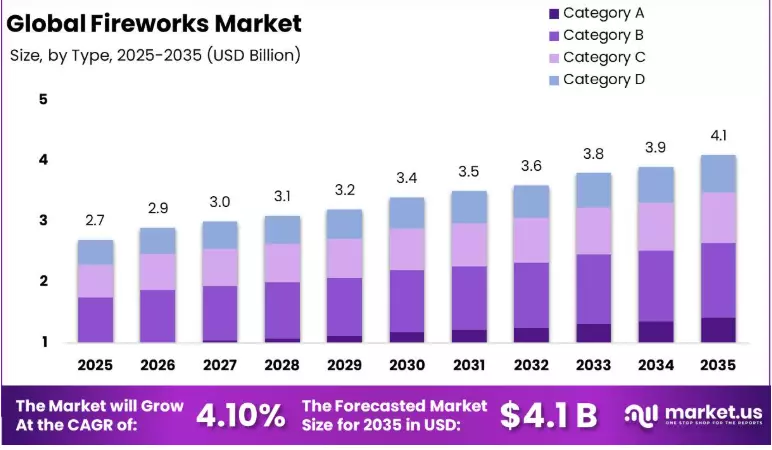
With continued demand from both consumer and commercial segments, the Fireworks Market is positioned for steady growth, offering significant opportunities for manufacturers, distributors, investors, and event organizers seeking long-term value creation.
Conclusion
The Fireworks Market remains a vibrant and evolving industry supported by cultural traditions, entertainment demand, and technological progress.
While regulatory and environmental challenges continue to influence market dynamics, innovation and sustainability initiatives are opening new pathways for growth.
As consumer preferences evolve and global celebrations continue to thrive, the industry is expected to maintain its relevance and unlock fresh opportunities across established and emerging markets alike.