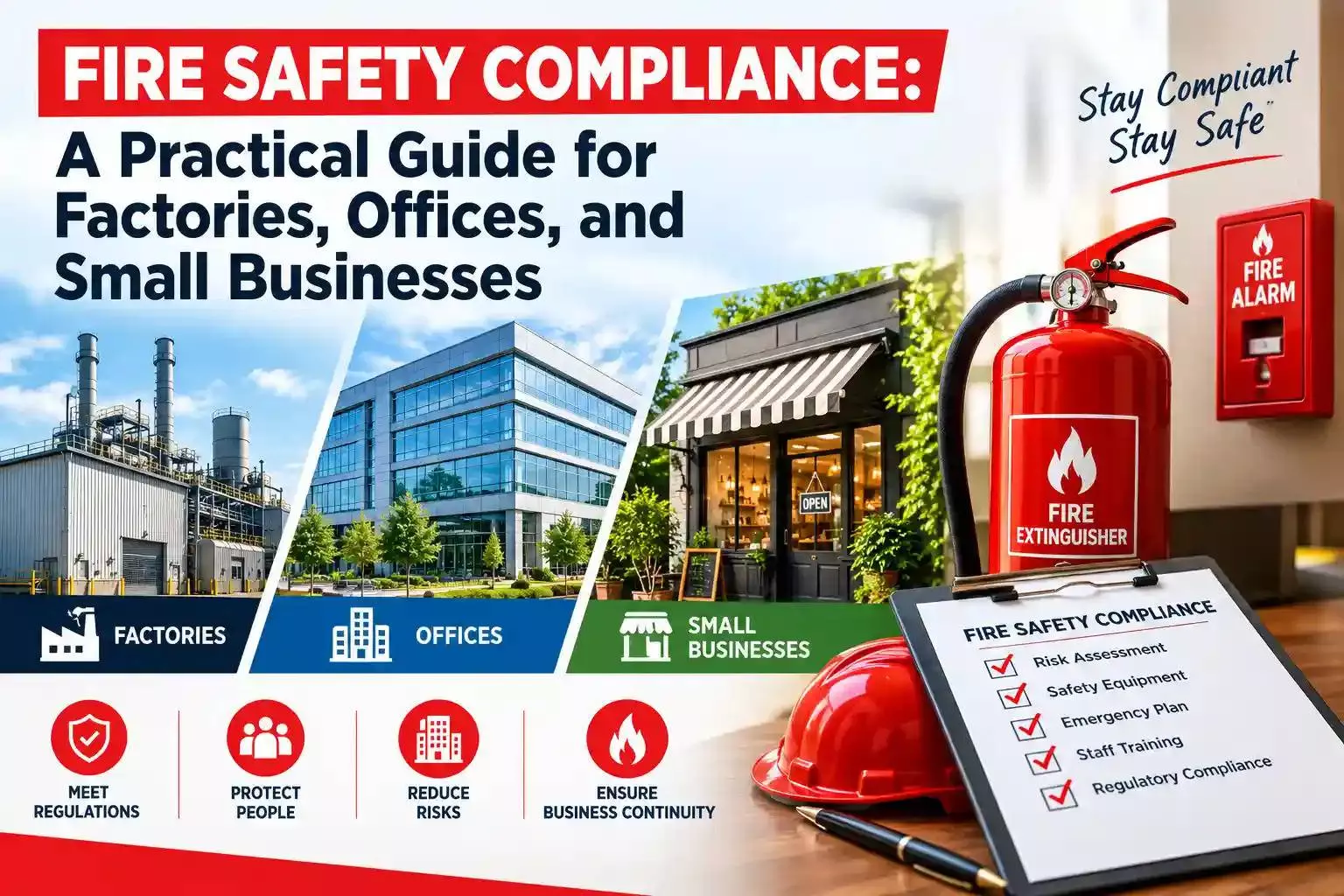
Fire Safety Compliance: A Practical Guide for Factories, Offices, and Small Businesses
What is fire safety compliance?
Fire safety compliance is the ongoing process of meeting legal and code requirements for preventing fires, detecting them, and getting people out safely.
It covers equipment (alarms, extinguishers, sprinklers), building features (exits, signage, lighting), and management (plans, training, inspections, records).
Two terms get confused:
- Compliance is meeting the minimum legal standard and proving it.
- Fire safety is actually reducing risk, which often goes beyond the minimum.
You need both. A business can pass an inspection and still have a dangerous storage habit that the checklist never asked about.
Who is legally responsible?
The employer, owner, or person in control of the premises. In the UK, the Regulatory Reform (Fire Safety) Order 2005 calls this person the "responsible person." Under US OSHA rules, it is the employer.
If you lease space, responsibility is often shared with the landlord, so check your lease and clarify who handles shared areas such as corridors and fire alarm panels.
Why does it matter? The numbers
- In the US, structure fires were 34% of all fires in 2024 but caused 81% of civilian fire deaths, with 470,500 such fires reported.
- At industrial and manufacturing properties, structure fires make up about 22% of fires but account for 66% of property damage.
- Non-residential structure fires reached an estimated 140,000 in 2022, with roughly $4.1 billion in property damage. That figure excludes business interruption, which often costs more.
These figures come from US NFPA data as reported by secondary sources. Verify against NFPA's current reports, and use your own country's fire service statistics where available.
The pattern holds across countries: fires are relatively rare events, but when they reach a building, the losses are severe. Compliance is mostly about stopping a small fire from becoming a structure fire.
Which fire safety rules apply to my business?
Three layers usually apply:
- National or state law: OSHA in the US, the Fire Safety Order in England and Wales, and equivalents elsewhere.
- Local fire code and building code: enforced by the Authority Having Jurisdiction (AHJ), usually the local fire marshal or fire department.
- Insurer requirements: your policy may demand stricter standards than the law, and breaching them can affect claims.
Standards commonly referenced worldwide include NFPA 101 (Life Safety Code), NFPA 1 (Fire Code), NFPA 10 (extinguishers), NFPA 13 (sprinklers), NFPA 25 (inspection and testing of water-based systems), and NFPA 72 (fire alarms).
What do factories need to focus on?
Factories carry the heaviest obligations because of process hazards. Manufacturing and processing plants account for about 63% of industrial structure fires. Priorities include:
- Flammable liquids and gas storage and handling
- Combustible dust control (wood, metal, flour, plastics)
- Hot work permits for welding and cutting
- Machinery and electrical maintenance
- Sprinklers or other fixed suppression
- Trained fire wardens across every shift, including nights
What do offices and corporate sites need?
The risk is lower, but the people count is higher, so evacuation is the focus:
- Clear exit routes and signage
- Working alarms and emergency lighting
- Floor wardens and a roll-call procedure
- Planning for visitors, contractors, and people with disabilities
- Control of electrical overload, server rooms, and kitchens
What do small businesses need?
Smaller firms are often not exempt, just scaled down. At minimum:
- A fire risk assessment (even a simple one)
- Working smoke or heat detection
- Correct extinguishers, serviced on schedule
- Unblocked exits
- Basic staff briefing on what to do
In the US, employers are only strictly required to have a fire prevention plan when a specific OSHA standard calls for it, though OSHA strongly recommends one for everyone. In practice, it is cheap protection and often required indirectly (for example, if you provide extinguishers for employee use).
Read: Fire Sprinkler Cost Calculator: Estimating Your Fire Protection
What does a compliant fire safety program include?
1. A fire risk assessment
A fire risk assessment identifies what could ignite, what could burn, who is at risk, and whether your controls are adequate. Review it at least annually and whenever something changes: a new machine, a new layout, a different storage pattern, more staff.
2. An emergency action plan (EAP)
An emergency action plan covers how people evacuate: alarm procedures, routes, assembly points, roles, and how you account for everyone. Under OSHA, EAP rules are in 29 CFR 1910.38.
3. A fire prevention plan (FPP)
A fire prevention plan covers how you stop fires from starting. It documents fire hazards, ignition sources, fire protection equipment, and procedures for handling hazardous materials. Employers with 10 or fewer employees may communicate it orally; larger employers should have it in writing.
4. Detection, alarms, and suppression
Fire alarms, sprinklers, and extinguishers need to be the right type, in the right place, and tested on schedule. Extinguisher classes matter: A (ordinary combustibles), B (flammable liquids), C (energized electrical), D (combustible metals), K (cooking oils). Using the wrong class can make a fire worse.
5. Exit routes
Exits must be unobstructed, unlocked from the inside during occupancy, clearly marked, and lit. Blocked exits, especially from storage creep, are among the most common violations inspectors write up.
6. Training and drills
Staff need to know the alarm, the route, the assembly point, and their role. Run drills on every shift and keep attendance records.
Do employees have to fight fires?
No. This is the most overlooked point. OSHA lets employers choose to evacuate everyone instead of having employees fight small fires, provided the right plans are in place.
If you pick that route, you still need to maintain any extinguishers that are on the premises. For many small businesses, "evacuate and call the fire service" is the safest and simplest policy.
How often do inspections and tests have to happen?
The table shows typical schedules. Your AHJ, insurer, or local code may require more.
Item
Typical frequency
Source/basis
Portable extinguisher visual check
Monthly
OSHA 1910.157(e)(2)
Extinguisher maintenance check
Annually
OSHA 1910.157
Extinguisher training
On hire and annually (for staff expected to use them)
OSHA 1910.157(g)
Fire alarm testing
Per NFPA 72 schedule (monthly to annual by component)
NFPA 72
Sprinkler and water-based systems
Per NFPA 25 (weekly to annual by component)
NFPA 25
Emergency lighting
Short monthly test, longer annual test
NFPA 101 (typical)
Exit routes and signage
Monthly walk-through (best practice)
Good practice
Fire drills
At least annually; more often for high-risk or multi-shift sites
Local code/best practice
Fire risk assessment
Annually and after any significant change
Good practice/local law
How do I become fire safety compliant? (7 steps)
- Find out which rules apply. Identify your national law, your local fire code, and your insurer's conditions. Call your local fire authority if unsure.
- Run a fire risk assessment. Walk the site. List ignition sources, fuels, people at risk (including night staff and visitors), and existing controls.
- Fix the high-risk items first. Clear blocked exits, fix damaged wiring, separate flammables, and install missing detection.
- Write your plans. Produce an EAP and an FPP sized to your business. Name a responsible person and a deputy.
- Install and service equipment. Get the right extinguisher classes, alarms, and signage, and book a qualified contractor for servicing.
- Train and drill. Brief every new hire. Run drills on each shift, then note what failed and fix it.
- Document everything and review. Keep logs and reports. Re-assess after any change and at least once a year.
What documents prove compliance?
If an inspector, insurer, or lawyer asks, "show me," these are the records that answer:
- The current fire risk assessment, with date and assessor
- The EAP and FPP
- Inspection and test logs (alarms, extinguishers, sprinklers, emergency lighting)
- Service certificates from contractors
- Training and drill attendance records
- Hot work permits and contractor induction records
- Records of corrective actions and who closed them
Think of this as your audit-ready binder. In a dispute, a fire protection system you can't show was maintained is treated as one that wasn't.
What are the most common violations?
- Blocked or locked exits
- Extinguishers that are missing, obstructed, or past their service date
- No records of testing or training
- Overloaded sockets and extension cords used as permanent wiring
- Flammable materials stored near ignition sources
- Fire doors wedged open
- Outdated risk assessments that ignore new equipment or layout
- Poorly managed charging of lithium-ion batteries (forklifts, e-bikes, tools)
What happens if I'm not compliant?
- Enforcement: notices, fines, or closure orders, depending on the jurisdiction.
- Insurance: a claim can be reduced or disputed if you breached policy conditions on fire protection. Check your policy wording.
- Legal liability: after a serious incident, owners, directors, and managers can face personal liability in some jurisdictions.
- Business continuity: even a "minor" fire can halt operations, delay orders, and lose customers. Property damage figures usually exclude this.
Frequently Asked Questions
What is fire safety compliance?
It is meeting the fire laws, building codes, and insurer requirements that apply to your premises, and keeping records that prove it. It covers risk assessment, emergency plans, equipment testing, exit maintenance, and staff training.
Is fire safety compliance mandatory for small businesses?
Generally yes, though requirements scale with size and risk. Most jurisdictions require at least basic detection, usable exits, and some form of risk assessment. In the US, a written fire prevention plan is only strictly required when a specific OSHA standard demands it, but it is strongly recommended.
Who is responsible for fire safety in a workplace?
The employer, owner, or person controlling the premises. In leased buildings, responsibility may be shared with the landlord, so confirm it in writing.
How often should fire extinguishers be inspected?
Check them visually every month and have them professionally maintained at least once a year, per OSHA's portable extinguisher standard. Local rules and your insurer may require more.
How often should we run fire drills?
At least once a year in most cases, and more often for factories, multi-shift sites, or high-occupancy buildings. Include night shifts and record the results.
Do employees have to use fire extinguishers?
No. You can adopt an evacuate-only policy under OSHA, provided you have the required emergency and fire prevention plans. If you expect employees to fight small fires, they need training on hire and annually.
What is the difference between an emergency action plan and a fire prevention plan?
The EAP covers what people do during an emergency (evacuation, alarms, roll call). The FPP covers how you stop fires from starting (hazards, ignition sources, storage, maintenance).
What does a fire safety audit include?
A review of your risk assessment, plans, equipment condition, test records, exits, signage, housekeeping, and training. A good audit ends with a prioritized action list.
Does insurance require fire safety compliance?
Often yes. Insurers commonly set conditions on alarms, suppression, hot work, and housekeeping. Breaching them can complicate claims. Ask your broker for the fire-related warranties in your policy.
How much does fire safety compliance cost?
It depends on site size, hazard level, and what's already in place. The biggest early cost is usually the risk assessment and any remedial work; ongoing costs are servicing, training, and record-keeping. Get quotes from certified providers.
What is the first thing I should do?
Walk your premises and check that every exit is clear and every extinguisher is in place and in date. Then schedule a formal fire risk assessment.