Fire Alarm and Detection Market Growth Outlook to 2033
Introduction
Fire alarm and detection systems play a crucial role in safeguarding lives and infrastructure across residential, commercial, and industrial spaces. With increasing awareness, stricter safety regulations, and the rise of smart city projects, the global fire alarm and detection market is expanding steadily. According to Straits Research, the market is set for significant growth in the coming decade.
Market Overview
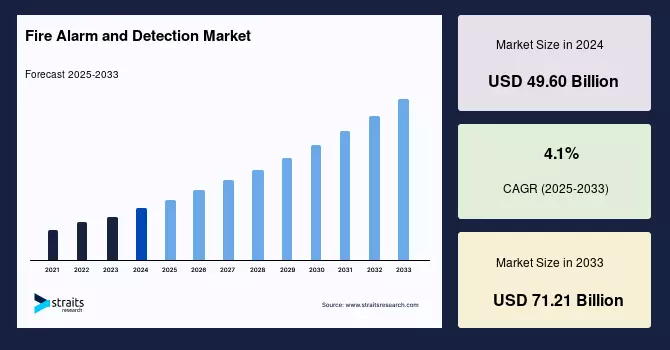
The global fire alarm and detection market was valued at USD 49.60 billion in 2024, is estimated at USD 51.63 billion in 2025, and is projected to reach USD 71.21 billion by 2033, registering a CAGR of 4.1% during the forecast period (2025–2033).
These figures reflect strong demand across both developed and emerging regions as safety compliance and infrastructure modernization gain momentum.
Key Market Drivers
1. Smart Infrastructure and Urbanization
The ongoing development of smart cities and modern infrastructure projects has fueled adoption of intelligent fire alarm and detection systems. Integrated solutions that connect with building management systems are increasingly in demand.
2. Stringent Fire Safety Regulations
Governments worldwide are enforcing stricter fire safety standards, compelling organizations to adopt certified and reliable fire detection equipment. This is particularly evident in commercial and high-density residential buildings.
3. Rising Awareness and Safety Culture
Growing public awareness of fire-related hazards has led to higher adoption of smoke detectors, alarm panels, and advanced monitoring devices across households and workplaces.
Market Segmentation
By Product Type
- Fire Detectors – including smoke, heat, and gas detectors, dominate the market due to widespread use in commercial and residential projects.
- Fire Alarm Systems – gaining traction as integrated solutions combining detection, alerting, and emergency response systems.
By Application
- Commercial – offices, hospitality, and retail remain the largest consumers, driven by strict compliance codes.
- Residential – growing adoption in apartments and housing societies, especially in urban regions.
- Industrial – heavy industries and manufacturing facilities are deploying advanced detection systems to protect assets and personnel.
Regional Insights
North America
Holds the largest market share, supported by advanced technology adoption, high safety awareness, and robust regulations.
Asia-Pacific
Emerging as the fastest-growing region, fueled by rapid urbanization, infrastructure investment, and government-led safety initiatives.
Europe
Maintains steady growth with well-established safety codes and early adoption of smart fire detection systems.
Leading Market Players
Prominent companies in the market include Honeywell International Inc., Siemens AG, Johnson Controls, Robert Bosch GmbH, Hochiki Corporation, and Gentex Corporation. These players are investing in innovation and expanding product portfolios to meet rising demand.
Challenges in the Market
- High Installation Costs: Advanced systems require significant upfront investment, which can be a barrier for smaller enterprises.
- Integration Issues: Legacy buildings may face challenges in integrating modern detection systems with existing infrastructure.
Opportunities Ahead
- IoT and AI Integration: Smart alarms with predictive monitoring capabilities present new opportunities.
- Emerging Markets: Developing countries with ongoing infrastructure projects offer high potential for future expansion.
Conclusion
With steady growth projected from USD 49.60 billion in 2024 to USD 71.21 billion by 2033, the fire alarm and detection market is poised for long-term expansion. North America leads in adoption, while Asia-Pacific emerges as the fastest-growing region.
For detailed insights, segment analysis, and competitive landscape, access the full report at Straits Research – Fire Alarm and Detection Market.