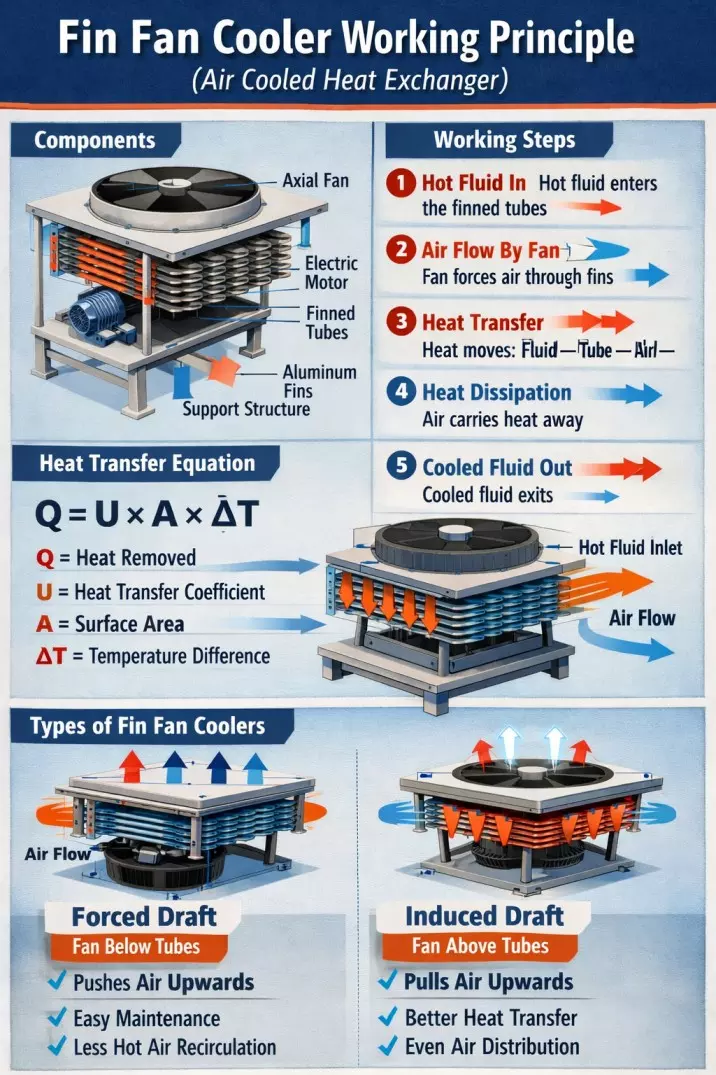
Fin Fan Cooler: Working Principle, Construction, and Applications
A Fin Fan Cooler, also known as an Air Cooled Heat Exchanger, is widely used in industries like power plants, chemical processing, petrochemicals, and refineries to cool process fluids or lubricating oils without using water. It uses air as the cooling medium and is highly efficient for continuous operation.
1. Construction of a Fin Fan Cooler
The main components include:
- Tube Bundle with Fins:
- Tubes carry the hot fluid, and fins are attached to the tubes to increase the surface area for heat transfer.
- Fans:
- Electric or steam-driven axial fans blow air across the finned tubes to remove heat from the fluid.
- Casing / Frame:
- The structure holds the tubes, fins, and fans securely in place.
- Inlet & Outlet Headers:
- The hot fluid enters through the inlet header, flows through the tubes, and exits through the outlet header at a lower temperature.
2. Working Principle of a Fin Fan Cooler
The Fin Fan Cooler operates on the principle of convection, transferring heat from the fluid to the air:
- Hot Fluid Flow:
- Process fluid (oil, water, or gas) enters the tube bundle through the inlet header.
- Heat Transfer to Tube Fins:
- Heat from the fluid is conducted through the tube walls and then to the fins, increasing the heat transfer surface area.
- Air Flow Over Fins:
- Fans blow ambient air across the fins and tubes. The moving air carries away heat through forced convection, cooling the fluid inside the tubes.
- Cooled Fluid Exit:
- The fluid exits from the outlet header at a lower temperature, ready for reuse in the system.
Read: Construction Cost Estimate
Formula for Heat Transfer:
Q=U⋅A⋅ΔTQ = U \cdot A \cdot \Delta TQ=U⋅A⋅ΔTWhere:
- QQQ = Heat removed (kW)
- UUU = Overall heat transfer coefficient (W/m²·K)
- AAA = Heat transfer surface area (m²)
- ΔT\Delta TΔT = Temperature difference between fluid and air (°C)
3. Key Features
- Air-Cooled: Does not require water, reducing maintenance and environmental concerns.
- Finned Tubes: Maximizes heat transfer efficiency.
- Fan Assisted: Ensures sufficient air flow for consistent cooling.
- High Efficiency: Capable of continuous operation at high temperatures.
4. Advantages
- Eliminates need for water, pumps, or cooling towers.
- Compact and modular design.
- Low operating cost compared to water-cooled systems.
- Suitable for remote or arid locations.
- Can operate under high-temperature and high-pressure conditions.
5. Applications
- Power Plants: Cooling lubricating oil, turbine oil, or water in closed loops.
- Petrochemical & Refinery Plants: Cooling process fluids and condensers.
- Marine Engines: Engine oil and jacket water cooling.
- Hydraulic Systems: Cooling hydraulic oil in presses, cranes, and heavy machinery.