Farm Management Software Market Set to Grow to USD 14.15 Billion by 2033
Introduction
Farm management software (FMS) is transforming agriculture by centralizing and optimizing farm operations—from scheduling to budgeting, crop planning to financial tracking. Today’s FMS platforms harness AI, machine learning, IoT, and cloud technologies to deliver real-time insights that boost productivity, profitability, and operational precision.
As global agriculture becomes more data-driven, FMS is becoming indispensable for medium to large commercial farms seeking efficiency and ROI.
Market Overview
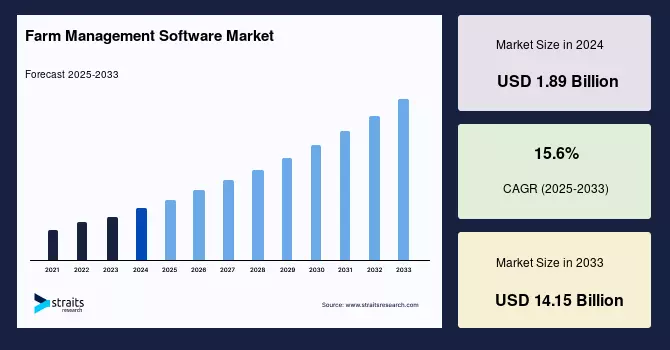
The farm management software market was valued at USD 1.89 billion in 2024. It is expected to rise to USD 2.27 billion in 2025, climbing robustly to USD 14.15 billion by 2033, with a projected CAGR of 15.6% from 2025 to 2033.
This impressive growth is catalyzed by expanding adoption of AI and machine learning for real-time data analytics, increasing government push toward precision agriculture, and the surging use of cloud-based SaaS platforms for seamless farm data management.
Market Drivers
AI & Real-Time Data Management
With the use of satellite imagery, GPS, field sensors, and analytics platforms, AI-enabled software is reshaping decision-making across crop cycles—improving planning, procurement, harvesting, and marketing based on real-time insights.
Government Initiatives & Cloud Adoption
Supportive policies promoting smart farming technologies and precision agriculture are accelerating FMS uptake. Cloud-based solutions further simplify cost structure, offering reduced infrastructure cost, scalability, and data accessibility wherever farming operations take place.
Challenges & Restraints
Technical Expertise Gaps
Many farmers lack the required training to effectively use advanced FMS tools. This lack of technical familiarity, especially among small-scale operators, limits adoption—though industry players and governments are increasingly providing education and implementation support.
Opportunities Ahead
Expanding Smart Farming Hardware
The proliferation of drones, soil and environmental sensors, and robotics integrated with FMS platforms provides new capabilities for monitoring and automating operations—especially in precision farming and greenhouse management.
Regional Insights
- North America dominates the space, depicted by widespread acceptance of precision agriculture and strong tech infrastructure, with a projected CAGR of 14.9%.
- Asia-Pacific is the fastest-growing region (forecast CAGR of 16.3%) thanks to growing agricultural modernization in countries like China and India.
Market Segmentation Highlights
- By Agriculture Type: Precision Farming is the largest contributor, commanding the market due to IoT-driven field analytics.
- By Deployment Model: Cloud-Based solutions lead and continue to grow fastest—thanks to affordability, scalability, and mobile access.
- By Service Type: Managed Services (outsourced support and data handling) are in highest demand, especially for drone data management and system integration.
Key Players
Leading companies shaping the global FMS landscape include:
- Deere & Company – Agricultural machinery giant offering integrated precision software.
- Trimble Inc. – Provider of GPS-enabled field management and analytics.
- AGRIVI (UK) – Cloud-native platform helping farmers plan, manage, and scale operations.
- Granular (Corteva) – Offers financial insights and agronomic data tools for profitability.
- Raven Industries – Focused on autonomous systems and sensor integration.
- Ag Leader Technology, Conservis, DeLaval, AgJunction Inc., CropX, AGCO, Corteva, Microsoft, Syngenta, Topcon Corporation, and IBM also significantly contribute with diverse software offerings tailored to farm planning, livestock, greenhouse control, and irrigation automation.
REQUEST SAMPLE: https://straitsresearch.com/report/farm-management-software-market/request-sample
Conclusion
From USD 1.89 billion in 2024 to a projected USD 14.15 billion by 2033, the farm management software industry is on an aggressive growth path (CAGR: 15.6%). The convergence of AI, cloud platforms, and supportive policies is propelling digital adoption in agriculture. As both developed and emerging markets embrace smart farming, FMS will continue to be a cornerstone of agricultural transformation—enhancing productivity, sustainability, and profitability farm-wide.