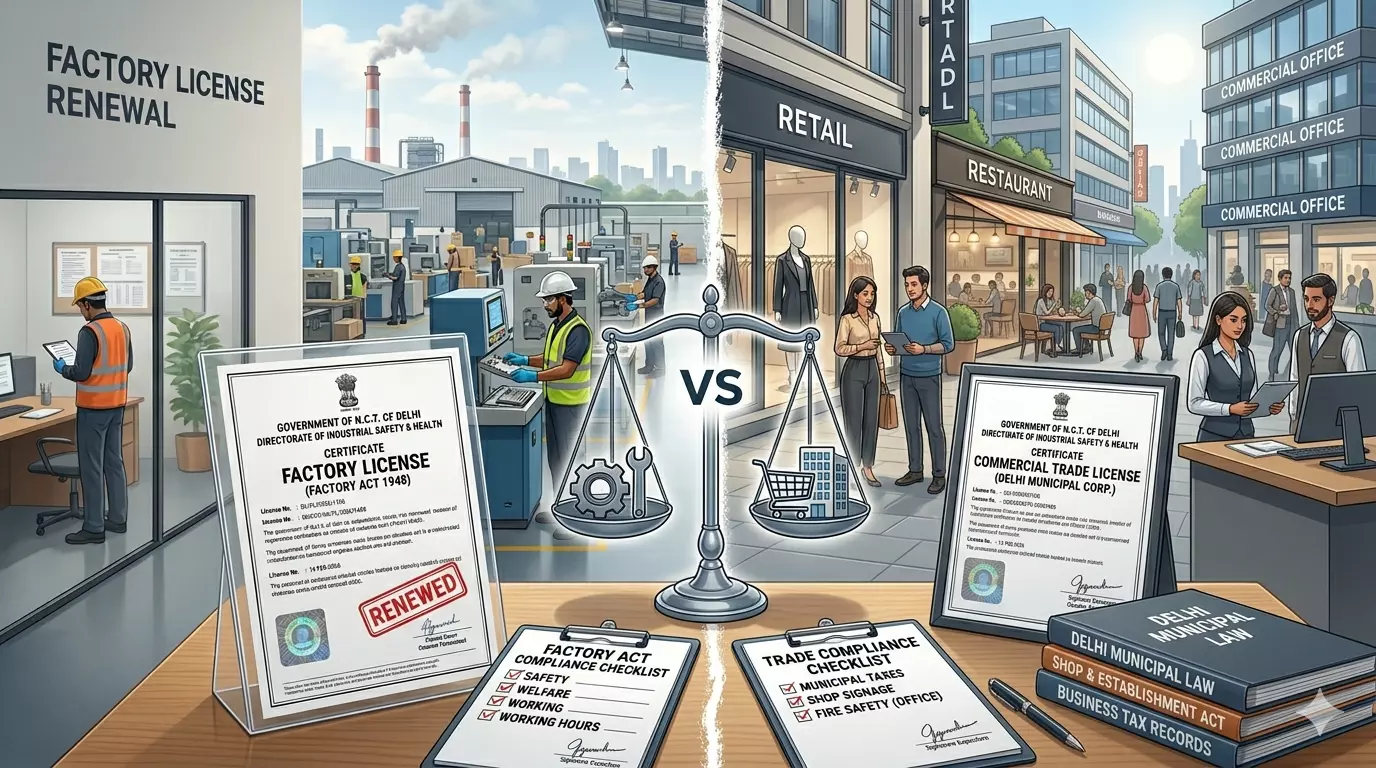
Factory License vs Trade License: What’s the Difference and Which One Does Your Business Need?
Many new entrepreneurs who are starting a manufacturing or industrial business often incorrectly assume that having just one business license is sufficient for legal operation. However, depending on the type of business you are conducting, different licenses from varying governmental bodies may be mandated.
Often the confusion centers on the distinction between two distinct types of permits; namely, the Factory License and Trade License.
Both are crucial, but the function and justification for each lie within different areas of the law.
If you are planning to start a manufacturing unit, it is also important to understand how a factory license in delhi differs from other approvals required for commercial operations.
You should understand what divides them if you're planning to begin any kind of manufacturing unit, warehouse, processing facility, industrial workshop, etc.
The Importance of Understanding Your Business Licenses
Before jumping through hoops, renting space, or even purchasing equipment and personnel, it’s important that you know which licenses and other legal approvals apply to you.
In many cases, entrepreneurs find out about these requirements only after receiving the notice for violation of applicable rules and regulations, or encountering delays due to the lack of properly acquired permits.
Obtaining appropriate licensing prior to commencement of the business operation simplifies various matters in the long run.
What is a Factory License?
- A license known as a factory license is issued to enterprises whose manufacturing operations fall under relevant factory laws and regulations.
- The purpose of this approval is to ensure compliance with workplace standards, machinery safety requirements, employee welfare provisions, and industrial hygiene norms.
- Businesses applying for a factory license renewal in delhi must comply with all applicable legal and safety requirements before commencing production activities.
- If your manufacturing business involves employment of labor or machinery, then acquiring a Factory License before commencing production operations will be absolutely vital.
Who Requires a Factory License?
- Manufacturing units of various kinds
- Processing facilities
- Packaging units
- Workshops
- Large-scale fabrication units
- Industrial production houses
Manufacturing owners need to obtain this license to conduct industrial activities legally.
Businesses operating under an mcd factory license must also ensure compliance with local authority requirements in addition to factory regulations.
What is a Trade License?
Typically issued by local municipal bodies and agencies, a trade license signifies a permit allowing an entity to operate in a certain geographical region in a variety of trade or business activities.
The objective behind the grant of trade licenses is basically ensuring public health, safety, and security while regulating commercial activities.
The municipal council, as the primary governing body, usually grants the license, which regulates and permits specified trades to operate at specified places.
Who Requires a Trade License?
- Retail shops
- Restaurant businesses
- Commercial establishments
- Service providers
- Warehouses
- Local businesses operating within municipal limits
The requirement for a trade license depends upon the nature and locality of the business.
Key Differences Between Factory License and Trade License
Purpose
A factory license serves to maintain the safe and hygienic operations of an industrial manufacturing business, while a trade license gives formal permission to conduct business activities within a local jurisdiction.
Businesses holding a factory license mcd approval must focus on industrial compliance, whereas trade license holders primarily follow municipal operating requirements.
Who Issues the License?
Typically, departments regulating industry and labor administer factory licenses.
Municipal corporations are usually responsible for the issuance of trade licenses.
Scope
Factory licenses mainly pertain to worker safety and industrial management, while trade licenses focus on public health and safety aspects of business operations.
Compliance
Obtaining a factory license involves approvals relating to machinery safety, worker welfare, and industrial standards.
For businesses operating under an mcd factory licence, compliance with local authority guidelines may also be required.
Can Your Business Need Both Licenses?
YES, in many cases both licenses may be required.
For example, if a business has a factory along with administrative offices and commercial activities within municipal limits, both licenses may be necessary.
Businesses running manufacturing units under an mcd factory license often require additional approvals depending on the nature of operations.
Common Mistakes by Business Owners
1. Assuming One License Will Do Everything
As the above differences prove, two entirely different aspects are handled by Factory Licenses and Trade Licenses.
Many entrepreneurs overlook one approval and later face regulatory issues.
2. Delayed Application Process
Many businessmen begin operations without obtaining the necessary licenses, resulting in penalties or business interruptions.
3. Ignoring Renewals
Licenses have validity periods and require renewal.
Business owners frequently search for factory license renewal delhi procedures to ensure they remain compliant.
Failing to renew can make a license invalid and create legal complications.
4. Not Seeking Professional Advice
Regulations differ based on business structure, activity type, and location.
This is particularly important for businesses operating under an mcd factory licence, where requirements may vary according to industrial category and municipal guidelines.
Read: How to Choose the Right Factory for Rent in Jaipur
What Would Be the Requirements of Licenses?
Here’s what you must answer about your venture:
- Do you plan to set up any manufacturing activity?
- Will machinery be part of your work?
- Is there a need to employ factory workers?
- Is your facility inside the municipality?
- Is there a need for commercial permission from the city or municipal council?
Based on the responses, you could figure out the licenses you need.
Benefits of Getting the Proper License
The right license can provide multiple benefits, including:
- Adhering to regulatory requirements
- Avoiding penalties
- Establishing business credibility
- Ensuring smoother operations
- Expanding business opportunities
- Building customer trust
Additionally, businesses should remain informed about factory license renewal fees and applicable mcd factory licence fees to avoid unexpected compliance costs in the future.
The Bottom Line
The fundamental role of a Factory License is to keep the workplace in a manufacturing unit secure for workers, machinery, and the surrounding environment.
A Trade License regulates commercial activities conducted within local municipal jurisdictions.
Whether you are applying for a factory license in delhi, managing an mcd factory license, operating under a factory license mcd framework, or preparing for factory license renewal delhi, understanding the correct licensing requirements is essential.
Taking proper guidance before beginning any entrepreneurial activity can prevent unnecessary penalties, operational hurdles, and legal conflicts. It is always advisable to identify the licenses you require, stay updated regarding factory license renewal fees and mcd factory licence fees, and complete the application process correctly from the outset.