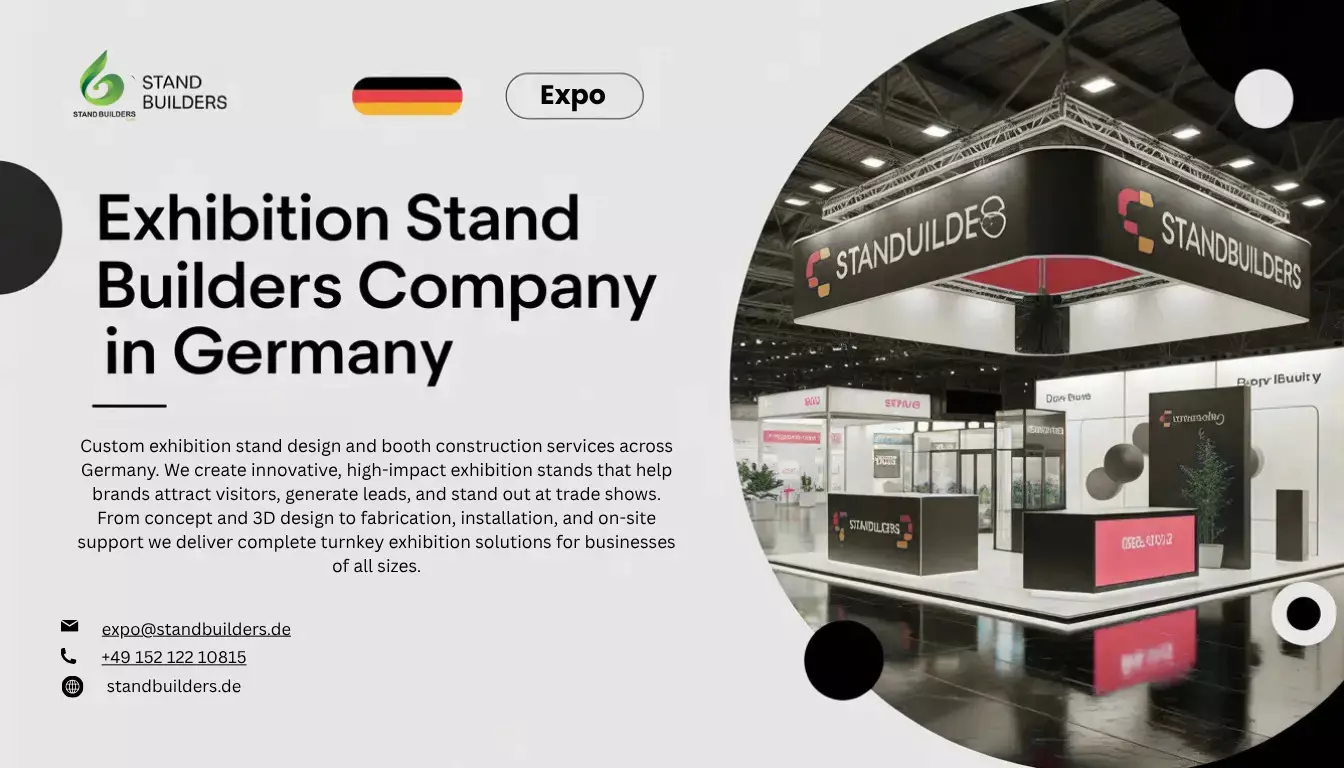
Exhibition Stand Builders Company in Germany: Planning for Impact
The trade fair sector in Germany still offers an important platform for firms in a range of fields such as manufacturing, technology, healthcare, automotive, engineering, retail, and others.
International exhibitors are drawn to the major exhibition cities, where they use the events to launch new products, establish partnerships, meet customers, and gain an understanding of evolving market expectations.
For any business that is planning to take part, the exhibition stand stands for far more than just a portion of floor space; it becomes the physical environment in which visitors first meet the company, investigate its products, and decide if a conversation is worthwhile.
Exhibition Stands Builders in Germany can help turn a first idea into a working exhibition environment; but achievable results are largely determined by the decisions taken before design and construction start.
Establishing clear objectives, understanding the audience, preparing a realistic budget, and making detailed logistical plans form a more solid basis for the whole project.
Understanding the Purpose of a Trade Fair Stand
Since every exhibition stand has a different purpose, a technology company might use its space to demonstrate its products, whereas an engineering manufacturer could require room for its machinery or technical models and a professional services company would place a stronger emphasis on meetings and networking.
It should be the case that the physical environment reflects these differences.
When visitor conversations are the main concern, having too many products on display can decrease the amount of space available for meetings.
However, if product demonstrations are a key part of the event strategy, the stand should have enough room for visitors to gather without obstructing the flow.
By establishing the purpose at the beginning, design decisions can be kept in line with the company's real exhibition objectives.
Researching the Exhibition Before Designing the Stand
Understanding the Audience
Expectations of visitors can differ a great deal from one industry to another. Prior to coming up with a stand concept, companies can look into the kinds of professionals who will be attending the event and the questions they are likely to ask.
People with a technical background might place a high value on demonstrations, specifications, and expert discussions, while those interested in business aspects are more likely to respond to clear and direct messaging, case studies, and specific meeting areas.
Studying the Venue
The features of the venue can have an effect on almost every physical decision; for example, the size of the hall, the position of the stands, the height of the ceiling, the access routes, the electrical connections, the installation timetable, the fire regulations and the rigging limitations all influence what can be done.
Looking at the documentation for the venue early on decreases the chance of having to make redesigns later in the process.
Building an Effective Exhibition Stand Architecture
The way a stand appears is determined by its architecture and also affects how visitors experience it.
Open plans can make a space seem welcoming and at the same time keep the products visible from the adjacent aisles, while partial walls offer the possibility of incorporating branding without fully enclosing the area.
Visual hierarchy can also be achieved by using different heights, but when it comes to tall structures they should be planned taking into account the venue regulations and those of the neighbouring stands.
Storage should, where possible, be incorporated into the design, with use being made of hidden cabinets, the rear walls, the counters, and specific utility areas in order to keep packaging and personal items out of areas that are accessible to visitors.
Exhibition Stand Design in Germany: Balancing Style and Function
Designing an exhibition stand in Germany entails more than just coming up with an attractive visual concept; the design also has to be suitable for use in actual exhibition conditions.
The lighting, graphics, furniture, product placement, digital displays, and the paths for visitors should all complement each other.
For instance, a product situated in a dimly lit corner will get less notice even if it is important. In the same way, a big meeting table placed close to the entrance can hinder movement and make the stand seem less accessible.
Instead of merely looking at how the display appears in an empty exhibition hall, a practical design takes into account what occurs during busy periods.
Creating a Strong Visitor Experience
People usually form their first impression of a company within a matter of seconds, and good branding will enable them to spot the company at once, while a brief message can make it clear what the company does.
When people have entered the site, the experience ought to become more informative.
Product demonstrations, interactive exhibits, samples, presentations, and talks with staff can offer information that becomes deeper and deeper as you go along. Ideally, the stand should let visitors take part at various levels according to how much time they have.
Someone who has only two minutes might need a brief summary, whereas a potential customer with thirty minutes would need a thorough demonstration and a private conversation.
Planning the exhibition environment to accommodate these various visitor journeys can make it more versatile.
Read: Exhibiting in Dresden? How to Build an Exhibition Stand
Technology Should Support Communication
Digital technology has the ability to change the way in which complex products are presented, since interactive screens, virtual demonstrations, LED displays, touch interfaces, and product visualization tools can be used to convey information that would otherwise have to be given in printed form.
Technology ought to be chosen on the basis of its purpose.
A manufacturing company could show off machinery that is too large to bring to an exhibition by using a digital model.
A software business could offer an interactive demonstration of its product. A medical technology company might use visualization to explain a complicated procedure.
In all the cases referred to, it is the technology that makes a contribution since it overcomes a communication challenge.
Budgeting Beyond Construction
The budgets for exhibitions often end up more complicated than expected since there are various costs that lie outside the actual production of the stand.
Businesses might have to take into account the space occupied by the floor, the cost of construction, that of the graphics, that of the furniture, the lighting, the electrical services, transportation, installation, dismantling, storage, the internet, cleaning, and other services relating to the venue.
The budget should therefore be based on the whole exhibition project not on the individual stand.
Businesses can also think about long-term value. Reusable parts, modular setups, flexible graphics, and sturdy furniture may work well for companies that go to several events.
Working With Exhibition Stand Builders in Germany
People who are looking into companies that build exhibition stands in Germany may come across a variety of degrees of project support.
Although some of these companies mainly concentrate on fabrication, others carry out design, production, graphics, logistics, installation, and dismantling as well.
A German exhibition stand contractor can be especially relevant when it comes to projects which involve detailed technical coordination, as he or she is able to turn a creative idea into a structure that satisfies the requirements concerning the venue and safety.
International businesses can also find local knowledge useful when dealing with installation schedules and venue procedures.
When companies that take part in a number of exhibitions in Europe wish to keep a consistent visual identity in various markets, they might consider using exhibition stand builders in Europe.
Similarly, companies looking for builders of exhibition stands in Germany should check whether the provider understands the particular requirements of the venue and the exhibition.
Operational Challenges That Should Be Planned Early
A very common problem is not having enough time since design approval, the technical drawings, production, the graphics, transportation, and installation all have to be coordinated.
A problem is also the availability of staff; even if the stand is well designed it will still perform badly if visitors have difficulty in finding knowledgeable representatives.
Storage is often underrated. When an exhibition is busy, brochures, packaging, personal items, samples, and equipment can very quickly take up a lot of the space that is available to visitors.
Sorting out these details beforehand ensures that a professional and functional atmosphere is kept throughout the event.
Measuring Value After the Exhibition
The process of running the exhibition does not come to an end once the stand has been taken down, and post-event analysis can be used to find out if the investment resulted in meaningful outcomes.
Businesses have the possibility of looking over visitor enquiries, meetings, product demonstrations, customer feedback, new contacts, and recurring questions. Insights gained in this way can affect both future marketing activities and the design of future stands.
For instance, if visitors kept on having difficulty in understanding a certain product, the following exhibition could make use of a simpler demonstration or clearer graphics.
A feedback loop is thus formed in which the information obtained from each exhibition is used to improve the next one.
Conclusion
A good presence at an exhibition in Germany has to be established well in advance of visitors entering the hall.
Factors such as an understanding of the audience, the setting of objectives, a study of the venue's requirements, the planning of visitor flow, cost management and the coordination of logistics all help to ensure that the stand is a success.
The physical design should be such that it promotes communication instead of making it stand out.
Through the use of clear branding, functional architecture, useful technology, suitable meeting areas, and practical storage, a more effective visitor experience can be achieved.
Exhibition Stand Builders Company in Germany which builds exhibition stands can offer assistance in the areas of design, construction, logistics, installation and dismantling.
If this professional knowledge is coupled with careful planning and specific objectives, then the exhibition stand can turn into a practical business environment rather than merely serving as a temporary display.
Frequently Asked Questions
What significance does the position of an exhibition stand have?
The location can have an effect on the number of visitors and on visibility; stands situated near the main entrances, next to popular attractions, or in busy corridors will show different movement patterns from those placed further inside the hall.
What makes an exhibition stand visitor-friendly?
A stand can be easier and more pleasant to navigate if it has clear branding, open access, logical pathways, comfortable meeting areas, well-organized product displays, appropriate lighting, and enough space.
What steps can companies take in order to prepare for exhibition logistics?
It is advisable to plan ahead for transportation, packaging, the delivery schedule, access for installation, storage, the electrical needs, and dismantling before the event takes place.
Should exhibition stands have private meeting areas?
It is useful to have private meeting rooms when the subject of the discussion is something confidential, when detailed negotiations are taking place, or when long consultations are required. The quantity of meeting space needed will depend on the aim of the exhibition.
How is an exhibitor able to determine if a trade fair has been a success?
Businesses have the possibility of looking over qualified enquiries, meetings, new contacts, demonstrations, customer feedback, and other predefined objectives. A more meaningful evaluation can be obtained by comparing the results with the original goals than by relying solely on visitor numbers.