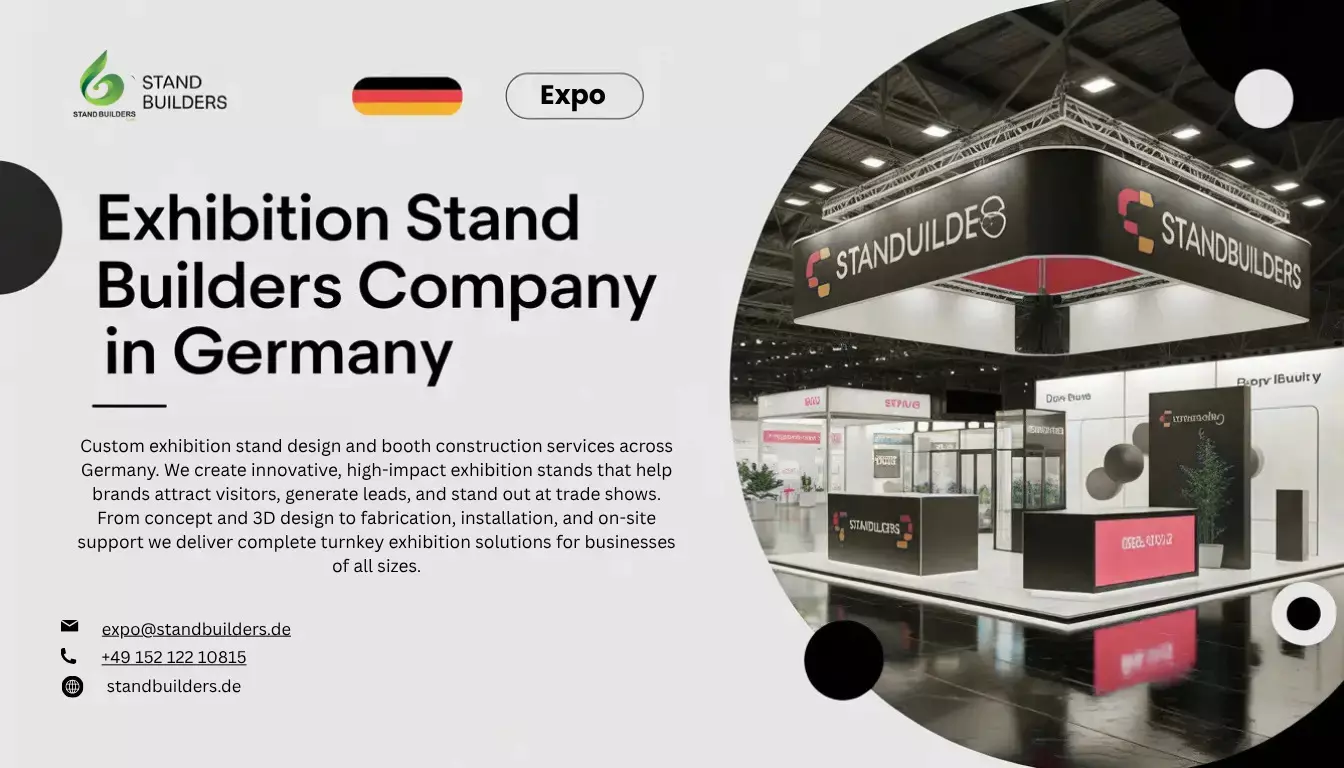
Exhibition Stand Builders Company in Germany | Complete Guide
Germany has for a long time been one of Europe's most important destinations for international trade shows, business events and industry exhibitions.
Whether it be in the fields of automotive and engineering or in healthcare, technology, retail and manufacturing, exhibition sites in Germany draw companies and professional visitors from all over the world.
For brands that are entering this competitive market, taking part requires much more than just reserving space on the floor. All aspects involving careful planning, a well-thought-out stand design, budgeting, logistics and engaging visitors have an effect on the overall exhibition experience.
A business in Germany which is engaged in the construction of exhibition stands can take part in the planning process if it needs professional assistance with design, construction, installation and dismantling.
Yet, only by first understanding the exhibition environment can companies make more informed decisions regarding their stand requirements.
Understanding the Exhibition Industry in Germany
Germany hosts some of the most well-known trade fairs in the world, Frankfurt, Düsseldorf, Munich, Berlin, Cologne, Hannover, and Nuremberg being among the main exhibition cities.
Events in fields such as technology, industrial manufacturing, medicine, the automotive industry, retail, and consumer goods bring together established companies, new businesses, suppliers, investors, and experts in the industry.
The variety present makes German exhibitions especially useful for businesses that sell to other businesses. Having a properly organised presence at an exhibition offers the chance to carry out networking, give demonstrations of products, conduct market research, have discussions about possible partnerships, and enter into direct conversations with potential customers.
Because these events are competitive, exhibition stands are becoming more and more strategic; rather than just showing products, modern stands often serve as places for meetings, areas for demonstrations, brand environments, and temporary centres for communication.
Because of this, the exhibition stand builders in Germany nowadays base their work on business objectives rather than viewing the construction of stands as a separate activity.
Key Factors to Consider Before Participating
Successful exhibition planning usually starts several months in advance of the event. The first thing to consider is the reason for attending.
For example, a company which is attending an exhibition in order to launch a product will need a quite different kind of environment from one that is mainly concerned with networking or generating business leads.
Another point to take into account is the amount of exhibition space available. The final design can be affected by such factors as the size of the stands, their position, ceiling limitations, the other exhibitors nearby, the access points, the storage needed, and the rules of the venue.
The layout should also take into account the target audience; for example, a technology company showing off complicated equipment will need separate demonstration areas, whereas a consulting business will get more benefit from having comfortable meeting rooms and private rooms for discussion.
Exhibitors should also take into account the practical requirements including electricity, lighting, internet connectivity, audiovisual equipment, storage for products, furniture, graphics, hospitality facilities, and accessibility.
Because of early planning, the stand builders in Germany are able to coordinate these requirements and at the same time reduce the chance of last-minute changes.
Types of Exhibition Stand Designs
Exhibition stand design has changed a great deal; although traditional modular systems are still useful for companies taking part in a number of events, custom-built stands are generally regarded as the option when a brand needs a special environment.
Custom Exhibition Stands
Custom stands are created in accordance with a company's particular objectives, its branding, its products, and the space available. They may include architectural features, hanging elements, product displays, meeting rooms, hospitality areas, and interactive technologies.
Modular Exhibition Stands
Modular systems make use of components that can be adapted so as to suit different sizes and positions of booths; they are suitable for businesses taking part in a number of exhibitions since some of the parts may be reused or modified.
Minimalist Stand Designs
Minimalist exhibition settings prioritize clarity over visual complexity. By using simple architectural lines, maintaining consistent branding, providing open spaces, and choosing graphics carefully, an elegant look can be achieved without diverting attention from the products or services.
Interactive and Technology-Driven Stands
Digital screens, touch displays, augmented reality, product simulations, and interactive demonstrations are now being used more and more in exhibition settings. Technology is most effective when it supports the visitor's experience rather than just providing visual effects.
The same principles apply when one is comparing exhibition stand builders in Europe since design expectations can differ from country to country, between venues, among industries, and from one particular trade fair to another.
Read: Complete Guide to Exhibition Stand Builders in Germany
What makes an exhibition stand design in Germany effective?
In Germany exhibition stand design places a great deal of importance on functionality, precision, brand consistency and the flow of visitors. Although a visually appealing booth is useful, its practical performance is equally important.
A good layout must at once show what the company stands for, with the branding being visible but not overpowering the area, and the key messages still being readable from the usual routes taken by visitors.
Open plan arrangements can lead visitors to go in spontaneously, while enclosed meeting rooms can offer privacy for important business discussions. When giving product demonstrations there should be sufficient space for visitors to gather without obstructing the flow.
Lighting is also a crucial aspect of design; when it is correctly placed it can emphasize products, architectural details, graphics, or reception areas, whereas inadequate lighting can cause an even sophisticated stand to look flat or hard to navigate.
Budget and Cost Considerations
The cost of the exhibition goes far beyond the actual building of the stand. The total budget can cover floor space, stand design, construction, graphics, furniture, lighting, audiovisual equipment, transportation, installation, dismantling, storage, staffing, accommodation, promotional materials, and venue-related services.
The larger and more complicated the stand is, the greater its construction costs will be; a simple modular booth usually involves a different level of investment than a large specially built environment which includes meeting rooms, hanging signage, extensive lighting, digital installations, and high-end finishes.
Geographical considerations can also have an effect on logistics; for example, a company taking part in an event in Düsseldorf will have different transportation or accommodation needs than one that is taking part in an event in Munich or Berlin.
Budget planning is therefore most effective when companies set their priorities as early as possible.
For instance, a brand that focuses on products might assign greater resources to demonstration technology, while one that concentrates on executive meetings would prioritise private meeting facilities and hospitality.
Common Exhibition Mistakes to Avoid
A frequent error is to begin the design process at a late stage. If the time available for preparation is limited, it will decrease the flexibility of the design and lead to greater logistical pressure.
A further problem is that there is too much visual clutter. If every product, service, message, and corporate detail is attempted to be displayed, the stand becomes difficult to understand. Since exhibition visitors generally have only a limited amount of time, it is necessary for the main message to be clear.
Failing to take visitor flow into account can lead to another issue. A structure which is visually striking might still have poor performance if the reception areas, the demonstration spaces, the storage areas and the meeting rooms affect one another.
Some exhibitors also fail to take into account the amount of storage space needed. Practical storage solutions are necessary for packaging, promotional materials, personal items, and operational equipment, and such solutions must not interfere with the environment facing the visitors.
A stand should not be designed in a way that is separate from the overall marketing strategy since the graphics, the messaging, the digital content, the brochures, the communication within the staff, and the follow-up activities all need to provide a consistent brand experience.
When Businesses Consider Exhibition Stand Professionals
For smaller exhibitions businesses can look after the more basic booth needs on their own, but with larger international events there are often complicated venue regulations, technical requirements, construction schedules, logistics, and installation procedures.
An exhibition stand contractor in Germany might then be a practical option, professional teams being able to handle such matters as design development, production, graphics, construction, installation, and compliance with the venue requirements.
Companies looking for builders of Expo Stands in Germany might assess the providers according to their experience with specific venues, particular industries, construction capabilities, project management procedures, and their ability to coordinate various suppliers.
The choice isn't solely based on the size of the stand; a smaller booth, for example, which has special technology or particular requirements regarding the venue, will still need a great deal of professional coordination, whereas a larger modular stand will generally have a simpler setup.
Conclusion
To take part in a fair in Germany one has to do much more than simply have an attractive booth; successful involvement relies on an understanding of the event's audience, on choosing the correct stand format, on planning the movement of visitors, on controlling costs, on fulfilling the venue's requirements, and on linking the physical design with wider business goals.
The exhibition environment should be designed in such a way that it promotes communication rather than just taking up floor space.
In the case of complicated projects, working with a exhibition stand building company in Germany can form a sensible aspect of the planning process, especially since local expertise is needed for construction, logistics, installation, and coordination at the venue.
In the end, making informed decisions and giving proper early preparation lay the foundation for a more organised, functional, and memorable exhibition presence.
FAQs
What makes Germany significant for international exhibitions?
Germany hosts a large number of major trade fairs which include industries such as manufacturing, automotive, technology, healthcare, retail, engineering, and consumer products; international exhibitors, buyers, professionals and decision-makers attend these exhibitions.
When should the planning of an exhibition stand take place?
It is generally advisable to plan several months in advance, especially when it comes to custom stands; extra time might be needed for design approval, production, logistics, complying with venue regulations, the graphics, and installation.
What kind of exhibition stand would be appropriate for a business?
What format to use will depend on the company's aims, the amount of space available, its budget, brand requirements, the product demonstrations and the kind of interaction that is expected from visitors. Designs that are custom, modular, minimalist, and technology-focused can all have different purposes.
What are the factors which have an influence on the cost of exhibition stands in Germany?
The total cost can be affected by factors such as stand size, the materials used in the construction, the complexity of the design, the graphics, the lighting, the furniture, the technology, transportation, installation, dismantling, storage, and venue-related services.
At what point should a company think about having professional support for its exhibition stand?
It is useful to have professional support in the case of a project which involves custom construction, has complex technical requirements, covers large exhibition spaces, has a tight installation schedule, or requires coordination with German exhibition venues and local suppliers.