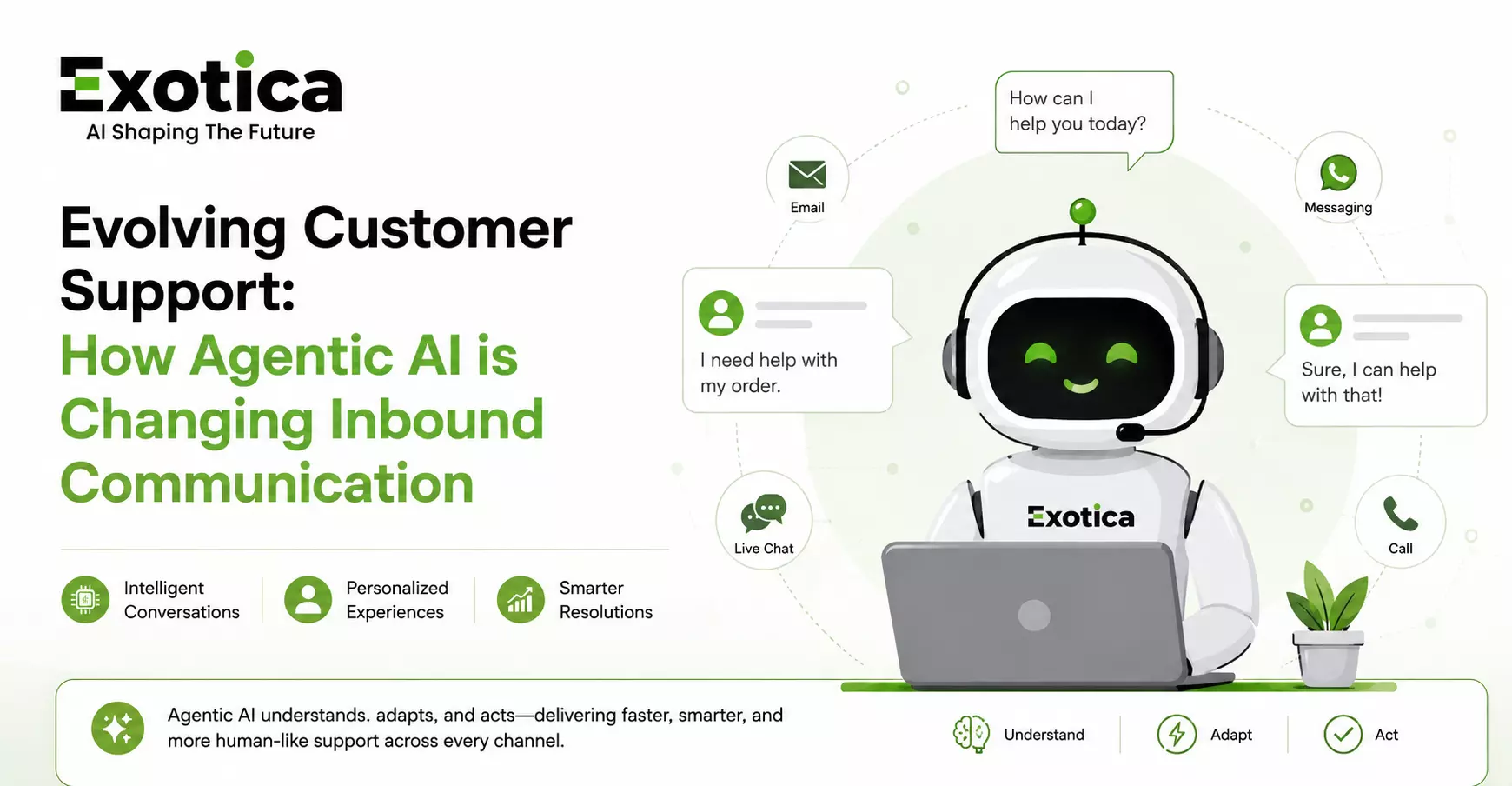
Evolving Customer Support: How Agentic AI is Changing Inbound Communication
For years, the promise of automated customer service felt like a bait-and-switch. Businesses were sold on the idea of seamless automation, while customers were subjected to frustrating phone trees and robotic voices that rarely understood nuance.
If a caller had a simple question like, "What are your business hours?" the system worked. If they had a complex issue—like rescheduling a partially completed service appointment while updating their billing address—the system broke down, leading to the dreaded "representative... representative!" shouting match.
However, the technology underpinning automated communication has fundamentally shifted. We are no longer dealing with basic, rigid decision-tree chatbots.
The rapid integration of Large Language Models (LLMs) and voice synthesis has ushered in the era of "agentic AI." These systems don't just read scripts; they perceive context, execute multi-step workflows, and dynamically adapt to the caller's intent.
For growing businesses, particularly those operating in highly competitive metropolitan markets, upgrading how inbound inquiries are handled is no longer just an operational efficiency—it is a critical requirement for maintaining brand trust.
Beyond the Basic Chatbot: The Era of Agentic Voice AI
To understand why modern voice AI actually works, you have to look at the architecture. Legacy interactive voice response (IVR) systems operated passively.
They waited for a specific keyword or a keypad press, and if the user strayed from the programmed path, the system failed.
Agentic AI represents a paradigm shift. Unlike reactive systems, agentic AI actively employs reasoning and dynamic tool use to interact with complex environments.
When a customer calls, the AI can cross-reference CRM data in real-time, generate conversational responses, and execute actions across different software platforms simultaneously.
What Makes Agentic Voice Different?
- Contextual Memory: Modern voice agents remember what was said two minutes ago in the conversation. If a caller says, "Actually, let's go back to Tuesday instead of Thursday," the system understands the reference without needing the caller to restate the entire request.
- Interruption Handling: Real human conversation is messy. We pause, we interrupt, and we change our minds mid-sentence. High-end generative systems can process interruptions naturally, stopping their speech when the caller interjects, rather than talking over them.
- Workflow Execution: Instead of just providing information, the AI can do things. It can securely process payments, update account details, book calendar slots, and send confirmation emails before the call even ends.
The Business Case: Managing High Volume with Empathy
A common concern among business owners is that deploying AI on the phones will alienate customers who want to speak to a real person. However, recent consumer behavior reports indicate a shift in expectations.
According to a 2026 Capgemini report on consumer trends, while shoppers still highly value human support for complex emotional or high-stakes interactions, they prioritize efficiency above all else for routine tasks.
Consumers do not want to wait on hold for twenty minutes just to confirm an appointment or check inventory. They want their problem solved immediately.
This is where regional specialization comes into play. For instance, a dental clinic or an HVAC company operating in a dense urban environment receives hundreds of routine inquiries weekly.
Missing these calls means missing revenue. Implementing an AI calling agent Toronto businesses use for their front-line dispatch allows companies to capture every lead, 24 hours a day, without expanding their administrative payroll.
When the AI handles the routine traffic—the scheduling, the basic triage, the FAQ responses—your human staff is freed up to handle the high-value interactions.
They can spend their time closing complex sales, handling sensitive customer complaints, or building relationships, which is exactly where human empathy is indispensable.
Use Cases That Actually Move the Needle
Not all industries need the same type of voice automation. The most successful deployments are tailored strictly to the operational bottlenecks of the specific business.
1. The Healthcare and Clinic Sector
Medical and dental offices struggle with high morning call volumes. Patients call to cancel, reschedule, or ask about pre-appointment protocols.
A voice agent can securely verify the patient's identity, access the practice management software, and adjust the schedule.
Crucially, modern systems can be designed to comply strictly with health data privacy regulations, ensuring that personal health information is not stored inappropriately.
2. Home Services and Trades
For plumbers, electricians, and HVAC technicians, missing a call often means the customer will simply dial the next company on Google. Generative voice agents can act as 24/7 dispatchers.
They can take down the caller's details, assess the urgency of the problem, provide a rough estimate based on company pricing guidelines, and instantly text the details to the technician on call.
3. E-commerce and Retail Support
E-commerce businesses frequently deal with "Where is my order?" inquiries. By integrating the voice agent with the shipping API, the AI can instantly verify the tracking status and verbally relay the exact location of the package.
If a refund is requested, the agent can initiate the RMA process and email the return label automatically.
The New Consumer Expectation: Efficiency and Control
As businesses integrate these systems, it is vital to maintain a philosophy of transparency and control.
The goal of generative AI voice agents is not to trick the customer into thinking they are speaking to a human. Attempting to deceive callers usually backfires, leading to frustration and eroded trust.
Instead, best practices dictate that the AI should introduce itself clearly: "Hi, I'm the virtual assistant for [Company Name]. I can help you book an appointment, check a status, or connect you to our team. How can I help you today?"
By setting the expectation upfront, the caller understands the parameters of the interaction. Furthermore, a seamless escape hatch must always be available.
If the AI detects frustration in the caller's voice tone, or if the caller simply says, "I need to speak to a person," the system must route the call to a human representative instantly, passing along the transcript of the conversation so the human agent doesn't have to ask the customer to repeat themselves.
Read: AI Voice Agent Development Company: Transforming
Getting Started: Implementation Without Alienating Customers
Deploying AI on your phone lines shouldn't be an overnight, flip-the-switch process. It requires strategic planning to ensure it actually improves the customer experience rather than hindering it.
Here is a recommended approach for rolling out customer support automation:
- Start with After-Hours: The lowest-risk environment to test an AI voice agent is after your office has closed. Instead of sending callers to a static voicemail box, let the AI answer. It can capture leads, book next-day appointments, and answer basic questions. This allows you to review the call transcripts and refine the AI's instructions based on real customer interactions.
- Map Your Knowledge Base: The AI is only as smart as the data you feed it. Before deployment, you must build a comprehensive knowledge base. This isn't just your website FAQ; it should include your pricing structures, service areas, cancellation policies, and brand tone guidelines.
- Define the Guardrails: Decide exactly what the AI cannot do. For example, you may allow the AI to book initial consultations, but forbid it from negotiating prices or discussing sensitive legal matters. When a conversation hits a guardrail, the AI should be programmed to gracefully take a message for human follow-up.
- Monitor and Tweak: Treat your voice agent like a new employee. In the first few weeks, review the call logs daily. You will likely find phrasing or edge-case questions you didn't anticipate. Because agentic AI is highly adaptable, you can simply update its system prompt to handle that specific scenario better next time.
Looking Ahead
The transition from manual call answering to AI-driven workflows is happening faster than previous technological shifts.
The businesses that thrive will be those that view AI not as a way to replace human interaction, but as a tool to protect human bandwidth.
By delegating the repetitive, high-volume tasks to a capable system, you give your team the time and energy to provide the high-touch, empathetic service that truly builds loyalty.
We are moving past the era of frustrating phone trees. The new standard is immediate, intelligent, and useful conversation—regardless of what time the customer decides to dial.