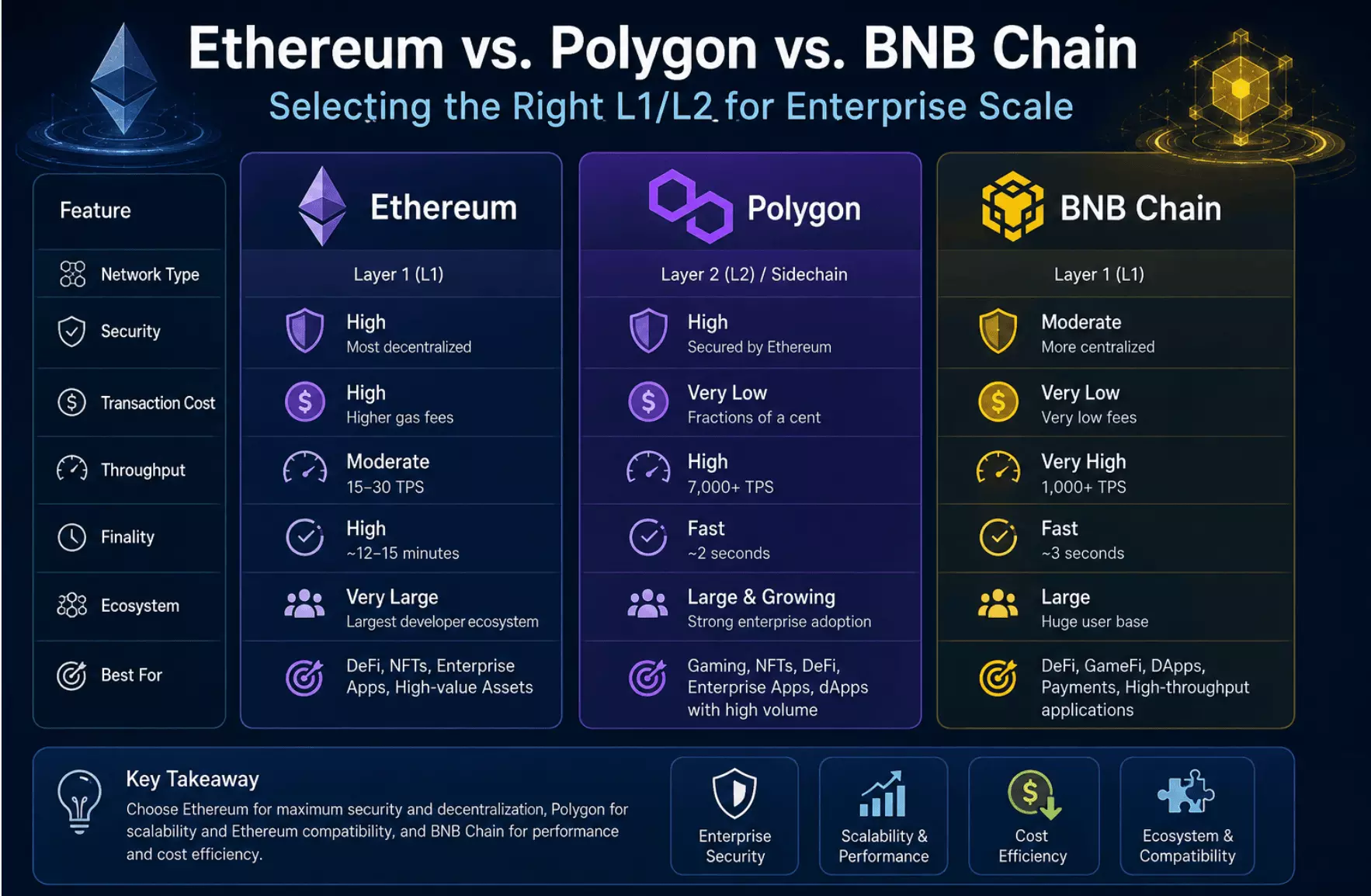
Ethereum vs. Polygon vs. BNB Chain: Selecting the Right L1/L2 for Enterprise Scale
Enterprise blockchain adoption has moved far beyond experimentation. Organizations are now building production-grade decentralized applications, tokenized asset platforms,
digital identity systems, supply-chain networks, and Web3 customer engagement ecosystems. As these initiatives scale, one critical architectural question emerges:
Should you build on Ethereum, Polygon, or BNB Chain?
The answer is not simply about transaction fees or network speed. Enterprise-scale systems require a careful balance of security, decentralization, compliance readiness, developer tooling, scalability, interoperability, and long-term ecosystem stability.
In this in-depth guide, we compare Ethereum, Polygon, and BNB Chain from an enterprise perspective and provide a practical framework for selecting the right L1/L2 architecture for your next Blockchain Development project.
Understanding L1 and L2 in Enterprise Blockchain
Before comparing the platforms, it is important to clarify the difference between Layer 1 (L1) and Layer 2 (L2) networks.
What Is a Layer 1?
A Layer 1 blockchain is the base blockchain network responsible for:
- Transaction validation
- Consensus
- Security
- Final settlement
Examples include:
- Ethereum
- BNB Chain
- Solana
- Avalanche
What Is a Layer 2?
A Layer 2 solution operates on top of an L1, inheriting part of its security while improving:
- Transaction throughput
- Scalability
- Cost efficiency
- User experience
Examples include:
- Polygon PoS
- Polygon zkEVM
- Arbitrum
- Optimism
For enterprises seeking scalable Web3 infrastructure, L2 networks often provide the most practical path to mass adoption.
Why Blockchain Selection Matters for Enterprises
The blockchain layer becomes a core infrastructure decision that affects:
- Operational costs
- Regulatory compliance
- Security posture
- Vendor flexibility
- Performance under peak load
- Future interoperability
- Customer adoption rates
A poorly chosen network can create expensive migration challenges later. This is why an experienced Blockchain Development company evaluates both technical and business requirements before selecting an execution layer.
Ethereum: The Enterprise Security Benchmark
Overview
Ethereum remains the most decentralized and widely adopted smart contract platform in the blockchain industry.
Read: Blockchain Development Companies in 2026: Which One
Key Advantages
1. Industry-Leading Security
Ethereum has:
- Thousands of validators
- A mature proof-of-stake consensus mechanism
- Extensive real-world battle testing
- Strong resistance to censorship and manipulation
For enterprises handling high-value assets or regulated financial workflows, this security profile is extremely valuable.
2. Mature Developer Ecosystem
Ethereum offers the richest smart contract ecosystem, including:
- Hardhat
- Foundry
- OpenZeppelin
- Alchemy
- Infura
- MetaMask
- Ethers.js
- Web3.js
This reduces development risk and accelerates enterprise Blockchain Development service delivery.
3. Institutional Adoption
Major banks, asset managers, and technology companies increasingly rely on Ethereum-compatible infrastructure for:
- Tokenized securities
- Stablecoins
- Digital identity
- Asset settlement
- Enterprise DeFi
Limitations
Ethereum’s primary challenge is scalability:
- Higher gas fees during congestion
- Lower transaction throughput
- More complex scaling architecture
Best Enterprise Use Cases
Ethereum is ideal for:
- Tokenized real-world assets (RWAs)
- Enterprise finance platforms
- Institutional custody solutions
- Digital identity systems
- Compliance-heavy smart contract applications
Enterprise Verdict
Choose Ethereum when security, decentralization, and long-term ecosystem stability are your highest priorities.
Polygon: Scalable Ethereum for Mass Adoption
Overview
Polygon has evolved from a simple sidechain into a comprehensive Ethereum scaling ecosystem that includes:
- Polygon PoS
- Polygon zkEVM
- Polygon CDK (Chain Development Kit)
- AggLayer interoperability initiatives
Why Enterprises Choose Polygon
1. Extremely Low Transaction Costs
Polygon transactions typically cost fractions of a cent, enabling:
- High-frequency user interactions
- Loyalty reward systems
- Gaming economies
- NFT marketplaces
- Consumer-scale Web3 applications
2. Ethereum Compatibility
Polygon is EVM-compatible, allowing existing Ethereum smart contracts to be deployed with minimal modifications. This dramatically reduces migration effort for organizations already invested in Ethereum tooling.
3. Better User Experience
Fast block times provide:
- Near-instant confirmations
- Lower friction for non-technical users
- Improved mobile and web application performance
4. Strong Enterprise Ecosystem
Many global brands have used Polygon for:
- NFT campaigns
- Customer engagement platforms
- Loyalty ecosystems
- Digital collectibles
- Web3 commerce initiatives
Limitations
Polygon PoS does not inherit Ethereum security in exactly the same way as a native Ethereum rollup. Enterprises requiring the strongest possible security guarantees should evaluate Polygon zkEVM or hybrid architectures.
Best Use Cases
Polygon is particularly well suited for:
- Customer loyalty platforms
- NFT ecosystems
- Web3 gaming
- Large-scale consumer applications
- High-volume decentralized applications
Enterprise Verdict
Choose Polygon when you need Ethereum compatibility, low fees, and enterprise-scale throughput for consumer-facing applications.
BNB Chain: Performance and Cost Efficiency
Overview
BNB Chain focuses on high throughput and low-cost transactions, making it attractive for rapidly scaling Web3 applications.
Strengths
1. Very Low Fees
Transaction costs remain consistently low, supporting:
- Microtransactions
- High-volume token transfers
- Consumer payment flows
- Gaming economies
2. High Throughput
BNB Chain can process significantly more transactions than Ethereum mainnet, making it suitable for applications with heavy operational activity.
3. Large Retail Ecosystem
The network has strong adoption across:
- Retail crypto users
- Emerging markets
- DeFi communities
- Consumer-focused Web3 products
Weaknesses
Greater Centralization
BNB Chain uses a smaller validator set, which may be a concern for enterprises requiring strong decentralization and governance transparency.
Regulatory Considerations
Organizations operating in heavily regulated industries may need additional legal and compliance review before adopting BNB Chain as a primary infrastructure layer.
Best Use Cases
BNB Chain works well for:
- Retail-focused decentralized applications
- Web3 payment systems
- High-volume token ecosystems
- Rapid MVP deployment
- Cost-sensitive consumer products
Enterprise Verdict
Choose BNB Chain when throughput and cost efficiency outweigh the need for maximum decentralization.
Side-by-Side Enterprise Comparison
Feature
Ethereum
Polygon
BNB Chain
Security
Excellent
Very Good
Good
Decentralization
Excellent
Good
Moderate
Transaction Cost
High
Very Low
Very Low
Throughput
Moderate
High
High
EVM Compatibility
Native
Native
Native
Enterprise Adoption
Excellent
Excellent
Moderate
Compliance Readiness
Excellent
Very Good
Moderate
Consumer App Suitability
Good
Excellent
Very Good
Real Enterprise Workload Scenarios
Scenario 1: Global Loyalty & Rewards Platform
Requirements
- Millions of monthly transactions
- Mobile and web access
- Low operational costs
- Fast reward redemption
Recommended Network: Polygon
Polygon provides the scalability and cost efficiency necessary for large-scale customer engagement systems.
Scenario 2: Tokenized Asset Infrastructure
Requirements
- Strong auditability
- Institutional trust
- Regulatory compliance
- Long-term settlement guarantees
Recommended Network: Ethereum
The higher transaction cost is justified by the superior security and ecosystem maturity.
Scenario 3: High-Volume Consumer Web3 Platform
Requirements
- Frequent user interactions
- Low transaction fees
- Rapid onboarding
- Global retail reach
Recommended Network: BNB Chain or Polygon, depending on governance and compliance requirements.
Cost Modeling for Enterprise Scale
Imagine a platform processing 10 million transactions per month.
Network
Relative Operational Cost
Ethereum
Very High
Polygon
Minimal
BNB Chain
Minimal
For high-volume applications, the difference can represent hundreds of thousands of dollars annually in infrastructure and transaction expenses.
This is why a professional Blockchain Development service must include transaction cost modeling during the architecture phase.
Security vs. Scalability Trade-Off
Ethereum
- Highest security
- Strongest decentralization
- Best for high-value transactions
Polygon
- Excellent scalability
- Strong Ethereum interoperability
- Balanced security-to-cost ratio
BNB Chain
- Maximum performance per dollar
- Faster operational throughput
- Higher centralization trade-off
There is no universally perfect blockchain; the correct choice depends on the application’s risk profile.
Recommended Architecture Patterns
1. Ethereum + Polygon Hybrid
This is currently one of the most popular enterprise Web3 architectures.
Architecture
- Ethereum: settlement layer and critical asset storage
- Polygon: operational transactions and user interactions
Benefits
- Ethereum-grade trust for valuable assets
- Low-cost scalability for day-to-day activity
- Flexible future migration options
A skilled Blockchain Development company often recommends this model for enterprises seeking both security and scalability.
2. Polygon zkEVM
For organizations that want stronger alignment with Ethereum security while maintaining lower fees, Polygon zkEVM offers:
- EVM equivalence
- Zero-knowledge proof security
- Reduced transaction costs
- Better long-term scalability characteristics
This is an excellent option for enterprises planning multi-year blockchain infrastructure investments.
3. BNB Chain Standalone Deployment
Best suited for:
- Consumer-first applications
- Cost-sensitive ecosystems
- Rapid product launches
- Emerging-market Web3 platforms
Governance and Compliance Considerations
Ethereum
Best for organizations requiring:
- Transparent governance
- Decentralized consensus
- Institutional credibility
- Regulatory confidence
Polygon
Provides a practical middle ground with:
- Active ecosystem governance
- Enterprise collaboration
- Rapid innovation cycles
- Strong Ethereum alignment
BNB Chain
Offers faster ecosystem evolution but may require additional internal governance and compliance assessment for regulated industries.
Decision Framework
Choose Ethereum If
- You manage high-value digital assets
- Regulatory scrutiny is significant
- Security is the primary concern
- Long-term decentralization is essential
Choose Polygon If
- User experience is critical
- Transaction volume is very high
- You need Ethereum compatibility
- Consumer adoption is a priority
- Cost efficiency matters
Choose BNB Chain If
- Lowest possible fees are required
- Time-to-market is the dominant factor
- The application targets retail crypto users
- Governance centralization is acceptable
Industry-Specific Recommendations
Industry
Recommended Network
Banking & Finance
Ethereum
Asset Tokenization
Ethereum
Supply Chain
Ethereum + Polygon
Loyalty & Rewards
Polygon
NFT Marketplace
Polygon
Web3 Gaming
Polygon
Consumer Payments
BNB Chain
Emerging-Market Fintech
BNB Chain
Enterprise SaaS with Web3 Features
Polygon
The Future Is Multi-Chain
The most important trend in enterprise blockchain is the shift toward multi-chain infrastructure.
Forward-looking organizations increasingly use:
- Ethereum for trust and settlement
- Polygon for scalable execution
- BNB Chain for specific regional or consumer-focused workloads
This approach reduces dependency on a single network while optimizing for security, cost, performance, and user experience simultaneously.
A modern Blockchain Development company should design applications with interoperability and cross-chain flexibility in mind from the beginning.
Key Takeaways
Ethereum
Best for: Security, decentralization, institutional trust, and regulated enterprise applications.
Polygon
Best for: Scalable enterprise applications, customer engagement platforms, NFTs, gaming, and mass-market Web3 adoption.
BNB Chain
Best for: High-throughput, low-cost consumer applications and rapid deployment scenarios.
Final Thoughts
Selecting the right L1/L2 platform is not simply a technical decision—it is a strategic business architecture choice that will influence your product’s scalability, operational costs, compliance posture, and long-term sustainability.
For most enterprises entering Web3 today, Polygon offers the strongest overall balance of scalability, developer productivity, Ethereum compatibility, and cost efficiency.
However, organizations handling high-value financial assets or operating in heavily regulated environments should continue to view Ethereum as the gold standard for security and trust.
The most future-ready strategy is often a hybrid Ethereum + Polygon architecture, combining Ethereum’s robust settlement guarantees with Polygon’s operational scalability.
If your organization is evaluating blockchain infrastructure for enterprise-scale deployment, partnering with an experienced Blockchain Development service provider can help you:
- Assess security and compliance requirements
- Model transaction costs at scale
- Design multi-chain architectures
- Build interoperable smart contracts
- Optimize performance for millions of users
A trusted Blockchain Development company can ensure that your blockchain platform is not only technically sound, but also scalable, secure, cost-effective, and ready for real-world enterprise adoption.