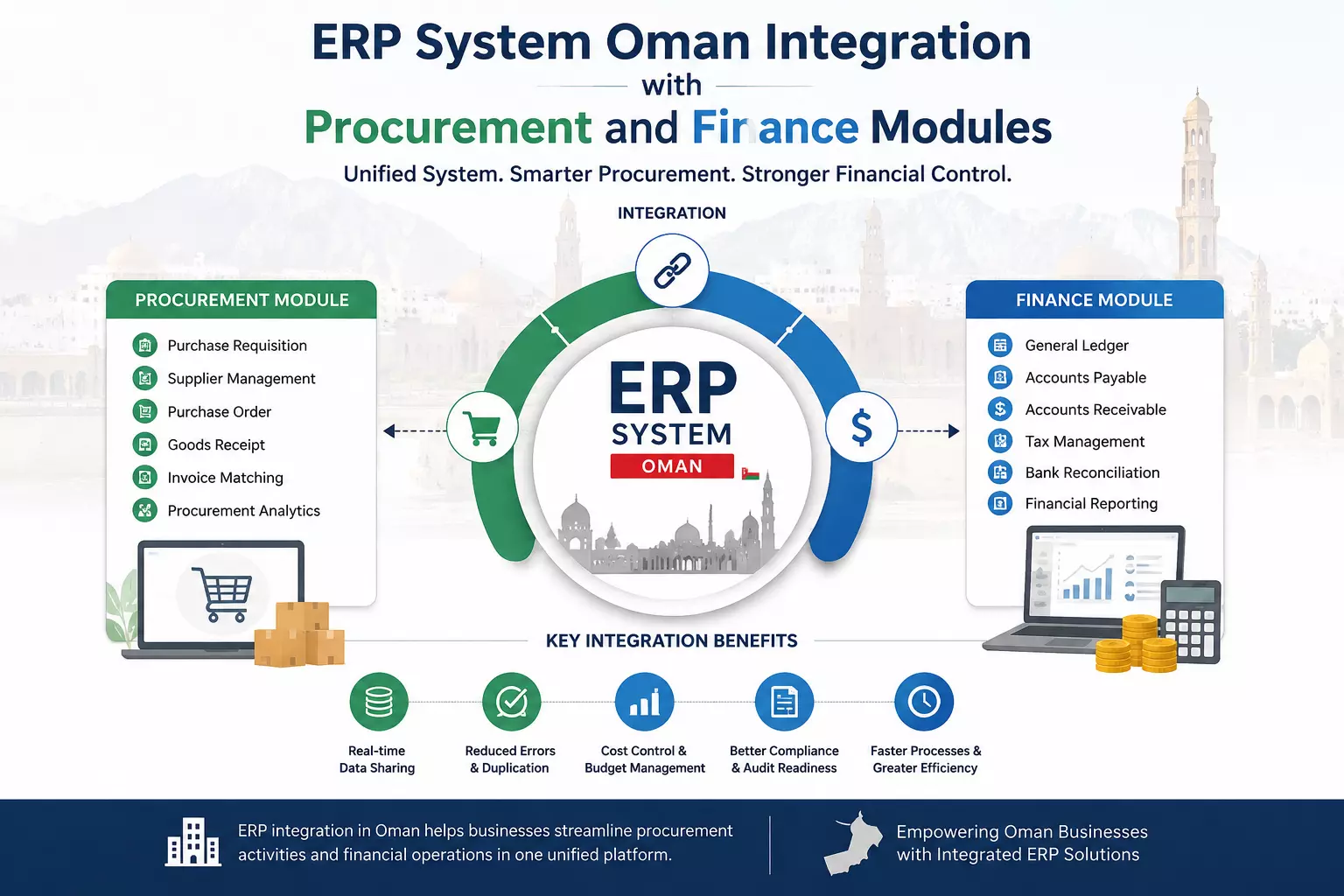
ERP System Oman Integration with Procurement and Finance Modules
In today's business landscape, Oman PLC has seen digitization play a crucial role in accurately managing procurement cycles and financial operations.
Unified ERP system integration allows for ease of data transfer between purchase, inventory and accounting departments, thereby reducing the risk of human error and enabling companies to exercise greater financial control.
A single ERP system company that integrates procurement with finance provides for real-time visibility into the company's spending, budget, supplier performance and account reconciliation.
This establishes a focused operational setting with data-backed decisions and audit-ready.
Procurement and Finance Synchronization in ERP Architecture
An ERP system that integrates the functions of procurement and finance resolves disjointed workflows. Both modules are based on a common database, eliminating the need for separate tools.
The following are key outcomes of the integration:
- Purchasing requests tied to a budget are automatically processed.
- COs are synced with accounting ledgers
- GRN (Goods Receipt Notes) are a direct validation with the vendors' invoice.
- Expense tracking in real time, on a per-department basis.
- You will get mechanised updates regarding the consumption of budget.
This integration allows financial discipline, ensuring that purchases are conducted efficiently.
Real-time financial accuracy is further boosted by the integration of advanced accounting software solutions, available as part of ERP packages oman, which link procurement data with accounting entries.
Procurement Workflow Automation Inside ERP System Oman
When handled by ERP automation layers, procurement processes become more structured. All these aspects of the purchasing process are standardized, thus complying and controlling costs.
The typical automated procurement process is:
- Creation of requisitions by departments.
- Multi-level approval workflow
- Comparing the quotations and selecting the Suppliers
- Purchase order generation
- Tracking of delivery and goods receipt validation.
- Ensuring matching and release of invoices for payment.
The entire process is captured digitally, minimizing manual involvement and ensuring traceability. A strong ERP system oman also applies procurement policies like spending restrictions, vendor approval rules etc.
Finance Module Integration & Real-time Accounting Control
The finance module functions as the main control centre of all procurement activities. All transactional data is automatically recorded in financial documents, making sure that the information is accurate and consistent.
The following are the core financial integration features:
- Proposes the creation of automatic journal entry from procurement action.
- General ledger updates as real-time data.
- Variance and budget control,
- AP Automation of vendor invoices.
- Forecasting the cash flow from purchase commitments
- Department/Project Expense by Category
This eliminates redundancy in the procurement system and in financial records, increasing the transparency of the financial system.
Vendor Management and Payment Lifecycle Integration
By integrating supplier management into ERP, companies can streamline their vendor lifecycle, ensuring there is a controlled process in place.
Key capabilities include:
- Centralized vendor database with a performance history.
- Automated vendor approval workflows.
- Contract-based pricing validation
- Verification of Invoices with Purchase Order
- Scheduled and automated payments processing.
This association helps the improvement of relationships with suppliers and guarantees the correct payment and financial discipline.
Budget Control and Cost Visibility Across Departments
A significant advantage of ERP integration is the real-time tracking of budgets. This ability to monitor procurement spending on the fly improves the agility of finance teams.
This real-time monitoring of procurement spend acts as an agility boost for finance teams.
Key controls include:
- Tracking allocation of departments budgets.
- Pre-approval budget checks prior to the purchase order
- Real-time expenditure dashboards
- Allocating costs to cost centers to ensure accurate reporting.
- Alerts on breaches of budget thresholds
This will enable organisations to function within their budgets and still have the flexibility of procurement.
Data Flow Between Procurement and Finance Modules
A connected erp system oman provides structured data flow between erp system modules without information duplication.
Common examples of data synchronization:
They are called purchase orders and are often referred to as accounting commitments.
- Receipts of goods → update of inventory values
- Supplier Invoices to Accounts Payable Entries
- Cash flow updates → payment processing.
This ongoing matching minimizes match time and enhances the accuracy of financial reporting.
Read: ERP Selection Guide: A Practical Path to Smarter Business
Application to track compliance and audit readiness
ERP integration makes it easier to be ready for audit since it keeps records of financial and procurement transactions in a structured manner.
System supports:
- End-to-end transaction traceability
- Version control of procurement document.
- Computerized financial document audit trails.
- Compliance-based approval hierarchies
- Historical transaction reporting
This simplifies the process of financial audits, making them quicker, easier to audit and removing the manual paper trail that makes audit and accountability tedious.
Reporting and Business Intelligence Integration
An integrated ERP system delivers up-to-date analytical information with both procurement and finance data.
The following are important reporting products:
- Supplier performance analysis
- Procurement cost breakdowns
- Department-wise spending reports
- Balance Budget to Actuals
- The effect of procurement on cash flow.
These pieces of information are useful for strategic decision making and enhanced cost optimisation strategies.
Systems Security and Access Governance.
ERP systems can guarantee safe interaction within the procurement and finance components via organized controls.
Security features include:
- Role-based access permissions
- Approval-based transaction control
- Multi-factor authentication
- Monitoring and tracking of activities
Protecting financial data with encryption.Encryption of financial data.
Conclusion
A well-integrated ERP system is reshaping procurement and finance functions into a data-centric landscape.
Organizations realize cost control, enhanced accuracy and increased visibility in their operations by aligning the purchasing process with financial accounting.
Embedded accounting software oman provides a solution to streamline financial processes, minimize manual errors and keep compliance up and running all throughout the procurement cycles.
This integration, in a nutshell, enables seamless scale, budget-consciousness, and efficient business operations.