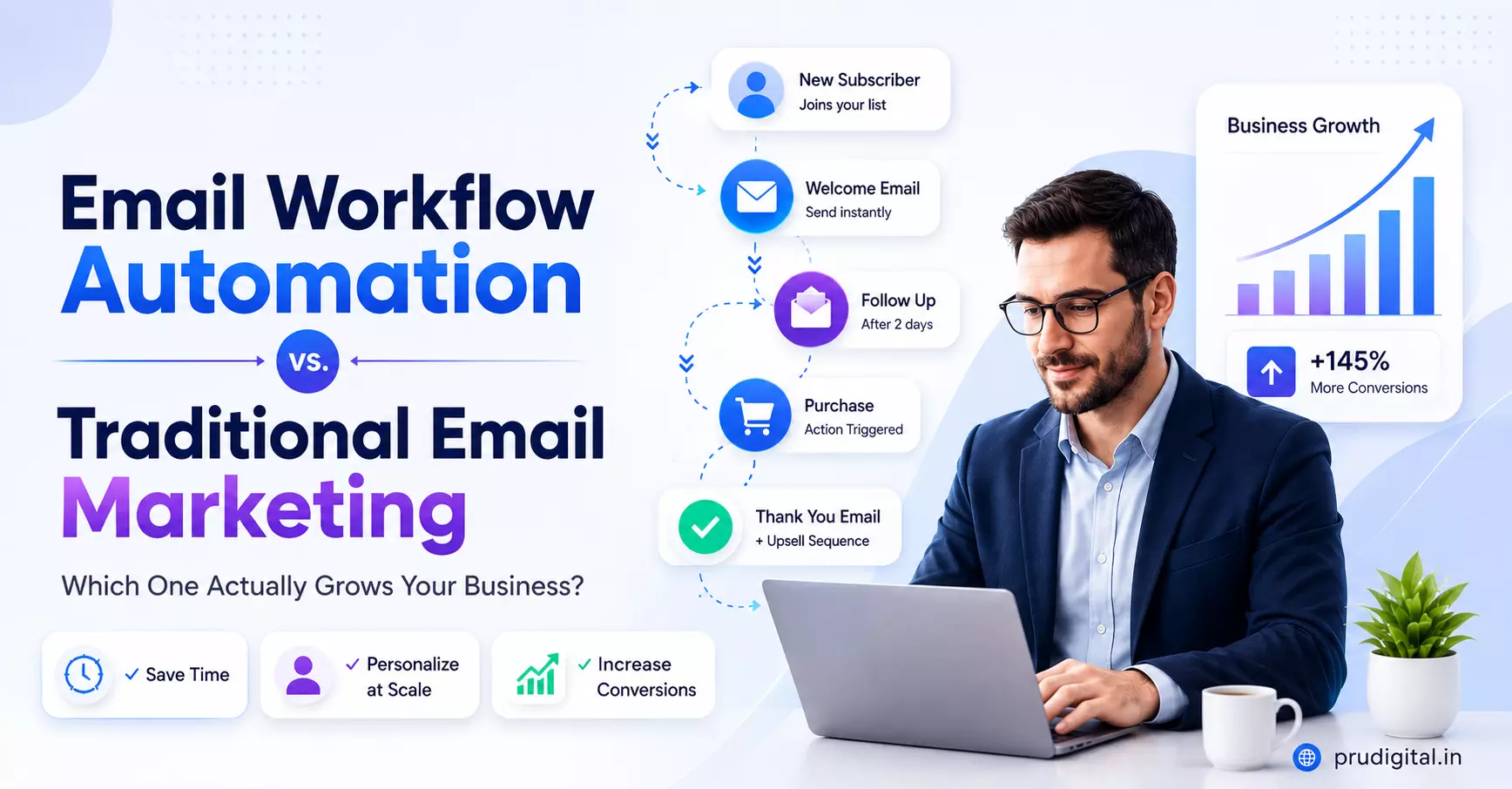
Email Workflow Automation vs. Traditional Email Marketing — Which One Actually Grows Your Business?
Let me be honest with you. A few years ago, I was manually sending the same "Welcome!" email to every new subscriber — one by one. It felt personal. It felt right. Then I started missing people. Forgetting follow-ups. Watching leads go cold.
That's when I finally understood why email marketing workflow automation is not just a buzzword — it's a business lifeline.
But here's the real question most marketers are still asking: Is automation really better than traditional email marketing, or does the personal touch still win?
Let's settle this once and for all
What Is Traditional Email Marketing, Anyway?
Traditional email marketing is exactly what it sounds like. You write an email, build a list, hit send, and hope for the best. It's done manually — either one contact at a time or to a bulk list all at once.
It has its place. Small newsletters, personal outreach, one-off announcements — traditional methods can feel warm and genuine.
But here's the problem: it doesn't scale. And in today's fast-moving digital world, if you're not scaling, you're falling behind.
So, What Is Email Workflow Automation?
Email workflow automation is the process of setting up a series of emails that go out automatically based on what your subscriber does — or doesn't do.
Someone signs up for your free guide? They get a welcome email instantly. They open it but don't click? A follow-up goes out two days later. They buy something? A thank-you and upsell sequence kicks in.
All without you lifting a finger after the initial setup.
The best email automation tools make this seamless — connecting your CRM, landing pages, and campaigns into one smart system.
Head-to-Head: Automation vs. Traditional
Time & Effort
Traditional email takes real hours. You're writing, scheduling, and managing everything manually. One campaign might eat up half your week.
Automated email campaigns, on the other hand, run in the background 24/7. Set it up once, and it works while you sleep.
Personalization
Here's a myth worth busting: automation doesn't mean impersonal. Modern email marketing automation software can personalize emails based on a subscriber's name, location, past purchases, browsing behaviour — even the device they use.
Traditional email? You're usually sending the same message to everyone.
Tracking & Results
With automation, you get real-time data. Open rates, click-through rates, conversion tracking — it's all there. You can A/B test subject lines and tweak your sequences based on what's actually working.
Traditional email rarely gives you that level of insight, especially if you're sending manually.
ROI
This one isn't even close. Automated email campaigns consistently outperform traditional methods when it comes to return on investment. Why? Because the right message reaches the right person at exactly the right time.
When Does Traditional Email Still Work?
Traditional email isn't dead — it just has a narrower role now.
It works well for:
- Very small, niche audiences where hyper-personal contact matters
- One-time announcements like event invites or press releases
- Relationship-building in early-stage startups with a tiny list
But even in these cases, a simple automation tool can handle most of the heavy lifting without losing that personal feel.
Read: The Ultimate Guide to Using an AI Content Marketing Tool
Choosing the Right Email Automation Tools
Not all tools are created equal. When evaluating email marketing automation software, look for:
- Easy visual workflow builders — so you can map out your sequences without needing a developer
- Segmentation options — the ability to split your list by behavior, demographics, or engagement level
- Analytics dashboards — clear data that tells you what's working
- Integration support — connects with your CRM, eCommerce store, or website
Some of the most popular options out there include Mailchimp, Active Campaign, and Convert Kit — but the "best" one always depends on your business size and goals.
Final Thoughts
The debate between email workflow automation and traditional email marketing isn't really a debate anymore. Automation wins — in efficiency, personalisation, and results.
If you're ready to stop sending emails the hard way and start building campaigns that actually convert, it's time to make the switch.
And if you're looking for expert guidance on setting up the right digital marketing strategy for your business, Prudigital Media (prudigital.in) is the partner you want in your corner — helping brands like yours grow smarter, not just harder.
Frequently Asked Questions (FAQs)
Q1. Is email workflow automation suitable for small businesses?
Absolutely. In fact, small businesses benefit the most because automation helps them compete with larger brands without needing a big marketing team.
Q2. What is the best email automation tool for beginners?
Tools like Mailchimp or Convert Kit are great starting points — they're user-friendly and offer solid free plans to get you started with automated email campaigns.
Q3. Does automation make emails feel less personal?
Not if done right. Good email marketing automation software lets you personalize content based on subscriber data, making emails feel more relevant — not robotic.
Q4. How soon can I see results from automated email campaigns?
Most businesses notice improved open rates and engagement within the first few weeks. Long-term ROI improves significantly over time as sequences are optimized.
Q5. Can I use both traditional and automated email marketing together?
Yes! Many brands use automation for their standard sequences and reserve manual emails for special announcements or VIP relationships.