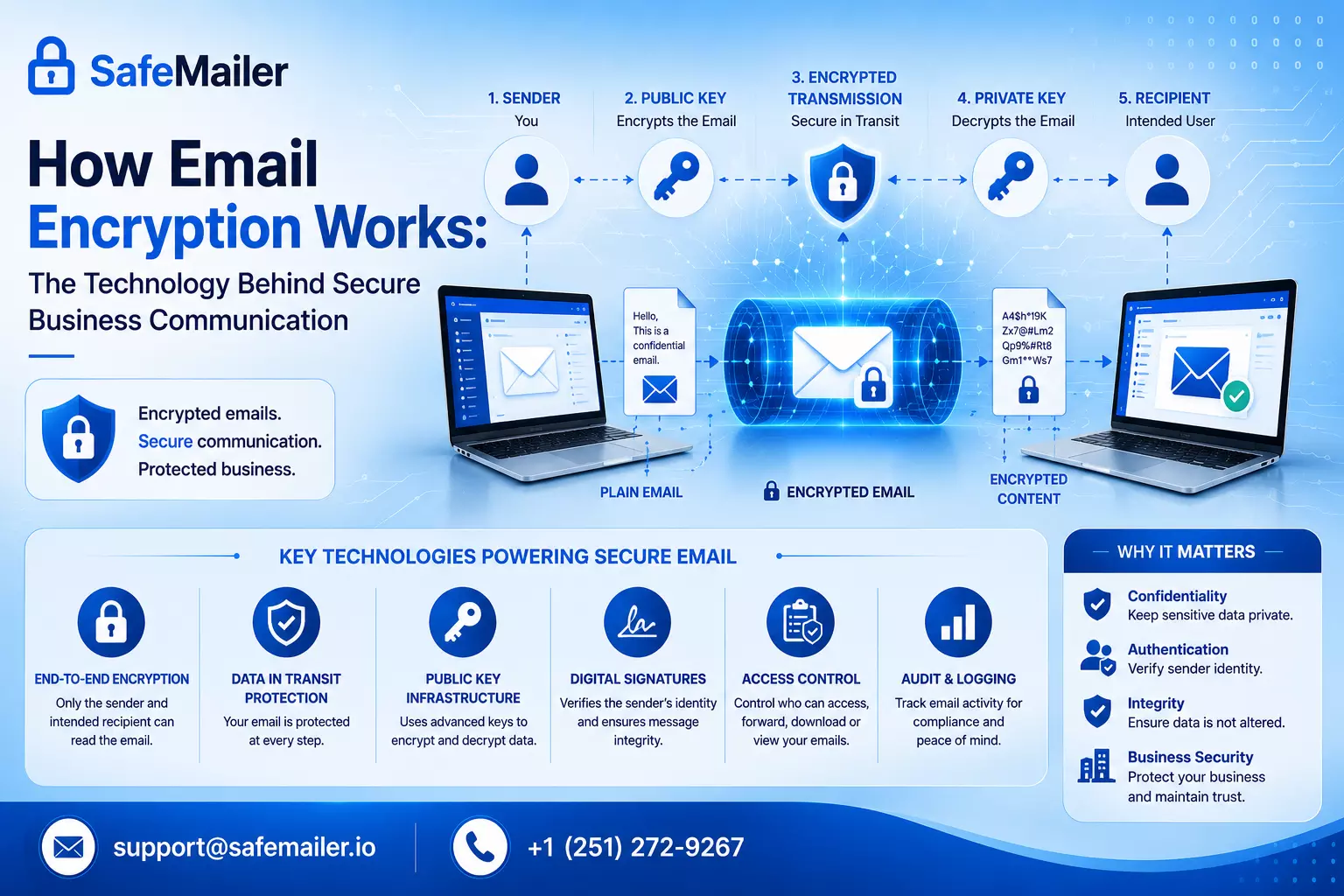
How Email Encryption Software Works: The Technology Behind Secure Business Communication
Most people who use email encryption software do not particularly need to understand the cryptography that makes it work. The tool handles it automatically.
But having a working understanding of the underlying technology helps when evaluating different solutions, making sense of the claims vendors make, and explaining to colleagues or clients why certain approaches to email security are more robust than others.
This is an explanation aimed at people who want to understand the technology without becoming cryptographers.
Why Standard Email Is Structurally Insecure
To understand what encryption software does, it helps to first understand the problem it is solving.
Email was designed in the early days of networked computing and the protocol, called SMTP, was built for simplicity and interoperability rather than privacy.
When you send an email, the message travels through a series of intermediate servers that route it toward its destination. Each of those servers can read the message in plain text.
This is not a flaw that can be patched with a software update. It is a structural characteristic of how email works. The servers that handle your mail, including those operated by your email provider, have access to the content of messages stored on them.
If a server is compromised, if a provider is subject to a legal order, or if an employee with server access looks at the wrong thing, the content of unencrypted messages is exposed.
Encryption does not change the underlying architecture of email. Messages still travel through servers. What changes is that the content of those messages is scrambled in a way that makes it unreadable to anyone who does not hold the key to unscramble it.
The Mathematics Behind Public Key Cryptography
Modern email encryption relies on a branch of mathematics called asymmetric cryptography, more commonly called public key cryptography.
The system works because of a mathematical relationship between two very large numbers: a public key and a private key. These keys are related in a specific way, but knowing one does not allow you to calculate the other in any practical timeframe.
When you want to receive encrypted messages, you generate a key pair. You make your public key available to anyone who wants to send you something. Your private key stays with you and never leaves your possession.
Someone who wants to send you an encrypted message uses your public key to encrypt it. The resulting scrambled content can only be decrypted using your private key.
The security of this system rests on a mathematical problem that is computationally infeasible to solve with current technology. Multiplying two very large prime numbers together is fast.
Factoring the result back into its original primes is so slow, given the key sizes used in practice, that it would take more time than the age of the universe using current hardware.
This asymmetry between the ease of encryption and the difficulty of unauthorized decryption is what makes the system secure.
What AES Has to Do With Email Encryption
Public key cryptography solves the problem of key exchange but is computationally expensive when used on large amounts of data.
Encrypting the full content of an email with its attachments using only asymmetric encryption would be slow. Modern email encryption software solves this by using a hybrid approach.
The actual content of the message is encrypted using a symmetric algorithm, most commonly AES, which stands for the Advanced Encryption Standard.
Symmetric encryption uses the same key to encrypt and decrypt, which makes it much faster than asymmetric encryption for bulk data. The session key used to encrypt the message content is itself then encrypted using the recipient's public key.
The recipient receives the encrypted session key and the encrypted message content. They use their private key to decrypt the session key, and then use the session key to decrypt the message.
The sender never needs to transmit the session key in a form that could be intercepted and misused. This hybrid approach combines the performance advantages of symmetric encryption with the key exchange advantages of asymmetric encryption.
End to End Encryption Versus Other Approaches
The phrase end to end encryption gets used frequently and sometimes loosely. In its precise meaning, it describes a system where the message is encrypted on the sender's device and can only be decrypted on the recipient's device.
No intermediate system, including the servers operated by the email provider, ever has access to the plaintext content.
This is different from what happens when an email provider encrypts messages stored on their servers.
Server side encryption protects against external attackers who might breach the servers, but the provider retains the ability to decrypt message content because they hold the keys.
This is meaningful security in some respects but it does not provide the same guarantees as end to end encryption.
End to end encryption matters most when the threat model includes the possibility of a provider being breached, being subject to legal orders to disclose message content, or simply having policies about data retention and access that do not align with what you need.
If only the sender and the authorized recipient can decrypt the message, then the contents are protected from everyone else, including the infrastructure that carries the message.
Digital Signatures and Why They Matter Alongside Encryption
Encryption addresses confidentiality, which means keeping message content readable only by the intended recipient. A related but distinct problem is authentication, which means verifying that a message actually came from who it claims to come from.
Digital signatures solve this problem. When you send a digitally signed message, your email software creates a mathematical hash of the message content and encrypts that hash using your private key.
The result is attached to the message. The recipient can use your public key to decrypt the hash and compare it against a fresh hash of the message content they received.
If the two hashes match, two things have been confirmed. First, the message came from someone who holds the private key associated with your public key, which should be you and only you.
Second, the content of the message has not been altered in transit. Any modification to the message content would produce a different hash, causing the verification to fail.
In practice, digital signatures are important for situations where impersonation is a risk, for verifying the integrity of documents sent by email, and for compliance purposes where organizations must be able to demonstrate the authenticity of communications.
Read: Gmail Temp – Free Temporary Email Generator for Instant
How Software Handles Key Management Without Burdening Users
Early implementations of email encryption required users to manually generate key pairs, exchange public keys with correspondents, and manage their own key storage. This created a high barrier to adoption that limited encryption largely to technically sophisticated users.
Modern email encryption software abstracts away most of this complexity. Key generation happens automatically when a user is provisioned.
Public keys are shared through centrally managed directories that the software queries automatically when composing a message to a known contact.
Key storage is handled by the software rather than requiring users to manage files. Expiration and rotation policies are enforced by policy rather than relying on individual users to remember.
The result is that users in organizations with properly configured email encryption software can send and receive encrypted messages without any understanding of how the keys work. The security is enforced automatically, and adoption does not depend on users choosing to do the right thing.
Access Control Layers That Work Alongside Encryption
Pure cryptographic encryption handles the problem of unauthorized reading of message content. But it does not address what an authorized recipient does with the content after they have received and decrypted it.
A legitimately authorized recipient could forward the message to someone else, download attachments and share them widely, or screenshot sensitive content.
Access control features in email encryption software address this additional layer. These capabilities work by keeping a connection between the message and the server even after delivery.
Instead of sending a static encrypted file that becomes fully independent once decrypted, the software requires the recipient to authenticate each time they access the message, and enforces the rules the sender set at the time of sending.
This makes it possible to prevent forwarding, block downloads, set messages to expire after a certain time, and revoke access entirely after sending if the message reached the wrong person or the situation changed.
The cryptographic protection is still present, but it is paired with behavioral controls that govern what verified recipients can do with the content.
The Role of PKI and Certificate Authorities
In some email encryption implementations, particularly those based on the S/MIME standard, trust is established through a public key infrastructure that involves certificate authorities.
A certificate authority is an organization that verifies the identity of individuals or entities and issues digital certificates binding their identity to a public key.
When you send an S/MIME encrypted email, your certificate was issued by a certificate authority that vouches for your identity.
Recipients can verify that the certificate is valid and was issued by a trusted authority, which gives them confidence that the public key they are using to verify your signature or encrypt a response to you actually belongs to you.
This model works well in controlled enterprise environments where a single organization manages its own certificate authority for internal communications.
It becomes more complicated when communicating with external parties who may use different certificate authorities or different encryption standards entirely.
What This Means for Evaluating Software
Understanding the technology helps make sense of vendor claims. When a vendor says they use end to end encryption, ask whether they ever hold decryption keys. When they say they use AES-256, ask what the key management architecture looks like.
When they talk about zero knowledge security, ask what they mean by that specifically and how it is implemented.
Email Encryption Software that genuinely protects your data operates on the principle that the provider should never be in a position to read your message content, regardless of what technical or legal pressures might arise.
The technology that underlies modern email encryption is mature and well understood.
The variation between products is not primarily in whether they use encryption at all, but in how they implement it, who holds keys, how they handle key management and recovery, and whether the access control features match what regulated or confidential business communication actually requires.
Those questions are worth asking clearly and expecting clear answers to.