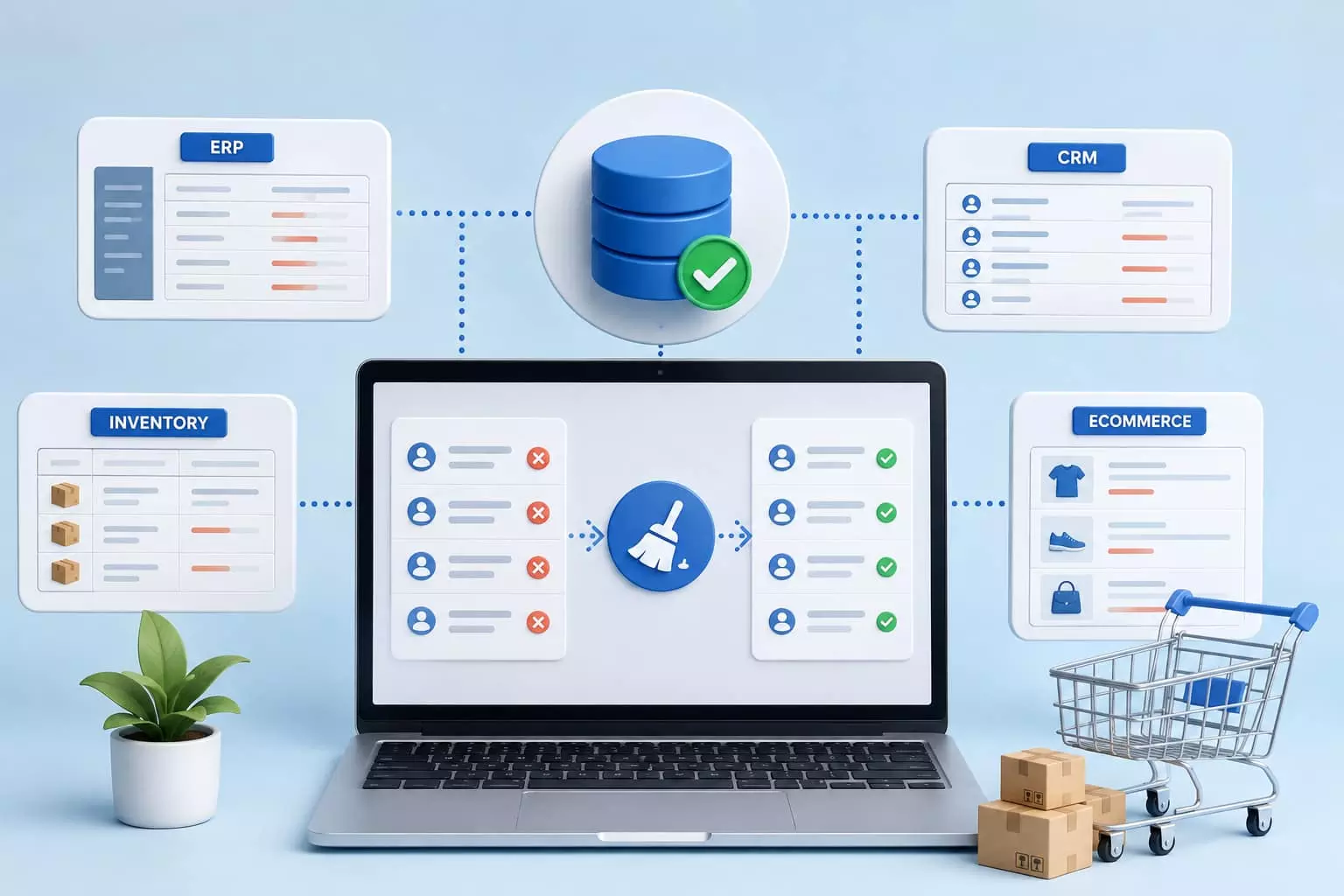
How to Eliminate Duplicate Data Across Systems and Improve Your Ecommerce Operations
Running an ecommerce business involves much more than selling products online. Behind every successful online store are multiple systems working together, including your ERP, ecommerce platform, inventory management, pricing database and customer records.
When these systems aren't connected properly, duplicate data quickly becomes a major issue.
Product information is entered more than once, customer records are duplicated, inventory levels become inaccurate, and staff spend valuable time correcting errors instead of growing the business.
For wholesalers, distributors and manufacturers, these problems can slow down operations and affect the customer experience. The good news is that duplicate data is preventable when your ecommerce platform and ERP system work together.
Why Duplicate Data Happens in Ecommerce
Many businesses start with separate systems that meet individual needs. They may have an online store, an ERP system, accounting software and CRM, but none of them share information automatically.
As a result, employees often have to manually transfer information between systems.
For example:
- A customer places an online order, but the sales team enters the same order into the ERP manually.
- Product prices are updated in the ERP but not on the website.
- New customers are added to multiple systems separately.
- Inventory is updated in one system while the website still displays old stock levels.
These manual processes create duplicate records and increase the chance of costly mistakes.
The Hidden Cost of Duplicate Data
Duplicate data is more than an inconvenience. It affects almost every part of an ecommerce business.
Incorrect Product Information
If product details are managed across multiple systems, there's a higher chance that descriptions, specifications or pricing won't match. This creates confusion for customers and increases support enquiries.
Inventory Errors
Nothing frustrates customers more than ordering a product that's actually out of stock.
Without real-time synchronisation between your ERP and ecommerce platform, inventory levels can quickly become inaccurate, leading to overselling or missed sales opportunities.
Slower Order Processing
When staff manually enter online orders into another system, it adds unnecessary work and increases the risk of duplicate or incorrect orders.
Inaccurate Reporting
Business decisions rely on accurate data. Duplicate customer records, sales orders or product information can make reports unreliable, making it harder to forecast demand or measure performance.
Signs Your Ecommerce Business Has a Duplicate Data Problem
You may already have a duplicate data issue if your business regularly experiences:
- Staff manually entering online orders into your ERP.
- Different product prices on your website and ERP.
- Duplicate customer accounts.
- Inventory levels that don't match your actual stock.
- Multiple versions of the same product.
- Time spent correcting data rather than serving customers.
- Frequent order or pricing errors.
If these challenges sound familiar, it's worth reviewing how your systems communicate with each other.
How ERP Integration Eliminates Duplicate Data
- One of the most effective ways to eliminate duplicate data is by connecting your ecommerce platform directly with your ERP system.
- Instead of entering the same information into multiple applications, data is shared automatically between systems in real time.
- For businesses using a NetSuite ecommerce platform, this means product information, inventory levels, pricing and customer records can remain synchronised without relying on manual updates.
- The result is a single source of truth across your entire business.
Read: Top 10 School ERP Software in 2025
5 Ways to Reduce Duplicate Data Across Your Systems
1. Connect Your Ecommerce Platform with Your ERP
When your website and ERP are integrated, information only needs to be entered once.
Updates to products, pricing, customers and inventory automatically flow between systems, reducing manual work and improving accuracy.
2. Keep Product Information in One Location
Managing product data in multiple systems often leads to inconsistencies.
Instead, maintain your product catalogue within your ERP and allow your ecommerce platform to automatically display the latest information. This helps ensure customers always see accurate pricing, descriptions and availability.
3. Automate Order Processing
Every manual step creates an opportunity for mistakes.
An integrated ecommerce solution can automatically send online orders to your ERP, removing the need to re-enter customer information or product details.
This speeds up fulfilment while reducing duplicate orders.
4. Synchronise Inventory in Real Time
Stock levels change throughout the day as orders are placed, cancelled or fulfilled.
Real-time inventory synchronisation ensures your website always reflects actual stock availability, helping prevent overselling and improving customer confidence.
5. Regularly Review Your Data
Even with automation, it's good practice to review customer records, product information and supplier data regularly.
Routine data checks help identify duplicate records before they become larger operational problems.
Why Integration Is Better Than Manual Processes
Many growing businesses still rely on spreadsheets, CSV imports or manual updates to move data between systems.
While this might work initially, it becomes increasingly difficult as order volumes grow.
An ERP-integrated ecommerce platform removes these repetitive tasks by automatically synchronising:
- Products
- Customer accounts
- Pricing
- Inventory
- Sales orders
- Order status updates
This allows your team to focus on customer service and business growth rather than administrative work.
The Long-Term Benefits of Eliminating Duplicate Data
Connecting your ecommerce platform with your ERP doesn't just improve efficiency today—it also prepares your business for future growth.
Some of the long-term benefits include:
- Faster order processing
- More accurate inventory management
- Consistent product information
- Better customer experiences
- Fewer manual errors
- Improved reporting and forecasting
- Increased productivity across sales and operations
As your business grows, having reliable, synchronised data becomes even more important.
Final Thoughts
Duplicate data is one of the most common challenges faced by ecommerce businesses, especially those relying on disconnected systems and manual processes.
While the issue may seem small at first, it can quickly affect inventory accuracy, customer satisfaction and day-to-day operations.
By integrating your ecommerce platform with your ERP, you can create a single source of truth for your products, customers and orders. This not only reduces duplicate data but also streamlines operations and supports long-term business growth.
If you're looking for an integraSell ecommerce platform, Native Software helps New Zealand businesses connect their ecommerce store with leading ERP systems, including NetSuite, Accredo, Business Central and Odoo.
With real-time synchronisation of products, pricing, inventory and orders, businesses can reduce manual administration, improve data accuracy and deliver a more efficient online buying experience.