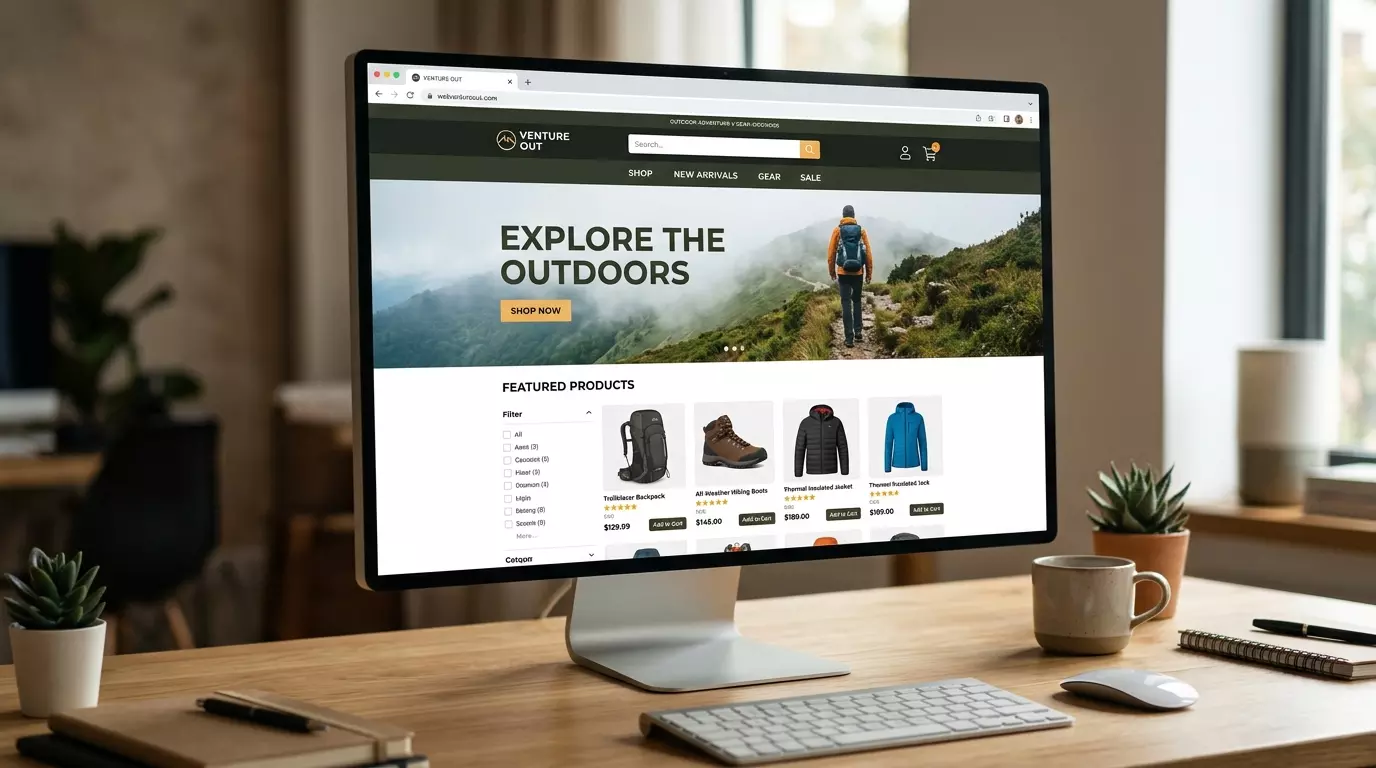
E-Commerce Website Design: What Aspects to Consider in an Online Store
Customers have very high expectations while browsing the Internet and making purchases. Therefore, it is necessary to ensure their comfortable and quick shopping and the ability to find the goods they need.
An e-commerce store should remove all barriers to buying and make the process as convenient as possible to increase the number of purchases.
E-commerce web design and development aims to provide customers with an easy-to-use interface, and E-Commerce Website Development is about the choice of the necessary options and extensions to increase sales. The aspects that any online store must have are discussed below.
1. Website Navigation in the Online Store Should be Easy
Customers should find products within several clicks. Categorize products by using broad categories and simple labels. Remember to add a search bar and sort/search options (price range, size, color, brand), if applicable.
If the online store has many items, add drop-down menus and navigation bars to help customers jump from one category to another without returning to the homepage.
It might also be helpful to sort the navigation according to the customers’ needs rather than the company’s departments.
For example, categories can be ‘men’s clothes,’ ‘women’s clothes,’ and ‘seasonal products.’ Search suggestions and related products might also assist customers browsing the online store.
It might be helpful to test the navigation options with a person who was not familiar with the website and ask them to find a specific product. Observe their actions and possible barriers to purchase.
2. Include All the Essential Information on Product Pages
Product pages are often the cornerstone of a purchase decision since a customer is unlikely to touch or try a product before buying. As such, images, specification sheets, description, and pricing, play a vital role in convincing customers to make purchases.
It is essential to utilize multiple images and specify vital specifications where applicable. Where relevant, make sure to give access to extra sizes, colors, and variations.
Description should also give the information necessary to purchase, ideally avoiding vague marketing language and focusing on benefits and characteristics.
Besides, product pages need to answer the most common questions; for example, indicate the size of the product, the materials from which it is made (if any), compatibility, accessories (if any), and care instructions.
Also, if applicable, the delivery time, return policy, and guarantees. A useful practice is to analyze the questions customers ask in the FAQ or product reviews, and respond to them directly on the product page.
3. Optimize the Store’s Design for Mobile Device Users
Many customers shop with the help of smartphones, so it is important to make sure the website is mobile-friendly. A responsive design should ensure that images and text are big enough, buttons are easy to press, and links are easy to access.
Wherever applicable, it may be helpful to optimize the navigation so that customers can return to the previous page or browse the categories without losing the current selection.
It may also be helpful to test through the entire purchase process on different devices to make sure that there are no roadblocks to purchase.
In practice, it may be helpful to pay extra attention to the following questions: can a customer scroll through the product pages effortlessly, will a keyboard appear when a customer needs to type, and can a customer go back or forward without closing the tab.
Essentially, a mobile-friendly design should allow for a smooth experience of the most common actions (e.g., browsing, checkout) and limit distractions away from the current task.
4. Facilitate the Checkout and Payment Process
The design of the checkout page plays a crucial role in the whole purchasing process and should be clear and concise to facilitate the payment process and prevent cart abandonment.
Such factors as confusing forms and the necessity to create an account, hidden fees, security issues, and others factor in a customer’s decision to leave a website.
To improve this area, it is essential to allow users to checkout as guests, reduce the number of fields to fill, provide helpful information about possible errors, implement shipping costs, applicable taxes, discounts, and the order’s total cost.
Besides, it is vital to offer a variety of payment methods depending on the audience, such as credit and debit cards, online wallets, cash on delivery, etc.
It is also essential to confirm the payment successfully and explain the next step after ordering. Another way to improve the process is to analyze abandoned carts and understand the reasons for leaving the purchase.
For instance, there might be an unexpected increase in shipping costs, so adding this information before proceeding to the payment can reduce the number of cancelled orders.

5. Follow Best Practices to Boost Website Security
Customers need to know that their personal and payment information will be kept safe and only used for the intended purpose.
First of all, make sure that the website uses a secure connection (HTTPS). However, a secure connection may not be enough if the website has vulnerabilities (outdated software, incorrect permissions). T
o minimize risks, use trusted payment gateways and regularly update the website’s software, payment processors, and other third-party platforms.
Limit the access to the administrative area and make sure that there are adequate security measures. Wherever possible, do not use sensitive customer data (credit card information).
If your organization processes payments, it should comply with the relevant data protection laws and regulations applicable to payment processors.
In addition to general security measures, an online store should be transparent to build customer trust and reduce the chances of chargebacks and disputes.
Ideally, contact details, delivery estimates, return policy, and product information should be easy to find and easy to understand. Customer reviews can also be an excellent source of information for prospective buyers.
Avoid making unrealistic promises (delivery time, product performance, or guarantee terms) that may disappoint the customers and lead to adverse online reviews. A trustworthy online store will keep its commitments to build long-term relationships with its customers.
Read: Top Ecommerce App Development Firms
6. Optimize the Performance and Speed of the Website
Slow website performance can frustrate customers and discourage them from browsing the online store or making purchases.
A sluggish website may have various issues, from large image sizes to too many scripts or incorrect hosting settings. Ideally, the website speed should be optimized for all key web pages.
The most visited web pages usually consist of the homepage, category pages, product pages, and the checkout process. Optimize images to reduce their size without compromising the visual appeal of the website.
Wherever possible, replace outdated graphic formats with new ones (HEIC). Remove unneeded scripts or plugins that affect the performance of the website.
Depending on the CMS and hosting plan, caches and content delivery networks (CDNs) may also help with boosting the performance of the online store.
It is usually advisable to test these solutions to see how much they can improve the performance of the website before adopting them. Ideally, prioritize actions that will bring the best result for the website performance.
While faster product pages are critical, other aspects (filters’ performance, cart, and payment pages) should also be considered.
7. Leverage SEO to Get More Traffic and Visibility
Search Engine Optimization (SEO) is vital for any e-commerce business to make products visible in search engines.
To optimize the online store, it is essential to optimize product titles and descriptions, use relevant headings and URL addresses, and properly sort products. It is necessary to avoid identical descriptions of different manufacturers and describe each product’s characteristics, advantages, and benefits.
It is also vital to ensure that search engines can access product and category pages; thus, technical SEO audits should be conducted periodically.
Moreover, technical SEO audits help eliminate indexing issues, detect duplicate content, damaged links, URL errors, and other problems. A well-organized online store structure and proper redirects allow search engines to correctly identify site content and improve visibility.

8. Analyze the performance to identify areas of growth
An e-commerce site selling products has to be improved every day. There might be various analytical tools that can help for this matter to see the items that are the most popular ones and exactly how customers interact with the website.
For example, if some products have high numbers of visitors and views, but no sales, it is necessary to reconsider their prices, photos, description, and other attributes.
Secondly, analytics can show why exactly a customer has abandoned the cart at a particular stage and what needs to be done to prevent this from happening.
It is also possible to see what layout, buttons, and other website aspects are popular and constantly experiment with the e-commerce site’s interface. Overall, the company can benefit from analytics by finding out the weak points in the existing system and trying to improve them step by step.
Conclusion: The Best Ways to Build an Online Store
Creating an online store is never an end but rather a beginning of further improvements that make customers come back.
E-Commerce Website Development should be channeled into customers’ needs: how to help them find what they want, get answers to their questions, and obtain the best value for their hard-earned money.
It is wrong to try to imitate all the successful elements other companies adopted. Instead, think about what flaws to remedy first to make the customer’s purchase as convenient as possible. Test the bottom funnels and make the checkout process working on all browsers and devices as it should.
Last but not least, analyze the buying process with analytic software to see room for improvement and invest into elevating the conversion rate to get more customers and sales.
Looking for Professional E-Commerce Website Development?
The Custom Websites caters to helping you develop a website that will provide its visitors with an optimal online shopping experience.
The company offers website design and development services that address various aspects related to building an online store, such as responsive design, e-commerce functionality, SEO and performance optimization, and more.
Check out The Custom Website's Clutch Profile to get to know more about the company's services and cooperation terms.