Digital Map Market Racing Toward USD 70B by 2033 — Navigating the Future of Cartography
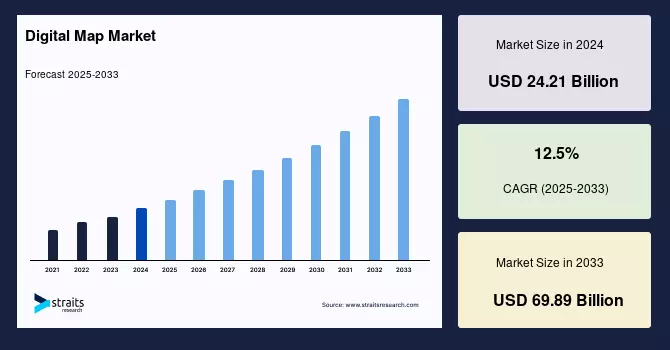
Explore how the digital map market is transforming navigation, retail, GPS, and smart cities—projected to climb from USD 24.2 billion in 2024 to USD 69.9 billion by 2033 at a 12.5% CAGR.
Introduction
Digital mapping has expanded far beyond static navigation. Today’s digital maps are dynamic platforms that combine real-time data, GPS, analytics, and immersive visuals. From ride-sharing apps and smart retail to autonomous vehicles and urban development, digital mapping powers seamless navigation, intelligent planning, and enriched user experiences.
Market Overview
- 2024 Market Size: USD 24.21 billion
- 2025 Forecast: USD 27.24 billion
- 2033 Projection: USD 69.89 billion
- CAGR (2025–2033): 12.5%
A robust growth trajectory underscores digital maps' critical role across industries.
Growth Drivers
Surge in Mobile Navigation
Smartphones and tablets ship with mapping software pre-installed. GPS, POI databases, and seamless UI/UX design drive usage—from food delivery to store locators. The immediacy and accuracy of mobile map tools accelerate adoption.
Expansion of Ride-Hailing & Real-Time Services
Digital maps are core to ride-share/drone dispatch, dynamic routing, and driver assistance. Fleet optimization, route planning, and proximity alerts rely on map data constantly updated via sensor and historical information.
Growth in Retail & Real Estate Use Cases
Retailers use digital maps for indoor navigation, location-based marketing, and in-store engagement displays. Malls and shopping centers implement interactive maps to guide shoppers, showcase promotions, and enhance user experience.
Rise in Real-Time Mapping
Real-time overlays—from traffic, geo-events, to social alerts—enhance responsiveness. Emergency services, logistics operators, and smart city planners benefit from up-to-the-minute cartographic visuals.
Market Challenges
Lack of Technical Expertise
Many businesses struggle to leverage geospatial tools effectively. Without skilled professionals or user-friendly platforms, they miss out on predictive insights and optimized decision-making. Expand training and tools are needed to democratize usage.
REQUEST SAMPLE: https://straitsresearch.com/report/digital-map-market/request-sample
Market Opportunities
Real-Time Asset Tracking & Safety
APIs and SDKs that merge live sensor data with mapping elevate fleet visibility, safety monitoring, and civilian risk management. Applications in emergency response, logistics, and smart infrastructure thrive on real-time geospatial data.
Smart Urban Planning & Infrastructure
Governments and urban planners increasingly use digital maps for managing utilities, traffic flows, and emergency services. GIS integration differentiates smart cities and enables better decision-making across transportation, health, and public safety departments.
Regional Insights
- North America: Leading market (2024), driven by automotive tech, mobile device penetration, and mapping infrastructure.
- Asia-Pacific: Fastest-growing region, fueled by infrastructure development, government initiatives, and agriculture/urban expansion.
- Europe: Strong growth expected, particularly in retail, automotive, and government analytics.
- LAMEA (Middle East, Africa, Latin America): Emerging growth markets, especially for fleet tracking and digital signage in retail and outdoors.
Market Segments at a Glance
SegmentLeading ContributorInsight SummarySolutionTracking & TelematicsKey for fleet management, vehicle safety, and logistics optimizationVerticalRetail & Real EstateIndoor maps, shopper engagement, and mall navigation drive usageDeploymentReal-Time Mapping CapabilityGrowing demand for live updates fuels platform growth
Technological Landscape
- Fleet Tracking & Telematics: Real-time location + driver behavior data enhance safety and routing.
- Indoor Navigation: Malls and campuses deploy touchmaps and mobile guidance for seamless navigation and engagement.
- Emergency Services Integration: Live mapping supports optimized law enforcement and rapid response during disasters or threats.
REQUEST SAMPLE: https://straitsresearch.com/report/digital-map-market/request-sample
Conclusion
The Digital Map Market is charting a strong upward path—from USD 24.21 billion in 2024 to USD 69.89 billion by 2033—growing at a solid 12.5% CAGR. As digital infrastructure evolves, AI-driven insights, real-time tracking, and immersive mapping will redefine how people navigate physical and digital landscapes. Businesses and cities harnessing this growth will lead the way into a mapped future.