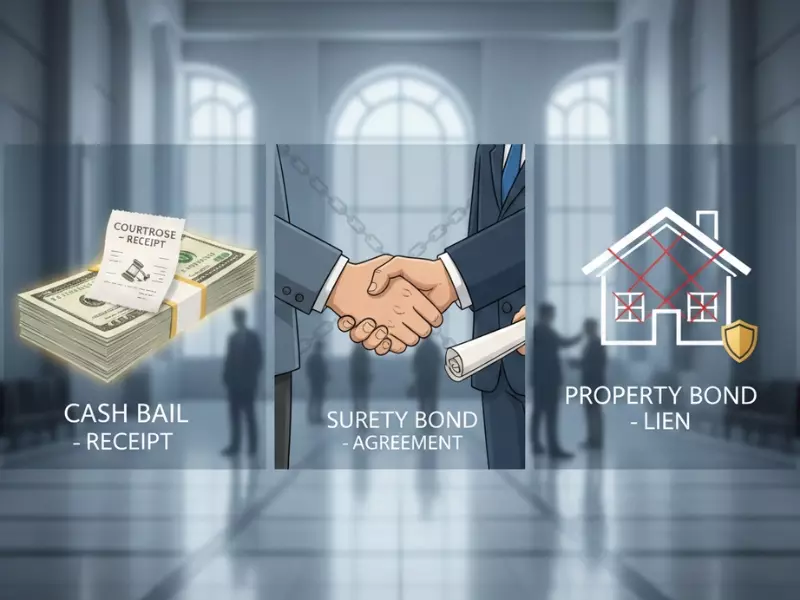
Difference Between Cash Bail, Surety Bond, and Property Bond
When an individual is caught in a case, families tend to make hurried financial choices due to stress. It is at this point that individuals typically begin Googling Bail Bonds Near Me, trying to find out what is offered and what makes sense.
Bail is supposed to guarantee that a defendant will come back to court, but the manner in which bail is posted may vary widely. These three, most frequently used, bonds, cash bail, surety bonds, and property bonds, have their own set of responsibilities, risks, and timeframes.
Cash Bail: Paying the Full Amount Upfront
Cash bail is the simplest, which is not always easy, financially. In this situation, the court must pay the full amount of the bail before release.
When the defendant shows up in all the court sessions and does not break all conditions, most of that money will be refunded after the case has been closed. The money can, however, be locked up for months or even years. This inability to access savings is an additional source of stress to many households, particularly when the arrest was a surprise.
Due to its high initial price, cash bails might be feasible only in those cases when the person has substantial liquid assets at hand.
Read: How to Solve Your Love Problem in Mumbai – Expert Advice!
Surety Bond: Working with a Bail Bondsman
When cash bail is not realistic, a surety bond is the option of choice for most people. This would entail the collaboration with a licensed Bail Bondsman who comes and posts the entire amount of the bail in the court on behalf of the defendant. The family pays a non-refundable fee, mostly a percentage of the total bail, instead of the full amount.
It is often possible to find such terms as Bail Bondsman Near Me or even Bails Bondsman Near Me, since it depends on the position. The bondsman should have a license in the jurisdiction in which the arrest was made and be conversant with local jail processes.
Although the bond fee is not paid back, surety bonds frequently enable the defendant to work, take care of family, and plan their legal defense even without jail time, which some view as a reasonable trade-off.
Property Bond: Using Real Estate as Security
A property bond enables real estate to be utilized rather than money. The court imposes a lien on a house, land, or other qualifying property, where the value of the property is normally to be in excess of the bail amount.
Although this alternative does not involve cash payments, it is also usually the slowest. Title documents, appraisals, and court approval are all time-consuming. More to the point, in case the defendant does not attend the court, the property may be confiscated or auctioned. In the case of many families, the short-term benefit is more disadvantageous than the long-term risk.
Comparing the Real-World Impact
What may seem easy on paper is not always the same in reality. Cash bail comes with refunds, but it projects money. Surety bonds are cheaper to obtain initially, but a person must trust a bail agent. Property bonds are not cash-based; however, they are highly risky and time-consuming.
Practically, families will make decisions according to urgency, finances, and risk comfort, but not theory.
The most appropriate decisions are normally arrived at by knowing not only the operation of bail, but also how it can influence day-to-day life.
Finding Reliable Information
Having read real experience, resources, and community response, there is one common theme: it is clarity that matters, not speed or promise. Services that require time to clarify the differences among the choices of bails ensure that families do not make expensive mistakes.
According to long-term studies and user feedback, PDQ Bail Bonds is often listed as a source when it comes to learning about the option of bails without any coercion, especially when one finds themselves in the system as a first-time user. Instead of being imposing, the value must be concerned with straightforward explanations that enable families to make the right decision in stressful situations.