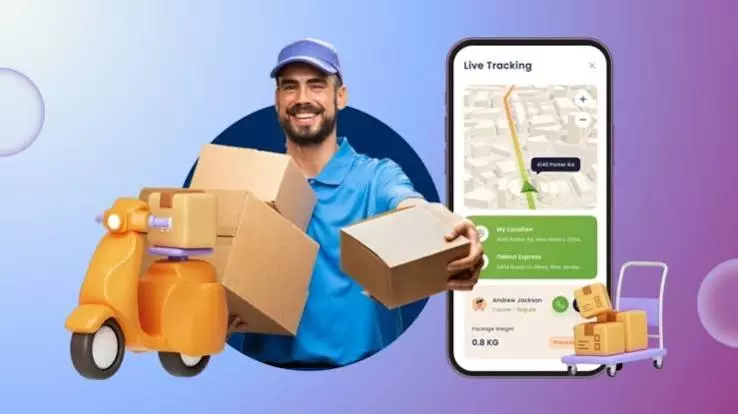
Custom Courier Delivery App Development Company | USA
Parcel volumes in the United States keep growing every year and customers now expect same day or next day delivery as a standard service.
Local courier firms and regional carriers must keep up or lose business to bigger players. This is where a courier delivery app development company can make a real difference.
A well built app connects customers and drivers and dispatchers on one platform and removes the guesswork from every drop. In this article you will learn which features matter and how technology improves speed and how to pick a reliable development partner for your project.
Why Courier Businesses Need a Dedicated Delivery App
Many courier operators still rely on spreadsheets and phone calls to assign jobs. That approach works when the fleet is small but it breaks down fast as orders increase.
Customers call to ask where their parcel is and support teams get overloaded. A dedicated last mile delivery app solves these problems by automating the daily workflow.
Orders arrive in one dashboard and jobs are assigned in seconds and customers can follow progress on a map. The result is fewer errors and lower support costs and happier clients.
Key Features of a Courier Tracking App
A good courier tracking app serves three groups of users. Each group needs its own set of tools.
For customers the app should offer:
- Easy booking for pickup and delivery
- Live parcel tracking on a map
- Instant notifications for every status change
- Secure digital payments and invoices
For drivers the app should include:
- Job lists with pickup and drop details
- Turn by turn navigation
- Photo and signature capture for proof of delivery
- Earnings and performance summaries
For the admin team the panel should provide:
- Order and driver management
- Automated dispatch rules
- Reports on delivery times and revenue
Read: Key Features Every Courier Delivery App Must Have in 2026
Route Optimization and Dispatch Automation
Route planning is one of the biggest cost drivers in courier work. Fuel and driver hours make up a large share of every delivery budget.
Route optimization software compares distance and traffic and delivery windows to build efficient multi stop routes.
Smart dispatch then assigns each job to the nearest available driver with enough vehicle capacity. This reduces idle time and helps drivers complete more deliveries per shift. Every fleet has different patterns so the system should learn from real trip data over time.
Proof of Delivery and Customer Communication
Disputes over missing parcels are costly for courier companies. Digital proof of delivery reduces them by storing a photo and a signature and a timestamp for every drop.
Support teams can check the record in seconds instead of searching through paper slips. Automated messages add more value because they tell customers when a driver is on the way and when the parcel arrives.
Integrations and Scalability
A courier app rarely works alone. It needs to connect with payment gateways and mapping services and accounting tools and e-commerce platforms. Merchants who ship daily orders often want API access so their stores can send jobs directly to your system.
Scalability matters too. An app that runs smoothly with fifty deliveries a day should still perform well at five thousand. Cloud infrastructure and clean architecture make this growth possible without a full rebuild.
How to Evaluate a Courier Delivery App Development Company
Picking the right courier delivery app development company takes careful research. Start by reviewing their past work.
Look for projects in delivery and dispatch and tracking rather than unrelated apps. Ask for measurable results such as faster dispatch times or fewer manual updates.
Next look at their process. A reliable team begins with discovery workshops to understand your goals and users. They share wireframes and prototypes before coding starts.
They test on real devices and explain their security practices clearly. Experienced providers such as 75way Technologies follow this kind of structured approach when building logistics and delivery platforms.
Finally confirm what happens after launch. Apps need regular updates and bug fixes and new features. A partner who offers ongoing support protects your investment.
Cost and Timeline Considerations
Cost depends on scope and there is no fixed price for every project. A simple app costs much less than an advanced platform with AI routing and multiple integrations. Timelines vary in the same way.
Basic versions can launch in a few months while larger systems take longer. A smart way to control spending is to launch a minimum viable product first with booking and tracking and dispatch and proof of delivery. Then collect driver and customer feedback and add advanced features step by step.
Common Mistakes to Avoid
Some courier projects struggle because of avoidable errors. Teams often try to launch every feature at once and run out of time and budget. Others ignore driver feedback and build screens that are hard to use on the road.
Weak security is another risk because customer addresses and payment details are sensitive. Some teams also forget about offline support even though drivers often work in areas with poor signal.
Conclusion
The courier industry rewards speed and transparency. A dependable courier delivery app development company can help you deliver both by building tools for booking and tracking and dispatch and proof of delivery.
Focus on features that solve daily problems and choose a partner with proven experience and open communication.
Start with a focused first version and improve it using real feedback. With the right plan and the right team your delivery business can grow faster and serve customers better across the USA.