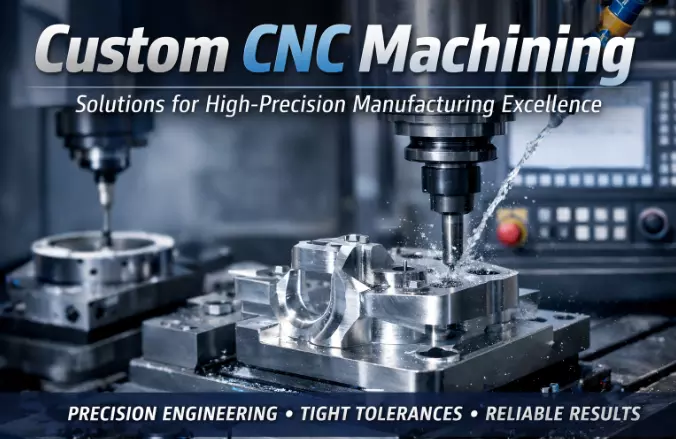
Custom CNC Machining Solutions for High-Precision Manufacturing Excellence
Modern manufacturing depends on accuracy, speed, and consistency. As industries push for tighter tolerances and more complex designs, custom CNC machining has become a critical solution for producing high-quality components at scale.
From prototypes to full production runs, CNC machining enables manufacturers to meet demanding specifications without compromising efficiency or reliability.
This article explores how custom CNC machining supports advanced manufacturing, the processes involved, the materials used, and why it remains a strategic advantage for businesses worldwide.
Understanding Custom CNC Machining in Today’s Manufacturing Landscape
Custom CNC machining refers to the use of computer-controlled machines to manufacture parts based on unique design requirements. Unlike standard machining, this approach focuses on tailored solutions that match exact drawings, tolerances, and functional needs.
Manufacturers choose CNC machining because it delivers repeatable accuracy while supporting complex geometries that manual processes cannot achieve consistently.
Why CNC Technology Drives Precision Manufacturing
CNC systems translate digital designs into precise machine movements. This digital control ensures accuracy across every operation.
Computer-Controlled Accuracy
CNC machines follow programmed instructions with minimal deviation, ensuring each part matches the original design.
High Repeatability
Once programmed, CNC machining produces identical parts across multiple production cycles, making it ideal for both low- and high-volume manufacturing.
Core CNC Machining Processes for Custom Components
Custom CNC machining relies on several specialized processes. Each process supports different part geometries and performance requirements.
CNC Milling for Complex Shapes
CNC milling removes material using rotating cutting tools. This process excels at producing intricate features, pockets, and contours.
Multi-Axis Milling Capabilities
Multi-axis CNC milling allows manufacturers to machine multiple faces of a part in one setup. This reduces errors, improves surface finish, and shortens production time.
CNC Turning for Cylindrical Precision
CNC turning rotates the workpiece while cutting tools shape it. This method is ideal for shafts, bushings, and threaded parts.
Consistent Surface Finishes
High-speed CNC lathes deliver smooth finishes and tight tolerances, even on challenging materials.
Secondary and Finishing Operations
Custom CNC machining often includes additional steps to refine part quality.
Precision Drilling
Ensures accurate hole placement and diameter control.
Grinding and Polishing
Improves flatness, surface smoothness, and dimensional accuracy.
Deburring and Surface Treatment
Enhances safety, aesthetics, and functional performance.
Materials Used in Custom CNC Machining
Material selection directly influences part performance, durability, and cost. CNC machining supports a wide range of metals and plastics.
Metal Materials for Strength and Reliability
Metals remain the backbone of CNC machining across industries.
Aluminum Alloys
Lightweight, corrosion-resistant, and easy to machine, aluminum is widely used in aerospace, automotive, and electronics
Stainless Steel
Stainless steel offers excellent strength and corrosion resistance, making it ideal for medical and industrial applications.
Titanium
Titanium provides exceptional strength-to-weight performance and biocompatibility, especially for aerospace and medical components.
Engineering Plastics for Specialized Applications
Custom CNC machining also supports high-performance plastics.
PEEK and PTFE
These materials provide chemical resistance, thermal stability, and electrical insulation.
Nylon and Delrin
They deliver lightweight, wear-resistant solutions for mechanical components.
Industries That Depend on Custom CNC Machining
Many industries rely on CNC machining to meet strict quality and performance standards.
Aerospace and Defense Manufacturing
Aerospace components demand extreme precision and material integrity. CNC machining produces lightweight, high-strength parts that perform reliably under stress.
Medical Device and Healthcare Equipment
Medical applications require flawless finishes and precise dimensions. CNC machining supports regulatory compliance and patient safety.
Automotive and Transportation
From engine components to transmission systems, CNC machining improves performance, efficiency, and durability.
Industrial Equipment and Automation
Robotics, automation systems, and industrial machinery rely on CNC-machined components for accuracy and repeatability.
The Strategic Advantages of Custom CNC Machining
Choosing custom CNC machining offers manufacturers long-term operational benefits.
Precision and Consistency at Scale
CNC technology ensures every part meets the same specifications, regardless of volume.
Faster Production and Reduced Lead Times
Automated machining shortens production cycles while minimizing rework and errors.
Cost Efficiency Over the Product Lifecycle
Although CNC machining requires upfront investment, it reduces long-term costs by improving quality and reducing failures.
Design Freedom and Innovation
Engineers can create complex designs without sacrificing manufacturability or performance.
Quality Control in CNC Machining Operations
Quality assurance remains central to CNC machining success. Advanced inspection systems verify every component.
Dimensional Inspection and Measurement
Coordinate Measuring Machines (CMMs) and optical inspection tools confirm accuracy and tolerance compliance.
Process Monitoring and Traceability
Continuous monitoring ensures consistent results while supporting documentation and quality standards.
Continuous Improvement Practices
Manufacturers invest in technology upgrades and process optimization to maintain competitive performance.
Why Manufacturers Choose Custom CNC Machining Partners
Companies partner with experienced machining providers to access advanced equipment, skilled engineers, and efficient workflows. Professional custom CNC machining enables businesses to focus on innovation while ensuring components meet exact specifications.
By outsourcing complex machining requirements, manufacturers gain scalability, technical expertise, and reliable production outcomes.
Read: How Sheet Metal Fabrication Ensures Precision and
Future Trends in Custom CNC Machining
CNC machining continues to evolve alongside digital manufacturing.
Smart Manufacturing and Automation
Data-driven CNC systems improve predictive maintenance and production efficiency.
Advanced Tooling and Materials
Innovations in tooling and material science enhance machining speed and part performance.
Sustainable Manufacturing Practices
Efficient CNC processes reduce waste and support environmentally responsible production.
Conclusion: Custom CNC Machining as a Competitive Advantage
Custom CNC machining stands at the core of modern manufacturing. It delivers precision, repeatability, and flexibility across industries that demand excellence.
By combining advanced CNC technology with skilled engineering and rigorous quality control, manufacturers can transform complex designs into reliable, high-performance components.
As industries continue to innovate, custom CNC machining remains a vital solution for achieving accuracy, efficiency, and long-term manufacturing success.