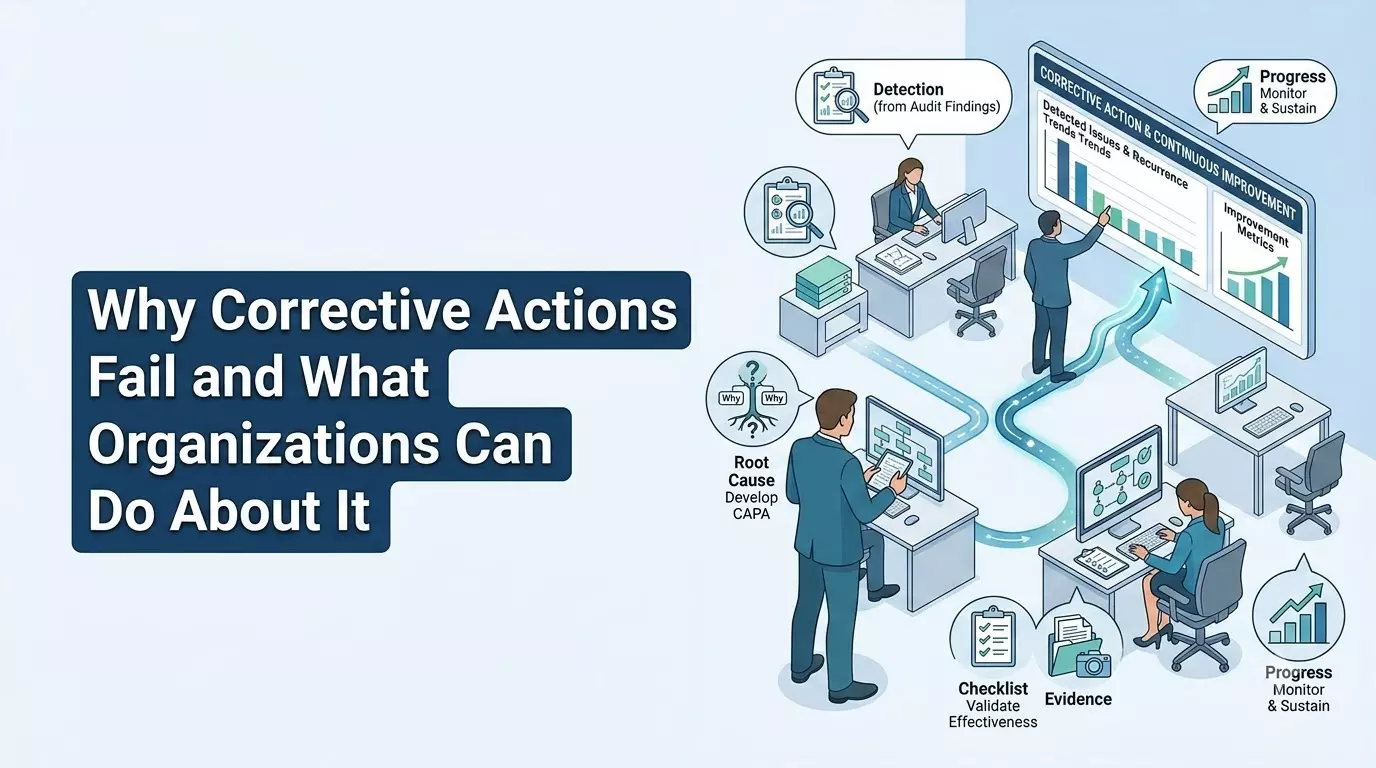
Why Corrective Actions Fail and What Organizations Can Do About It
An audit identifies a control weakness. Someone is assigned an action. A new procedure is introduced, training is completed, or a document is updated. The evidence is uploaded, and the finding is marked closed.
But there is a question that often gets less attention: Did the organisation actually fix the problem?
A completed corrective action and an effective corrective action are not necessarily the same thing.
The difference matters because organisations can spend significant time closing findings only to discover the same issue during a later audit, incident investigation, or compliance review.
Why Do Corrective Actions Fail?
One reason is that organizations sometimes respond to the visible symptom rather than the underlying cause.
Imagine employees repeatedly make mistakes while completing a particular process. The organisation responds with additional training. That might work.
But what if the actual problem is an unclear procedure? Or a poorly designed system? Or a process that requires information employees cannot easily access?
Training may reduce the problem temporarily without addressing what caused it. This is where root cause analysis becomes important.
Before deciding what action to take, organizations need to understand why the problem occurred and what conditions allowed it to happen.
How Can Organizations Find the Real Cause?
The right level of investigation depends on the problem. A minor documentation error may have a straightforward explanation.
A serious incident or recurring control failure may require a deeper review of processes, people, technology, responsibilities, and organisational conditions.
A simple technique is to keep asking why an issue occurred until the explanation moves beyond the immediate event.
For example, a report was submitted late. Why? Because the employee did not receive the necessary information. Why? Another team had not provided it. Why?
There was no clearly defined responsibility for providing the information. The corrective action in this case may need to address ownership and workflow rather than simply reminding employees about deadlines.
The objective is not to make every investigation complicated. It is to make sure the response matches the actual cause.
Read: Streamlining Success with CE Certification
What Happens When Corrective Actions Have No Clear Owner?
Even a well-designed corrective action can fail if nobody is clearly responsible for delivering it. This becomes particularly difficult when an action involves several departments.
One team may be responsible for changing a process. Another may need to update technology. A third may need to provide training. Without clear accountability, everyone may assume someone else is responsible for moving the action forward.
A strong process gives each significant action an owner, a realistic deadline, and a clear definition of what successful completion looks like.
A structured incident and corrective-action process can help teams track actions after an incident rather than allowing them to disappear into email threads or disconnected spreadsheets.
The important part is not simply assigning a name to an action. The owner needs enough authority and resources to actually resolve it.
Does Closing an Action Mean It Worked?
No, completion and effectiveness should be treated as two separate questions.
Completion asks whether the planned activity happened. Effectiveness asks whether the activity achieved its intended outcome.
Consider an organization that discovers inconsistent access reviews. It creates a new checklist and trains the relevant employees.
The action can be completed once the checklist exists and training has taken place. But management may still need to verify whether access reviews are now being performed consistently.
That could involve sampling records, reviewing evidence, monitoring incidents, or conducting a follow-up assessment. This distinction prevents organisations from confusing activity with improvement.
What Can Audit Findings Teach an Organisation?
Audit findings are often treated as problems that need to disappear from the report. That mindset can lead organisations to focus on closure rather than learning. A better approach is to ask what the finding reveals about the organisation's processes.
A recurring documentation issue might indicate unclear policies. Repeated control failures could suggest that a process is too complicated. Similar findings across several departments might point to a systemic issue rather than isolated mistakes.
This makes audit information valuable beyond the individual finding. The Office of the Australian Information Commissioner uses risk-based privacy assessments to identify privacy risks and areas of non-compliance, with recommendations intended to address significant risks and improve practices.
How Can Organisations Prevent Recurring Findings?
A recurring finding deserves more attention than a one-time administrative error. If the same problem continues to appear, organisations should question whether the previous corrective action addressed the underlying cause.
It may also be useful to look for patterns across departments, locations, or processes. A repeated issue in several parts of the business may indicate a common weakness in policy, training, technology, or governance.
This is where connected information becomes useful. When findings, risks, incidents, controls, and actions can be viewed together, organisations have more context for determining whether a problem is isolated or part of a wider pattern.
AssurePlus provides a GRC platform that brings different governance, risk, and compliance activities into a connected environment. The benefit of this approach is not simply better record-keeping. It can make relationships between different types of organisational information easier to see.
Why Should Corrective Actions Be Part of Continuous Improvement?
A corrective action should ideally leave the organisation stronger than it was before the problem occurred.
That means the process should not stop when the immediate issue is resolved. The organisation can ask what it learned, whether another part of the business faces the same risk, and whether the change should be incorporated into policies, controls, training, or future assessments.
ISO 31000 identifies monitoring, review, and continual improvement as important parts of effective risk management. Its framework is designed to help organisations integrate risk management into governance, strategy, planning, reporting, policies, values, and culture.
This creates a broader view of corrective action. The goal is not simply to make one problem disappear. It is to reduce the likelihood that the organisation will face the same problem again.
What Should a Strong Corrective-Action Process Look Like?
A practical corrective-action process should create a clear connection between the original problem and the eventual improvement.
The organisation identifies the issue, investigates its cause, decides what needs to change, assigns ownership, tracks implementation, collects evidence, and verifies whether the action was effective.
The process can then feed its lessons back into risk assessments, controls, policies, and training.
That creates a continuous loop:
Finding → Root Cause → Corrective Action → Evidence → Verification → Improvement
The exact workflow will vary by organisation, but the principle remains the same.
Conclusion
Organisations get greater value from audits and incidents when they look beyond the immediate correction and ask why the issue happened in the first place. Clear ownership, appropriate root cause analysis, evidence-based verification, and follow-up can make corrective actions more meaningful.
Most importantly, organisations should treat findings as sources of information rather than administrative tasks.
When corrective actions lead to stronger controls and fewer recurring problems, the organisation is not merely closing findings. It is learning from them.