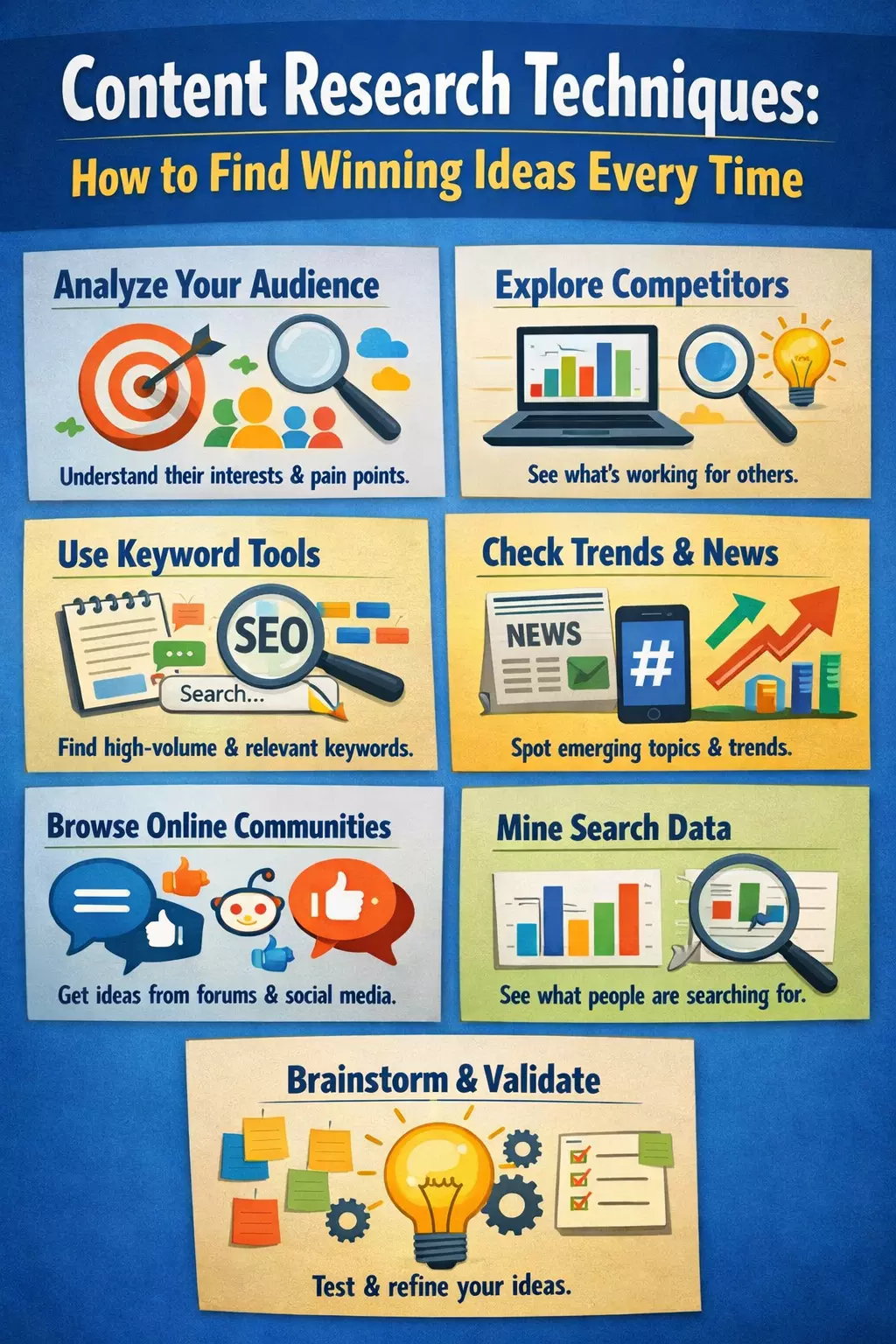
Content Research Techniques: How to Find Winning Ideas Every Time
Introduction to Advanced Content Research Techniques
In today’s competitive digital landscape, content research techniques define the difference between content that performs and content that gets ignored.
We focus on building a structured, data-driven approach that consistently uncovers high-impact, audience-focused content ideas.
By leveraging precise research methods, we ensure that every piece of content aligns with search intent, user demand, and ranking opportunities.
Understanding Search Intent for Smarter Content Ideas
To uncover winning ideas, we begin by identifying search intent, which falls into four primary categories:
- Informational Intent – Users seeking knowledge
- Navigational Intent – Users looking for specific websites
- Transactional Intent – Users ready to purchase
- Commercial Investigation – Users comparing options
We align every topic with clear intent signals, ensuring that our content directly satisfies user expectations. This alignment increases engagement, dwell time, and conversion rates.
Keyword Research: The Foundation of Content Discovery
Effective content research techniques start with deep keyword analysis. We focus on:
1. Long-Tail Keywords
These keywords have lower competition but higher conversion potential.
Example: “content research techniques for SEO beginners”
2. Semantic Keywords
We expand keyword coverage using related terms, improving topical authority.
3. Question-Based Queries
We target queries like:
- “How to do content research?”
- “Best tools for content research”
These drive featured snippets and voice search visibility.
Analyzing Competitor Content for Gaps
We conduct a thorough competitor content analysis to identify:
- Top-performing pages
- Content gaps
- Weak or outdated sections
By reverse-engineering competitor strategies, we uncover opportunities to create better, deeper, and more valuable content. Our goal is to produce content that is more comprehensive, actionable, and current.
Using Data-Driven Tools for Content Insights
We rely on advanced tools to refine our research process:
Content Analysis Tools
- Identify trending topics
- Analyze keyword difficulty
- Track search volume
Audience Research Tools
- Understand user behavior
- Discover content preferences
- Identify engagement patterns
Trend Monitoring Tools
We track emerging topics to stay ahead of the curve and publish timely, high-demand content.
Leveraging User-Generated Platforms for Ideas
One of the most effective content research techniques is analyzing real user discussions. We extract insights from:
- Forums
- Q&A platforms
- Comment sections
These sources reveal real problems, questions, and pain points, allowing us to create content that directly addresses user needs.
Topic Clustering for Authority Building
We organize content into topic clusters, which include:
- Pillar Content – Comprehensive main topic
- Cluster Content – Supporting subtopics
This structure improves:
- Internal linking
- Topical authority
- Search engine rankings
By covering a topic in-depth, we signal expertise and relevance.
Content Gap Analysis for Competitive Advantage
We identify missing or underdeveloped topics in the market. This involves:
- Finding keywords competitors are not targeting
- Expanding shallow content into detailed guides
- Updating outdated information
This approach ensures we consistently publish unique, high-value content that stands out.
Social Listening for Real-Time Content Ideas
Social platforms provide immediate access to trending conversations. We analyze:
- Viral posts
- Popular hashtags
- Audience discussions
This helps us create timely and relevant content that resonates with current interests.
Analyzing Search Engine Results Pages (SERPs)
We study SERPs to understand what ranks and why. Key elements include:
- Featured snippets
- People Also Ask sections
- Top-ranking formats (lists, guides, videos)
By aligning our content structure with what already performs, we increase our chances of ranking higher.
Content Formats That Drive Engagement
We diversify content formats to maximize reach:
- How-to guides
- Listicles
- Case studies
- Step-by-step tutorials
Each format serves a specific purpose and enhances user engagement and retention.
Building a Repeatable Content Research System
We implement a structured workflow:
- Identify target keywords
- Analyze competitors
- Map search intent
- Find content gaps
- Validate with data tools
- Create optimized outlines
This system ensures consistent production of high-performing content ideas.
Optimizing Content for Maximum Visibility
We ensure every piece of content includes:
- Keyword-rich headings
- Optimized meta descriptions
- Internal linking strategy
- Clear content hierarchy
These elements improve both user experience and search engine crawlability.
Read: Why Content Marketing is Integral to Search Engine
Measuring Content Performance and Refining Strategy
We continuously analyze:
- Traffic performance
- Engagement metrics
- Conversion rates
Based on this data, we refine our content strategy to maintain consistent growth and ranking improvements.
Conclusion: Mastering Content Research for Long-Term Success
By applying advanced content research techniques, we create content that is not only optimized for search engines but also delivers real value to users.
Our approach combines data analysis, audience insights, and strategic planning to consistently uncover winning content ideas.