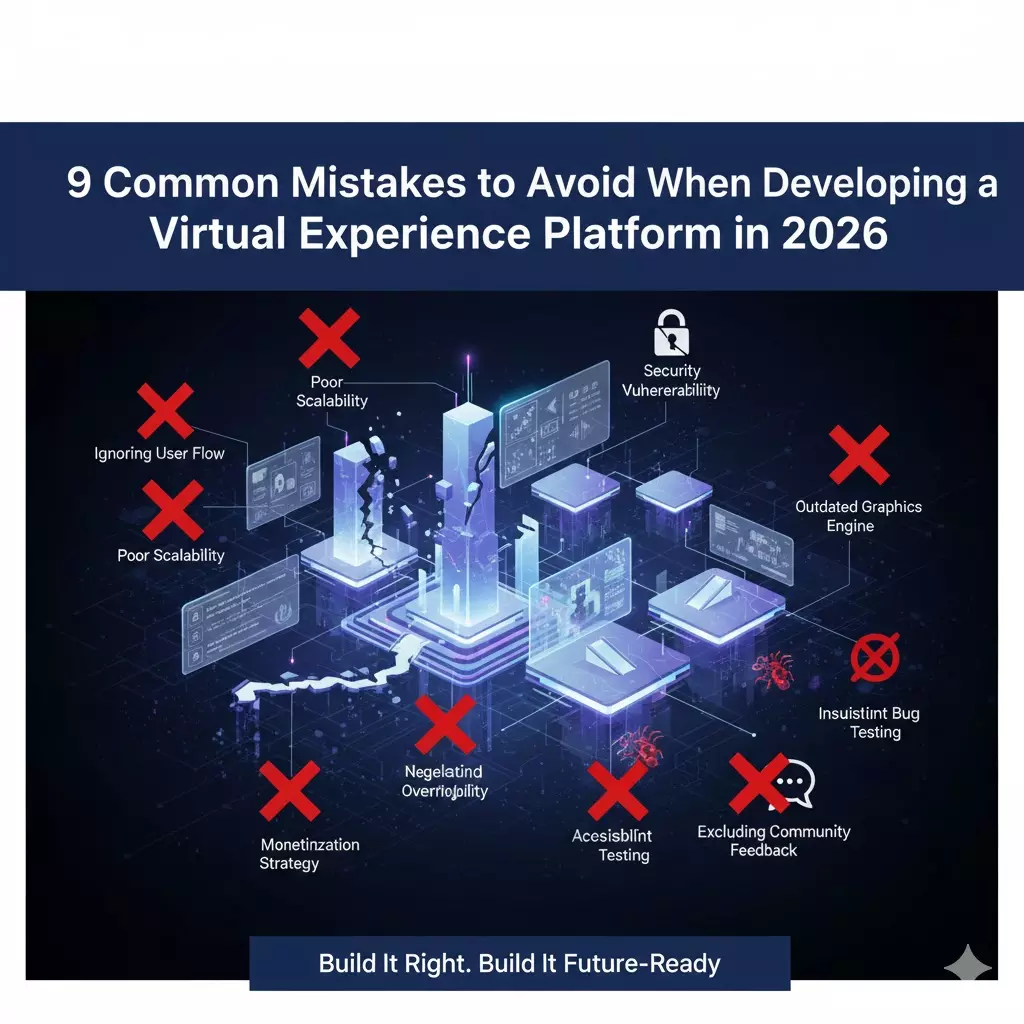
9 Common Mistakes to Avoid When Developing a Virtual Experience Platform in 2026
The race toward immersive digital ecosystems is accelerating. Retail, gaming, education, healthcare, and real estate businesses are investing in virtual environments. They aim to boost engagement, open new revenue streams, and secure their brands for the future. A great virtual experience platform requires more than 3D visuals and blockchain hype.
In 2026, competition is tougher. User expectations are higher, and technology is more complex. Many companies rush development without planning. This leads to poor adoption, security issues, and high infrastructure costs.
Choosing a top metaverse development company? Be aware of common pitfalls. This can protect your investment and help ensure long-term success.
Below are nine critical mistakes businesses must avoid.
1. Starting Without a Clear Business Model
Many virtual platform projects fail. They often launch without a revenue plan. This is one of the most common mistakes in development.
A virtual experience platform is not a technical product — it is a digital economy. Without monetization clarity, growth becomes unsustainable.
Common monetization strategies include:
- Virtual land sales
- NFT-based digital assets
- Subscription access
- In-platform advertising
- Transaction fees
- Brand partnerships
Before development begins, define:
- Who your target audience is
- What value do you offer them
- How we will generate revenue
- What retention mechanisms will sustain engagement
A strong platform can still fail if it doesn't have a clear business model.
2. Ignoring Scalability from Day One
Many companies build for current demand rather than future growth. This leads to infrastructure bottlenecks when user traffic increases.
Virtual platforms must have a scalable architecture because they involve:
- Real-time rendering
- Concurrent users
- High data processing
- Blockchain transactions (if integrated)
Poor backend planning leads to:
- Lag and crashes
- Poor user experience
- Increased hosting costs
- Security vulnerabilities
Rank scalable cloud infrastructure and modular architecture in early development. Don’t add them later as a patch.
3. Overcomplicating the User Experience
Advanced graphics do not compensate for poor usability. Even the most visually impressive platform will fail if navigation is confusing or onboarding is complex. A professional metaverse development company must prioritize intuitive design, seamless interaction, and scalable virtual experience platform development to ensure long-term engagement and retention.
In 2026, users expect:
- Simple onboarding
- Fast loading environments
- Intuitive navigation
- Minimal technical friction
Overloading users with complex controls, unnecessary steps, or heavy device requirements reduces adoption.
User experience design should focus on:
- Accessibility across devices
- Clear navigation systems
- Quick account creation
- Seamless wallet integration
A virtual platform works best when the technology stays hidden. This way, users can have a smooth experience.
4. Neglecting Cross-Platform Compatibility
A major strategic mistake is building only for high-end VR hardware. VR adoption is growing. But many users still access virtual environments on mobile devices and desktops.
Limiting access to specific devices restricts audience growth.
Your development roadmap should include:
- Web-based accessibility
- Mobile compatibility
- VR/AR support
- Cloud streaming options
Cross-platform accessibility enhances market reach and engagement.
5. Underestimating Security & Data Protection
Virtual platforms involve user accounts, digital assets, financial transactions, and personal data. Weak security infrastructure can lead to devastating consequences.
Security oversights often include:
- Weak smart contract auditing
- Poor wallet integration safeguards
- Inadequate data encryption
- Lack of compliance planning
In 2026, cybersecurity threats are more sophisticated than ever. Integrators should build security into the architecture from the start. It shouldn't be an afterthought.
Partnering with experienced developers who focus on:
- End-to-end encryption
- Multi-layer authentication
- Smart contract audits
- Regulatory compliance
is essential for long-term credibility.
Read: How to Build a Super App Like Gojek for Multi-Service
6. Failing to Build a Strong Digital Economy
Its internal economy sustains a virtual platform. Many projects place great emphasis on environmental design while overlooking economic incentives.
Without value exchange mechanisms, user engagement declines.
An effective digital economy includes:
- Token utility
- Marketplace functionality
- Scarcity models
- Incentive-driven participation
- Creator monetization tools
Users must have reasons to return. Ownership, rewards, and economic participation create stickiness.
7. Lack of Community-Building Strategy
Virtual platforms thrive on community engagement. Yet many businesses treat them as static digital spaces rather than living ecosystems.
Community-building requires:
- Interactive events
- Live sessions
- Social interaction tools
- Creator collaboration
- Feedback loops
In 2026, user-generated content drives retention. Open platforms enable creators to build, sell, and customize experiences. These systems expand faster than closed ones.
Community is not a marketing add-on — it is the growth engine.
8. Poor Performance Optimization
Immersive platforms demand heavy computational power. If environments lag or crash frequently, users abandon them immediately.
Performance issues usually stem from:
- Unoptimized 3D assets
- Heavy textures
- Poor server load balancing
- Inefficient code architecture
Optimization should include:
- Lightweight rendering techniques
- Smart asset compression
- Server scaling automation
- Continuous performance monitoring
A system's speed and responsiveness directly affect user satisfaction and retention.
9. Treating Development as a One-Time Project
Virtual platforms are dynamic ecosystems. Many businesses divide their budget only for initial development and neglect long-term updates.
In reality, successful platforms must:
- Continuous feature upgrades
- Security updates
- Community engagement tools
- Performance optimization
- Market adaptation
Digital ecosystems evolve at a fast pace. A platform that does not adapt becomes obsolete.
Long-term strategic planning must include:
- Maintenance budgets
- Roadmap planning
- Data analytics tracking
- Feedback-driven improvements
Sustainable growth requires continuous iteration.
Strategic Considerations for 2026
The competitive landscape in 2026 demands more than innovation — it demands execution excellence.
Businesses entering the immersive digital space must consider:
- Market positioning
- Technology stack selection
- Legal compliance
- Intellectual property protection
- Interoperability standards
Working with a professional development expert gives you clear planning and tech know-how. You also get infrastructure that is ready for the future.
Cost Implications of Common Mistakes
Avoiding these nine mistakes has a direct impact on ROI.
When businesses neglect strategy or scalability, they face:
- Rebuilding costs
- Security breach liabilities
- User churn losses
- Brand credibility damage
- Investor hesitation
But strategic development leads to:
- Higher retention
- Stronger monetization
- Faster user acquisition
- Long-term brand authority
In financial terms, prevention costs much less than correction.
The Competitive Advantage of Doing It Right
Organizations that approach virtual platform development with discipline gain several advantages
- Sustainable digital ecosystems
- Higher investor confidence
- Stronger user trust
- Scalable monetization models
- Technological resilience
The difference between success and failure often lies in planning, not coding.
Final Thoughts
Virtual experience platforms are a key digital opportunity of this decade. But the technology alone does not guarantee success.
Avoiding these nine common mistakes ensures:
- Strong infrastructure
- Scalable growth
- Secure transactions
- Engaged communities
- Sustainable revenue
In 2026, companies will lead the market. They will view immersive platforms as lasting digital ecosystems. They won't see them as experiments.
Key elements for a future-ready virtual experience platform are smart planning. You also need technical skills and effective execution. This platform will not only launch well but also grow and thrive over time.