Common Mistakes Teams Make When Deploying AI Agents in Production
Common Mistakes Teams Make When Deploying AI Agents in Production
A few months back, a mid sized company proudly announced their new AI agent that could handle customer support tickets on its own. It worked well in testing. The demo looked flawless. Everyone was excited.
Then it went live, and within the first week, it started giving wrong answers to real customers because the live data looked nothing like the clean test data it had trained on. The team had to pull it back within days.
This story is not rare. According to research covered by LumiChats, an S&P Global Market Intelligence survey found that only 11% of organizations with AI agents actually have them running in production, even though 97% of enterprises have explored or built one.
That gap tells a simple story. Building an AI agent is easy. Running it safely in the real world is where most teams struggle.
This is exactly why AI agents in production mistakes have become such a common talking point among engineering teams and business leaders.
It is not that agentic AI does not work. It is that most teams approach deployment the wrong way and end up paying for it later. This article walks through the mistakes that cause AI agent deployment challenges and shows what actually helps teams succeed.
Why Most AI Agent Projects Never Reach Production
The main intent behind understanding AI agents in production mistakes is simple. People want to know why a technology that performs so well in a demo often falls apart once real customers, real data, and real pressure enter the picture.
The answer usually has little to do with the AI model itself. It has more to do with how teams plan, test, and support the agent once it goes live.
Most failures fall into a handful of repeatable patterns. Once a team understands these patterns, avoiding them becomes far easier. Let us go through each one.
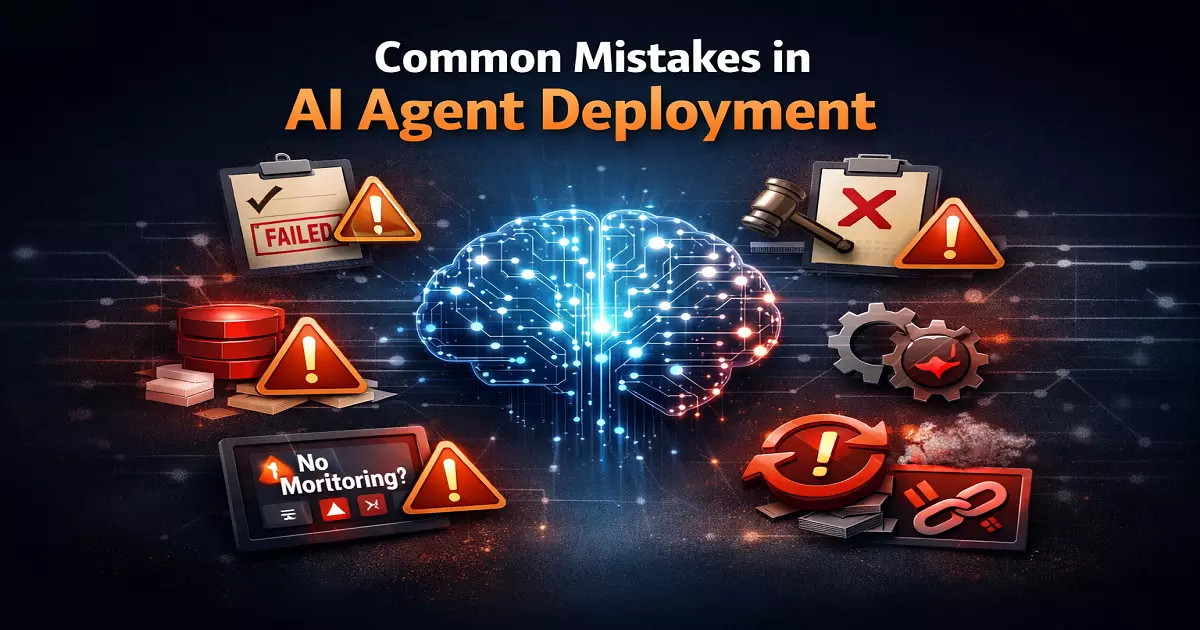
Common Mistakes in AI Agent Deployment
Most AI agent projects fail not because of the model itself, but because of how teams plan, test, and support deployment. These mistakes repeat across organizations and can be avoided with the right approach.
Treating a Pilot Like a Finished Product
A pilot project runs in a controlled environment. The data is clean. The scenarios are limited. The users are often internal employees who know how to phrase their requests correctly.
Production is nothing like that. Customers write messy sentences. They ask questions the agent was never trained to expect. They switch topics mid conversation. Many production AI agent failures happen simply because a team assumed pilot success meant production readiness.
A pilot proves an idea can work. It does not prove the system is ready for real traffic, real edge cases, and real consequences.
Ignoring Data Quality Before Deployment
An AI agent is only as reliable as the data feeding it. Many teams rush into deployment with data that is incomplete, inconsistent, or scattered across different systems that were never designed to talk to each other.
This is one of the most common pitfalls in agentic AI implementation for businesses. The agent might work fine on paper, but once it touches real records with missing fields or outdated information, its answers start to fall apart. Fixing data quality after deployment is far more expensive than fixing it before the agent goes live.
Skipping Governance and Approval Processes
Many teams treat governance as paperwork that slows things down. In reality, governance is what keeps an AI agent safe once it starts making decisions on its own.
Without clear rules about what an agent can and cannot do, teams often discover problems only after something goes wrong. A support agent might issue refunds it was never authorized to approve. A scheduling agent might book appointments without checking real availability. These are not rare edge cases. They are the direct result of deploying an agent without defining its boundaries first.
Setting up approval processes, audit trails, and clear escalation paths before launch is one of the simplest ways to prevent this kind of production AI agent failure.
Read: Custom AI Agent Development Services Powering Intelligent
Underestimating Integration Complexity
On paper, connecting an AI agent to existing business systems sounds straightforward. In practice, it rarely is. Many enterprise systems were built long before AI agents existed, and they were never designed to be queried the way an agent needs to query them.
Authentication issues, rate limits, and inconsistent data formats often turn a two week integration plan into a two month project. This is one of the biggest reasons behind enterprise AI agent deployment delays, and it catches teams off guard because the agent itself may be fully built and ready while the surrounding infrastructure is not.
Not Planning for Monitoring and Rollback
An AI agent that nobody is watching is a risk waiting to happen. Some teams launch an agent and assume it will keep performing the same way it did during testing. But agents can drift over time as data changes, as user behavior shifts, or as the systems around them get updated.
Without proper monitoring, a small issue can quietly grow into a major failure before anyone notices. Without a rollback plan, teams often scramble under pressure once something breaks, which usually makes the problem worse. This is one of the clearest examples of why AI agents fail in production environments even after a smooth launch.
Best Practices for Deploying AI Agents at Scale
Avoiding these mistakes does not require a massive budget or a large team. It requires discipline. Teams that succeed usually start with a narrow, well defined use case instead of trying to automate everything at once. They invest time in cleaning and organizing their data before deployment instead of after.
They build governance and monitoring into the project from day one rather than adding it later as an afterthought. And they treat the first version of the agent as something that will keep evolving rather than a finished product.
Learning how to avoid AI agent deployment failures often comes down to slowing down at the right moments. A limited agent that works reliably in production is far more valuable than an impressive agent that only works in a demo.
Conclusion
Deploying AI agents is not just a technical task. It is an organizational one. The teams that succeed are not necessarily the ones with the most advanced models. They are the ones who plan for real world data, set clear boundaries, and build monitoring into the system from the start.
Understanding common AI agent deployment challenges early can save businesses months of wasted effort and a lot of frustration later. If your team is planning to deploy an AI agent, treating production readiness as the goal from day one, rather than an afterthought, makes all the difference.