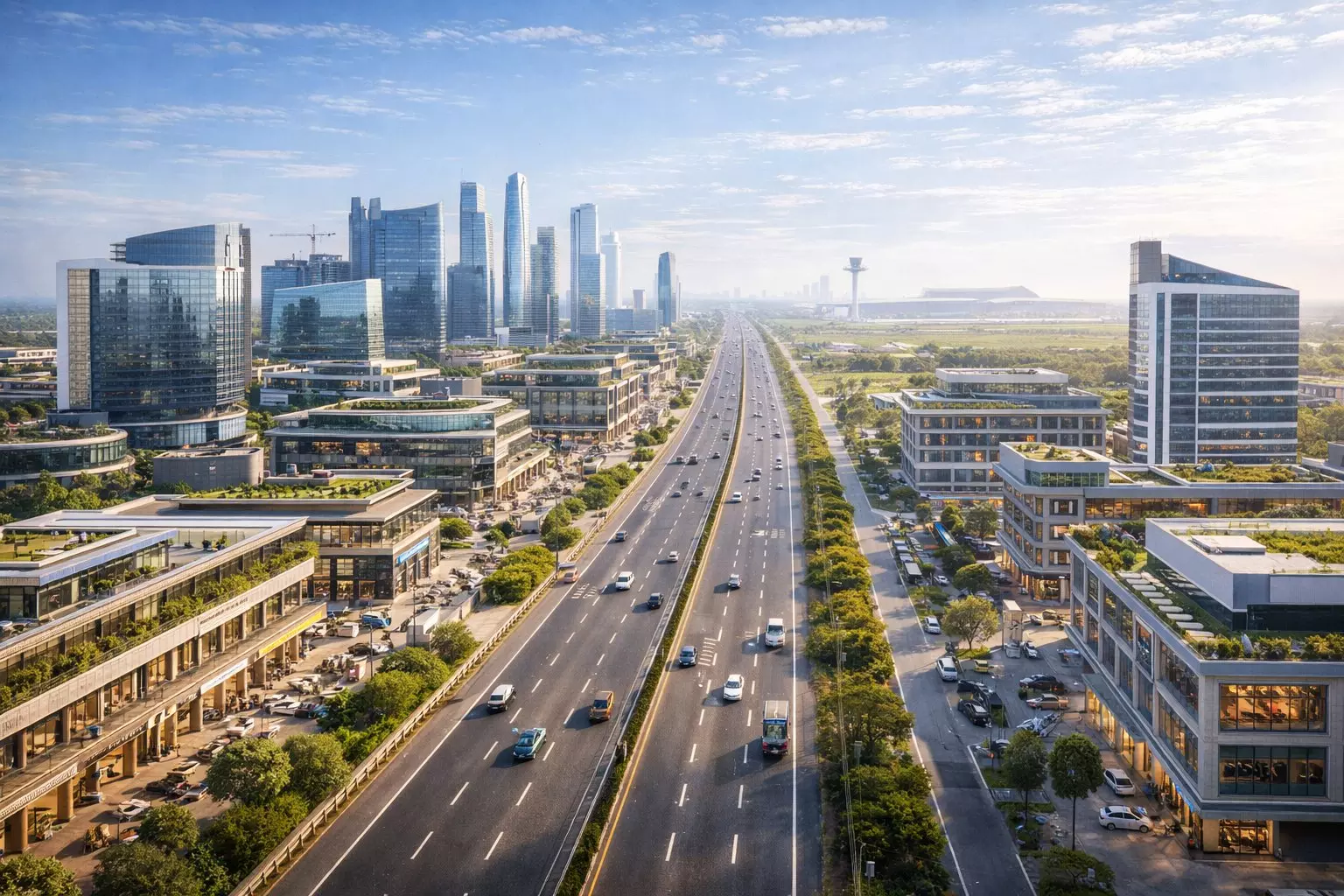
Why Are Serious Investors Paying Attention to Commercial Property on the Yamuna Expressway?
If you are browsing commercial property along the Yamuna Expressway, you are likely asking one critical question:
Is this corridor genuinely a high-return opportunity, or is it just another developing stretch?
The answer lies in structure, infrastructure, and timing.
What originally began as a high-speed connectivity route between Greater Noida and Agra has evolved into one of North India’s most strategically planned commercial growth corridors. The Yamuna Expressway, unlike speculative micro-markets that rely on hype, receives support from
- Long-term infrastructure commitment
- Authority-backed sector planning
- Clearly defined zoning regulations
For investors looking beyond saturated NCR markets, this corridor represents a calculated opportunity—not speculation.
Why Is the Yamuna Expressway Transforming into a Commercial Hub?
The real estate potential of any corridor depends on two key factors:
- Clarity of planning
- Successful infrastructure execution
The Yamuna Expressway benefits from both.
Structured master plans allocate large land parcels for:
- Commercial zones
- Industrial and logistics clusters
- Institutional development
- Mixed-use sectors
- Infrastructure corridors
Unlike organically grown city markets where zoning confusion often creates risk, this corridor follows defined land-use regulations. That clarity reduces uncertainty—a major advantage for commercial investors.
When infrastructure and planning move in alignment, long-term value creation becomes more predictable.
Infrastructure: The Core Driver of Commercial Demand
Infrastructure is not just a support system—it is the engine behind commercial real estate growth.
The Yamuna Expressway offers:
- Direct connectivity between Greater Noida and Agra
- Seamless access to major NCR highways
- Expanding regional road networks
- Proposed metro and logistics improvements
Improved mobility enhances:
- Business operations
- Workforce accessibility
- Supply-chain efficiency
Commercial zones backed by strong infrastructure typically show steady absorption rather than unstable price spikes. This is one of the primary reasons serious investors are closely monitoring this corridor.
Jewar International Airport: The Game-Changer
The upcoming Noida International Airport at Jewar is one of the most significant growth catalysts for commercial property along the Yamuna Expressway.
Historically, airports have functioned as economic anchors. They stimulate ecosystem growth across:
- Office and business parks
- Retail developments
- Hospitality and hotel projects
- Logistics and warehousing facilities
Commercial property in airport-influenced zones often experiences sustained demand growth driven by corporate expansion and employment generation.
As airport infrastructure moves toward operational readiness, surrounding commercial sectors are expected to shift from planning stages to active business absorption.
For long-term investors, this catalyst significantly strengthens the risk-reward equation.
Read: How Planning Discipline Affects Property Decisions
What Types of Commercial Property Are Available?
Investors evaluating this corridor typically assess multiple asset categories:
1. Commercial Plots
Ideal for long-term capital appreciation and development flexibility.
2. Retail and SCO Projects
Designed to serve future residential, industrial, and workforce demand.
3. Mixed-Use Developments
Integrating retail, office, and service spaces within a unified environment.
4. Institutional and Corporate Land Parcels
Supporting logistics operators, industrial users, and corporate expansion.
This structured variety allows investors to align their investments with budget, holding period, and risk tolerance.
Why Investors Are Comparing Yamuna Expressway with Noida and Gurugram
Established NCR markets like Noida and Gurugram offer stability—but often at higher entry costs and limited scalability.
In contrast, the Yamuna Expressway offers:
- Early-stage pricing
- Defined commercial zoning
- Infrastructure-driven development
- Long-term expansion capacity
- Airport-driven growth visibility
For investors focused on capital appreciation rather than immediate rental yield, this corridor represents a strategic entry opportunity.
In commercial real estate, timing matters. Historically, entering before large-scale end-user absorption provides stronger appreciation potential.
Long-Term Investment Outlook
Over the next decade, the Yamuna Expressway is expected to mature into a self-sustaining commercial ecosystem. As infrastructure milestones are completed and business establishments increase, demand for quality commercial assets is likely to grow steadily.
The transition from infrastructure planning to commercial execution typically establishes long-term value.
Investors who prioritize:
- Sector clarity
- Zoning verification
- Infrastructure alignment
- Long-term holding strategy
We are in a better position to reap the benefits of this structured growth phase.
For a detailed analysis of infrastructure drivers, airport impact, commercial property categories, and investment considerations, refer to: