Comme des Garçons: Fashion’s Avant-Garde Revolution
Fashion, at its most expressive, acts as a mirror and a challenge to society. Few labels have pushed the envelope of design and thought as consistently and radically as Comme des Garçons, the Japanese brand founded by Rei Kawakubo in 1969.
For over five decades, this enigmatic label has not only questioned the norms of Commes Des Garcon beauty and form but redefined what fashion can mean intellectually, culturally, and emotionally. Its approach is not merely to clothe the body, but to provoke, to unsettle, and to inspire.
The Visionary Behind the Brand: Rei Kawakubo
Rei Kawakubo, the force behind Comme des Garçons, did not originally intend to become a fashion designer. With a background in fine arts and literature, Kawakubo brought a conceptual and academic approach to design that had rarely been seen in the fashion world. Her designs are often more sculptural than sartorial, challenging the notions of symmetry, gender, and conventional aesthetics.
Kawakubo’s disdain for the traditional was apparent from her early collections. In a fashion landscape dominated by European elegance and opulence, her pieces—often black, asymmetric, and deconstructed—stood as stark rebukes. She didn't just create clothes; she created statements. Her work introduced a visual language of rebellion, disruption, and radical beauty.
Breaking the Mold: The 1981 Paris Debut
The global fashion community was first truly shaken by Comme des Garçons during its Paris debut in 1981. At a time when fashion was celebrating excess, color, and glamour, Kawakubo presented a collection that was intentionally raw and unfinished. Dubbed "Hiroshima chic" by critics for its distressed and somber appearance, the collection featured tattered fabrics, monochromatic tones, and unstructured silhouettes.
While the press was divided—some outraged, others captivated—the collection made one thing clear: Comme des Garçons was not here to please. It was here to confront. In rejecting fashion’s norms, Kawakubo carved a space for herself and for others who would follow her path of intellectual and artistic design.
Deconstruction and the Anti-Fashion Movement
The philosophy of deconstruction became a hallmark of the brand’s identity. Rei Kawakubo turned the inside out, exposed seams, and made what was traditionally hidden into a focal point. Comme des Garçons was at the forefront of the anti-fashion movement of the late 20th century, which aimed to subvert the commercial, decorative aspects of clothing in favor of a more honest and raw representation of human experience.
Garments often appeared as if they were still in the process of becoming. They were intentionally asymmetric, layered in odd proportions, and sometimes bore no obvious gender identity. In this way, Comme des Garçons pushed boundaries not only in terms of form but also in how fashion related to identity and the body. Kawakubo famously said she wanted to "design clothes that have never existed"—and she did exactly that.
Beyond Fashion: A Conceptual Playground
Unlike many designers who release collections with commercial sensibilities, Kawakubo often treats her shows like conceptual art exhibitions. Collections like “Body Meets Dress, Dress Meets Body” (Spring/Summer 1997), also known as the "Lumps and Bumps" collection, used padding to distort the natural body shape, challenging beauty norms and evoking emotional responses from the audience. These weren’t just clothes; they were provocations.
Comme des Garçons has often blurred the lines between fashion and performance art. The brand’s shows are less about selling garments and more about telling stories or posing questions. Why must fashion flatter? Why must garments adhere to the body’s shape? These questions resonate not only within the fashion world but also in wider cultural discourses around gender, identity, and self-expression.
The Power of Monochrome and Minimalism
Throughout the history of Comme des Garçons, one constant has been the profound use of black. In the early years, black was more than a color; it was a philosophy. Kawakubo embraced black not as a symbol of mourning or uniformity but as a canvas of potential. It emphasized form, texture, and shadow. Over time, her palette expanded, but the discipline and deliberateness behind color usage remained.
This minimalism extended beyond color to structure and presentation. Kawakubo’s minimalism is not about simplicity but about essentialism. Every detail, no matter how small or disruptive, carries meaning. The absence of conventional beauty allows other aspects—emotion, thought, structure—to come to the forefront.
Commercial Subversion: PLAY and Collaborations
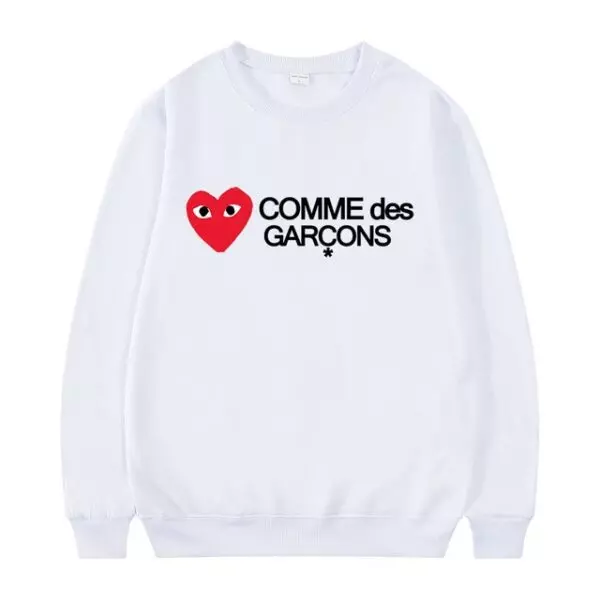
Despite the brand’s avant-garde roots, Comme des Garçons has never shied away from commercial ventures. In fact, it has subverted them. The creation of the PLAY line, with its iconic heart-with-eyes logo designed by Polish artist Filip Pagowski, introduced the brand to a younger, more mainstream audience. Yet, even here, the line retained a quirky, independent spirit.
Collaborations have also been central to the brand’s ability to exist both within and outside of mainstream fashion.
Partnerships with Nike, Louis Vuitton, Supreme, and Converse have brought Comme des Garçons aesthetics into everyday wardrobes without diluting its radical roots. Kawakubo has proven that commercial success and conceptual integrity need not be mutually exclusive.
The Dover Street Market Phenomenon
In 2004, Kawakubo launched Dover Street Market, a retail space that embodied the Comme des Garçons philosophy. Far from being just a store, it was a curated experience—an art installation, a cultural space, and a marketplace in one. With locations in London, Tokyo, New York, and beyond, Dover Street Market has become a global hub for experimental fashion and art.
Each store undergoes frequent “tachiagari” (reopening or rebirth), where the interior is entirely redesigned. This cyclical reinvention mirrors Kawakubo’s own creative process: refusing stasis, always evolving. It has provided a platform for new designers and a sanctuary for fashion lovers seeking Comme Des Garcons Long Sleeve the unusual and the unexpected.
Rei Kawakubo’s Enduring Legacy
Rei Kawakubo’s influence extends far beyond the walls of Comme des Garçons. Her vision has inspired generations of designers—Martin Margiela, Yohji Yamamoto, Rick Owens, and many more—who share her commitment to pushing the boundaries of fashion as art. In 2017, she became only the second living designer (after Yves Saint Laurent) to be honored with a solo exhibition at the Metropolitan Museum of Art’s Costume Institute in New York, further cementing her legacy.
Her refusal to explain her work, to engage in fashion’s marketing games, or to compromise her vision has made her an icon of creative independence. Kawakubo has said she wants to “create something new” rather than “retell a story,” a mantra that defines her every move.
A Revolution That Continues
Comme des Garçons is more than a brand—it is a revolution in motion. In an industry that often rewards predictability and profit, Rei Kawakubo continues to challenge norms and expectations. Her designs demand to be felt and interpreted, not simply worn. Each collection is a new chapter in a story that refuses to conform.
In many ways, Comme des Garçons doesn’t just dress the body—it speaks to the soul of those unafraid to question the world. As fashion moves further into the digital age, with increasing pressure toward mass appeal, the uncompromising vision of Rei Kawakubo stands as a beacon for those who believe that fashion can still be art, activism, and above all, a space for revolutionary thought.