Collision Avoidance Sensor Market Accelerates Toward USD 19 Billion by 2033
Introduction
Collision avoidance sensors—using technologies like radar, LiDAR, ultrasound, and cameras—are vital for detecting obstacles and preventing collisions in vehicles, machinery, and drones. With rapid uptake across automotive, construction, mining, aerospace, and logistics sectors, demand for these sensors is surging. From driver assistance systems to autonomous navigation, collision avoidance sensors are emerging as essential safety enablers in modern applications.
Market Overview
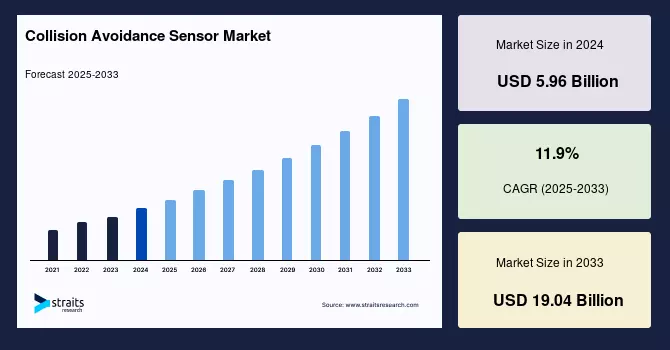
- 2024 Market Size: USD 5.96 billion
- 2025 Forecast: USD 6.45 billion
- 2033 Projection: USD 19.04 billion
- CAGR (2025–2033): 11.9%
Over this period, the market is expected to triple, reflecting strong traction in both consumer and industrial segments.
Market Drivers
ADAS Proliferation & Safety Mandates
Advanced Driver Assistance Systems (ADAS)—such as automatic emergency braking, forward collision warnings, blind-spot detection, and adaptive cruise control—are becoming standard features. Regulatory mandates are rapidly pushing automakers to include these systems in more vehicle models.
Industry Diversification
Beyond automotive, sectors like mining and construction are embracing collision avoidance sensors to enhance workplace safety and operational efficiency. Even autonomous drones rely on sensor fusion for obstacle detection and safe navigation.
Market Challenges
Environmental Sensitivities
Sensors can fail or degrade in challenging conditions—like snow, ice, or road debris—that obscure functionality such as radar or camera vision. Ensuring consistent performance in all weather conditions remains a critical technical hurdle.
Market Opportunities
Frequency Shift to 77 GHz & Next-Gen Technologies
Global regulations are encouraging a shift from 24 GHz to more advanced 77 GHz radar systems, offering better resolution and range. Combined with rapid LiDAR, ultrasonic, and camera innovations, this opens doors for safer, smarter collision systems.
Regional Landscape
- Europe: Led the market in 2024, propelled by stringent safety legislation and a mature automotive supply chain.
- Asia-Pacific: Poised for fastest growth; economic expansion, rising vehicle sales, and updated safety standards are key motivators.
- North America: Growing steadily with strong R&D in ADAS integration and connected mobility.
- LAMEA: Emerging opportunities in fleet tracking and industrial safety are gradually driving growth.
REQUEST SAMPLE: https://straitsresearch.com/report/collision-avoidance-sensor-market/request-sample
Segment Highlights
- Type: Parking assistance leads the segment share—leveraging ultrasound and camera systems for safe maneuvering.
- Technology: Radar dominates sensor technologies with its accuracy and versatility, while LiDAR and imaging solutions broaden capability sets.
- Application: The automotive sector remains the heavyweight—fueled by higher demand for driver safety features and autonomous capabilities.
Conclusion
The collision avoidance sensor market is on a steep ascent—from USD 5.96 billion in 2024 to USD 19.04 billion by 2033, reflecting an impressive CAGR of 11.9%. Major growth drivers include ADAS mandates, cross-industry adoption, and evolving sensor technologies. As autonomy and safety converge, collision avoidance systems will continue to underpin the future of smart and secure mobility.