Citrine Color Structure and the Truth Behind Its Golden Glow
Citrine is one of the most recognizable members of the quartz family. Loved for its warm yellow, golden and orange-brown colors, this gemstone brings a bright and energetic appearance to jewelry.
However, the story behind citrine is more complex than its sunny color suggests.
Natural citrine is comparatively uncommon, while much of the material available in today’s jewelry market began as amethyst and acquired its golden color through heat treatment.
Understanding citrine’s composition, color origin, treatments and identifying characteristics can help collectors and jewelry buyers make better-informed decisions.
The Gemology of Citrine
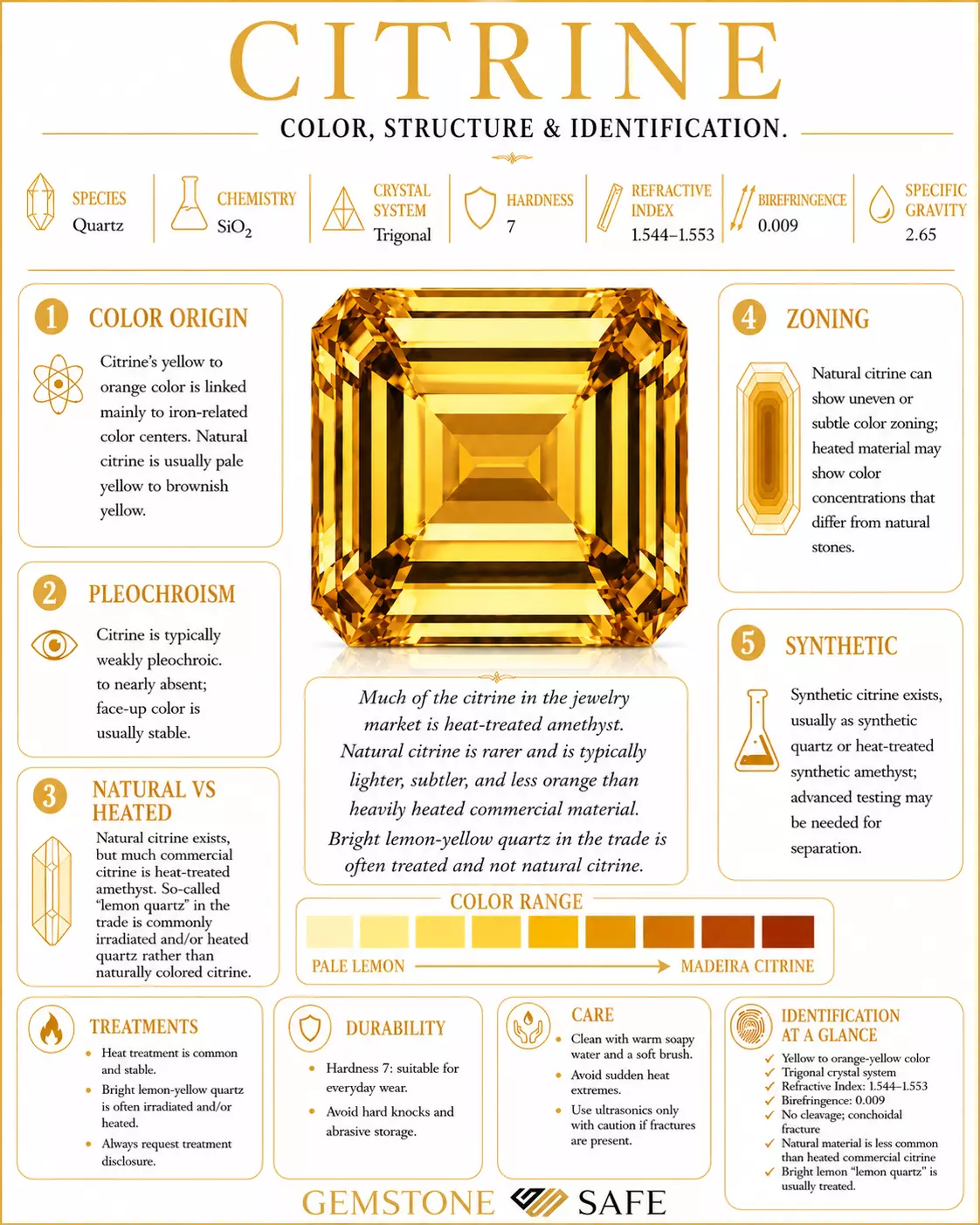
Citrine is a yellow-to-orange variety of quartz with the chemical formula SiO₂. It belongs to the trigonal crystal system and has a Mohs hardness of 7, making it suitable for many types of jewelry when worn with reasonable care.
Its refractive index generally ranges from approximately 1.544 to 1.553, while its birefringence is around 0.009. Citrine has a specific gravity of approximately 2.65. These properties are consistent with quartz and help gemologists separate it from some visually similar materials.
Like other varieties of crystalline quartz, citrine typically displays conchoidal fracture and lacks cleavage. Its combination of recognizable optical and physical properties forms an important part of professional identification.
What Produces Citrine’s Color
Citrine’s yellow, golden or orange color is associated mainly with iron-related color centers within the quartz structure. Natural citrine is often lighter and more subtle than heavily treated commercial material. Its colors may include pale lemon yellow, soft golden yellow and brownish yellow.
Some natural stones display uneven or delicate color zoning. This distribution can provide useful information when considered alongside inclusions and other gemological evidence. Nevertheless, zoning alone cannot conclusively determine whether a stone is natural or treated.
Citrine is typically only weakly pleochroic, and in some examples pleochroism may appear nearly absent. As a result, its face-up color generally remains relatively stable when the gemstone is viewed from different directions.
Natural Citrine and Heat-Treated Amethyst
One of the most important facts for buyers to understand is that a significant amount of citrine in the commercial market is heat-treated amethyst. Controlled heating can transform the purple or violet color of certain amethyst into yellow, orange or reddish-brown shades.
Heat treatment is widely accepted within the gemstone industry, provided it is properly disclosed. The treatment is generally stable under normal conditions, but disclosure remains important because natural citrine is rarer and may be valued differently.
Natural citrine often has a paler, more restrained appearance. By comparison, heated material may display stronger orange tones or concentrated areas of color. These visual tendencies can offer clues, but appearance alone is not always enough to establish treatment conclusively.
Bright material sold as “lemon quartz” should also be approached carefully. This commercial name may refer to quartz that has been irradiated, heated or subjected to a combination of treatments rather than naturally occurring citrine. Buyers should always request accurate treatment information instead of relying solely on an attractive trade name.
Madeira Citrine and the Citrine Color Range
Citrine occurs across a broad range of colors, from very pale lemon yellow to rich golden orange and deep reddish brown. The term “Madeira citrine” is commonly used in the trade for stones with warm orange, brownish-orange or reddish tones reminiscent of Madeira wine.
Madeira is a color description rather than proof of geographic origin. A gemstone should not be assumed to come from the island of Madeira simply because this term appears in its name.
Color preference is subjective, but valuation may be influenced by saturation, evenness of color, clarity, cutting quality, size and whether the color is natural or treatment-induced.
Synthetic and Laboratory-Grown Material
Laboratory-grown quartz may also be produced in yellow or orange colors and sold as synthetic citrine.
In some cases, synthetic amethyst can be heat treated to create citrine-like coloration. Distinguishing natural quartz from synthetic material may require careful microscopic examination and advanced laboratory testing.
A professional gemological report can be particularly valuable for an important stone when natural origin, treatment status or synthetic growth is a significant consideration.
Durability and Proper Care
With a hardness of 7, citrine is durable enough for rings, earrings, pendants and bracelets. Even so, it can still be scratched by harder gemstones and damaged by a strong impact. Avoid hard knocks, abrasive storage and sudden temperature extremes.
Clean citrine using warm soapy water and a soft brush or cloth. Ultrasonic cleaning may be used cautiously when the gemstone has no significant fractures, but steam cleaning and sudden exposure to intense heat are best avoided. Store citrine separately from harder gems to preserve its polish.
Citrine’s golden beauty makes it an appealing and versatile gemstone, but its true value lies in understanding what the material actually represents. Whether natural, heat treated or laboratory grown, accurate identification and transparent disclosure allow its color to be appreciated with greater confidence.