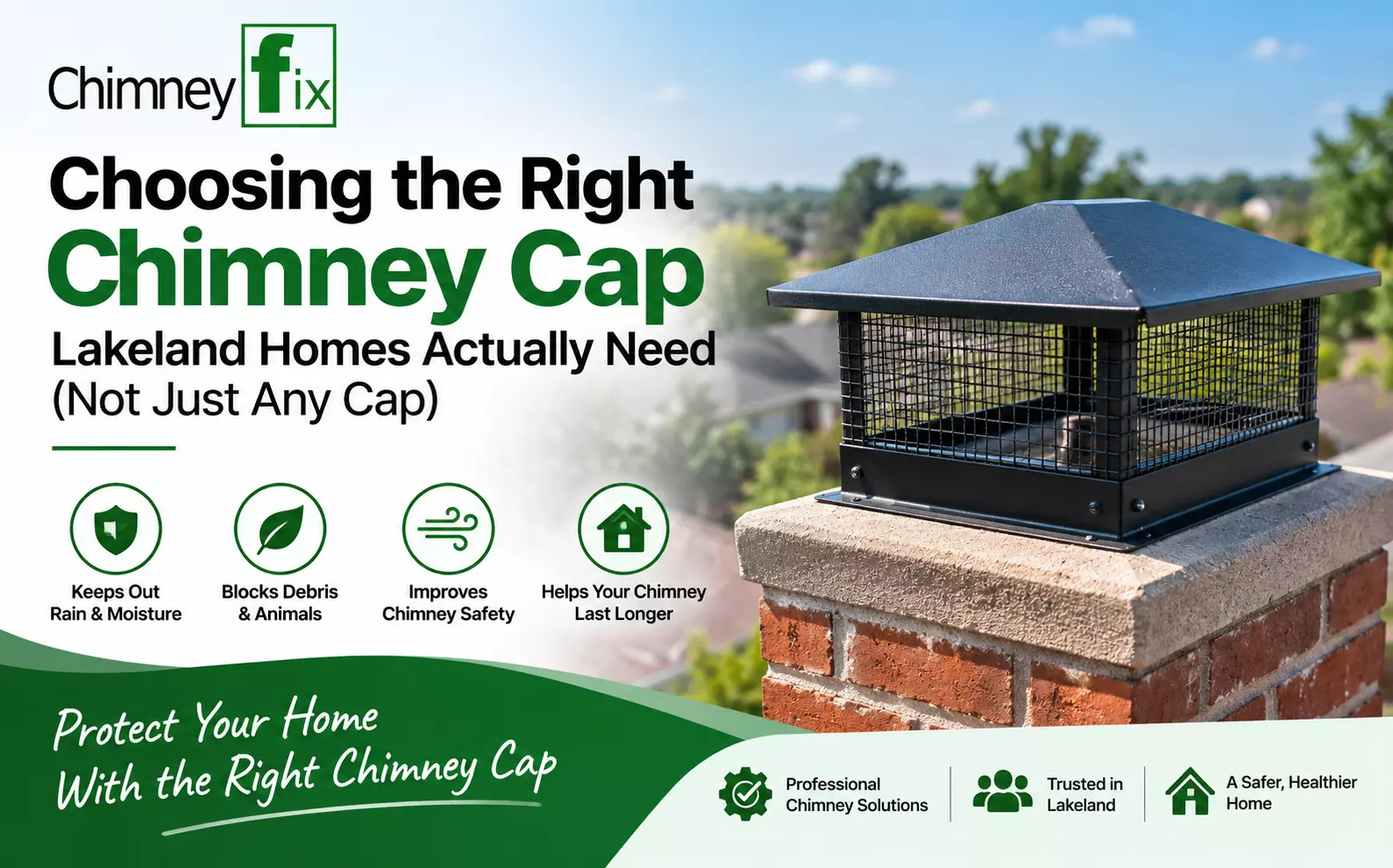
Choosing the Right Chimney Cap Lakeland Homes Actually Need (Not Just Any Cap)
Homeowners often treat a chimney cap as a commodity item — buy one, have it installed, done.
But a mismatched cap causes problems that aren't always obvious right away: poor draft, recurring wildlife issues, or premature rust that has the homeowner back to square one within a couple of years.
Choosing the right cap actually depends on several factors specific to the chimney itself, not just picking whatever's available at a hardware store.
Why "One Cap Fits All" Doesn't Hold Up
A chimney cap has one job that sounds simple: keep water, debris, and animals out of the flue while letting smoke escape.
But the design details that accomplish that job well vary significantly depending on how many flues a chimney has, what fuel type it vents, and what kind of wildlife pressure exists in the surrounding area.
A cap that works perfectly on a single-flue wood-burning chimney can cause real problems if installed on a multi-flue system without adjustment.
Single-Flue vs. Multi-Flue Considerations
Many Lakeland homes, particularly older ones, have chimneys venting more than one flue — a fireplace and a furnace, for example, sharing the same chimney structure but with separate flue passages.
Single-flue caps
These are straightforward. A cap sized specifically to that flue's dimensions provides consistent, predictable draft performance.
Multi-flue caps
This is where mistakes happen more often. A single large cap covering multiple flue openings can sometimes create airflow interference between the flues, especially if one is actively venting a furnace while the other is a rarely used fireplace.
Homeowners who install a mismatched multi-flue cap sometimes end up with a smoky fireplace and blame the fireplace itself, when the actual issue is the cap design disrupting proper draft separation between flues.
Getting flue count and spacing measured correctly before selecting a cap style prevents this problem entirely, but it's a step that's easy to skip when buying a cap without a proper on-site assessment first.
Read: A Homeowner's Guide to Identifying and Fixing Chimney Leaks
Material Choice Matters More in This Climate Than Most
Cap material affects lifespan dramatically, and Central Florida's climate is harder on some materials than others.
Galvanized steel
The most common and least expensive option. It holds up reasonably well in drier, milder climates, but Lakeland's humidity and wet-dry cycling accelerate rust, particularly at the mesh seams and screw points, often within just a handful of years.
Stainless steel
Meaningfully more resistant to the corrosion pattern that affects galvanized caps in humid climates.
The higher upfront cost is usually offset by a much longer service life in a region like Central Florida, where the return on a more durable material shows up faster than it would in a milder climate.
Copper
The most expensive option, but it develops a natural patina rather than rusting, and holds up extremely well long-term.
Some HOA communities in the Lakeland area actually have aesthetic guidelines that favor copper for visibility from the street, which is worth checking before installation in a neighborhood with strict exterior standards.
Wildlife-Specific Design Considerations
Florida's warm climate keeps wildlife active essentially year-round, unlike colder regions where animal activity drops off seasonally. This makes mesh quality and gap sizing more important here than in many other markets.
A cap with mesh openings that are too large can still allow smaller animals — squirrels, in particular — to squeeze through, while openings too small can restrict airflow and cause draft issues.
Getting this balance right is part of why a generic hardware-store cap sometimes underperforms compared to one selected based on an actual assessment of local wildlife pressure and flue draft requirements.
Draft Performance: The Overlooked Factor
Homeowners rarely think about draft when picking a cap, but cap design affects how well smoke draws up and out of the chimney.
A cap that sits too low, has an undersized opening relative to the flue, or uses a mesh density that's too restrictive can all contribute to draft problems that get misdiagnosed as a fireplace issue rather than a cap issue.
This is one of the more common reasons a homeowner replaces a cap, still experiences smoke backing into the room, and assumes the fireplace itself is broken. In many of these cases, the actual fix is a different cap design rather than fireplace repair.
What a Proper Cap Selection Process Looks Like
- Flue count and dimension measurement — confirming exactly how many flues exist and their individual sizes
- Material recommendation based on exposure — homes near lakes or with significant tree cover often benefit from higher-grade stainless or copper given added humidity and debris exposure
- Mesh gap sizing appropriate for regional wildlife, balancing animal exclusion against draft requirements
- HOA or aesthetic consideration, where applicable, since some materials are more visible from street level than others
- Proper mounting and sealing, since even the right cap performs poorly if installed with inadequate mounting hardware or degraded sealant
Homeowners comparing options for a Chimney Cap Lakeland installation should ask specifically whether flue measurement and material recommendation are part of the service, rather than assuming a generic cap will perform the same regardless of chimney configuration.
A Common Mistake Worth Avoiding
One recurring issue involves homeowners replacing a cap reactively after storm damage, using whatever size is quickest to source, without reassessing whether the original cap was even correctly matched to the chimney in the first place.
If the original cap was undersized or poorly suited to a multi-flue setup, a like-for-like replacement just repeats the same problem.
A storm-damage replacement is actually a reasonable opportunity to correct a mismatch that may have existed since the original installation.
The Bottom Line
A chimney cap isn't an interchangeable part — flue configuration, material durability, wildlife pressure, and draft performance all factor into which cap actually works well for a specific chimney.
In Lakeland's humid, wildlife-active climate, getting these details right the first time prevents the cycle of premature rust, wildlife intrusion, or draft complaints that come from treating cap selection as an afterthought.