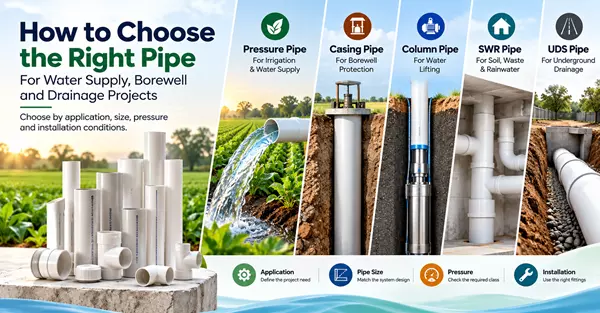
How to Choose the Right Pipe for Water Supply, Borewell and Drainage Projects
Two pipes can look similar in size and material but still be designed for completely different jobs. A pressure pipe used for irrigation, for example, should not be selected in the same way as a casing pipe used in a borewell or an SWR pipe used for drainage.
For water supply, irrigation, borewell and drainage projects, the best starting point is to identify the application first, then check size, pressure, installation conditions and compatible fittings.
Start With the Application
Before comparing pipe sizes or prices, define what the system needs to do.
Typical applications include:
- agricultural irrigation,
- pressurized water distribution,
- borewell casing,
- water lifting with a submersible pump,
- building drainage,
- underground drainage.
Different applications require different pipe systems. A useful starting point is to review uPVC piping solutions for different applications.
Pressure Pipes for Irrigation and Water Supply
Pressure pipes are designed for systems where water moves under pressure.
They are commonly used in:
- agricultural irrigation,
- water distribution,
- suitable pressurized water systems.
For these applications, diameter alone is not enough. The pipe size and pressure class should both match the system requirement.
A pipe may have the correct diameter but still be unsuitable if its pressure capability does not match the operating conditions.
For product-specific details, see uPVC pressure pipes for water and irrigation systems.
Casing Pipes for Borewell Protection
Casing pipes are used as part of a borewell structure.
Their role is to support and protect the borewell installation. Selection should consider the required bore size, installation depth and product specification.
A casing pipe should not be confused with a column pipe because the two perform different functions.
Column Pipes for Water Lifting
Column pipes are used with submersible pumps to carry water upward from the borewell.
A simple distinction is:
Casing Pipe → Borewell structure
Column Pipe → Water lifting
Both may be used in the same borewell project, but they serve different purposes.
Read: How to Protect Your Home from Burst Pipes During Winter
SWR and UDS Pipes for Drainage
SWR stands for Soil, Waste and Rainwater. These pipes are commonly used in building drainage systems for wastewater, soil discharge and rainwater movement.
UDS pipes, on the other hand, are intended for underground drainage applications.
The simple difference is:
SWR → Building drainage
UDS → Buried or underground drainage
This distinction matters because the installation environment and jointing requirements can be different.
5 Factors to Check Before Selecting a Pipe
1. Application
Identify the actual job first: irrigation, water supply, borewell, plumbing, building drainage or underground drainage.
2. Pipe Size
The required diameter should match the flow and system design. Bigger does not automatically mean better.
3. Pressure Requirement
For pressure-water systems, check the correct pressure class along with pipe size.
4. Installation Conditions
Consider whether the pipe will be installed above ground, underground, inside a building or inside a borewell.
5. Fittings and Jointing
Use fittings and connection methods that are compatible with the selected pipe system.
Common Selection Mistakes
Some common mistakes include:
- selecting only by diameter,
- choosing only by lowest price,
- assuming all pipes have the same use,
- confusing casing and column pipes,
- ignoring pressure class,
- using incompatible fittings.
A practical selection sequence is:
Application → Pipe Type → Size → Pressure → Installation → Fittings
Final Takeaway
Choosing the right pipe is mainly about matching the product to the actual operating conditions of the project.
Pressure pipes, casing pipes, column pipes, SWR pipes and underground drainage pipes are designed for different purposes. Before selecting a pipe, identify the application, then confirm the size, pressure requirement, installation environment and compatible fittings.
For application-specific product information, explore the Duke Pipes uPVC product range.