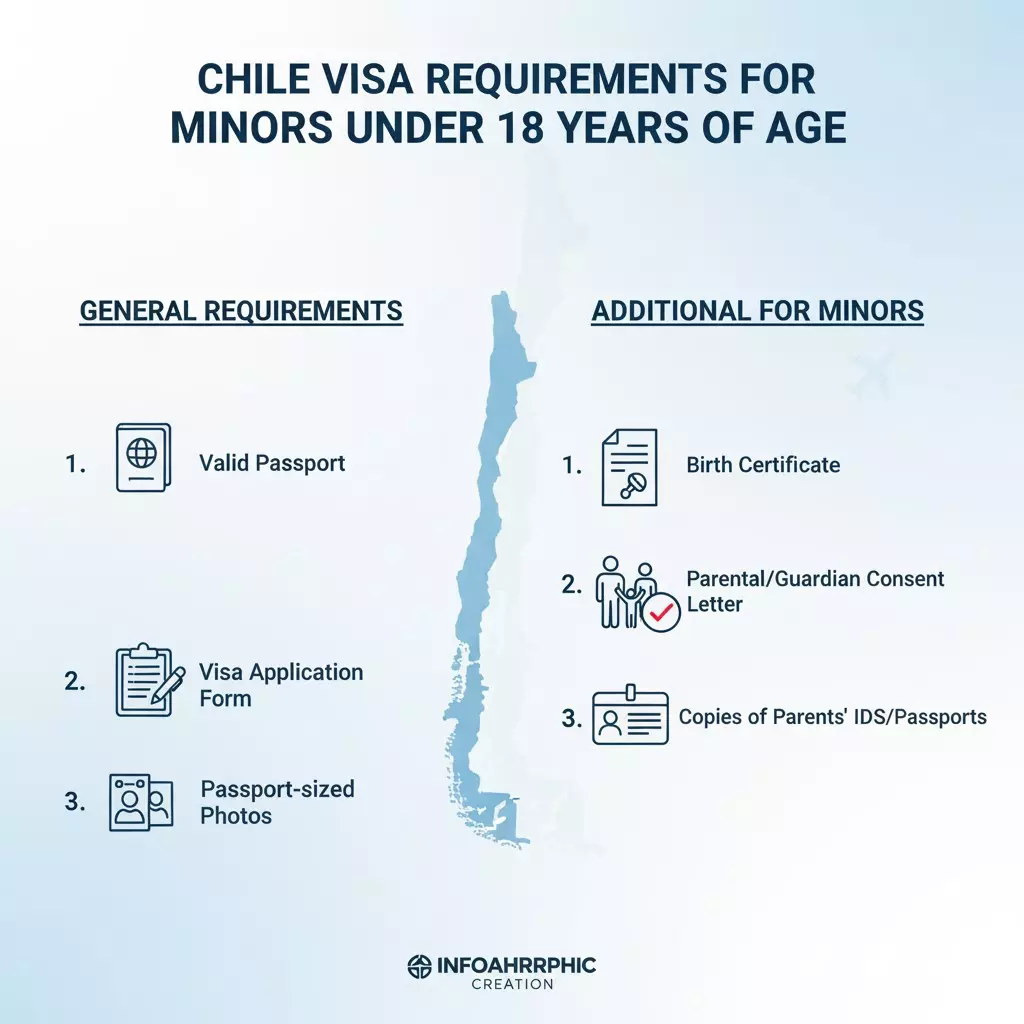
Chile Visa Requirements for Minors Under 18 Years of Age
It is thrilling to plan a family trip to Chile--imagine yourself in Patagonia to hike up the mountain, in the colorful streets of Valparaiso, or on the Andes skiing. However, the thing is you have to get one thing right before you make that flight and that is the Chile visa minor requirements of travelers under the age of 18 years.
The Chilean laws concerning minors are stringent unlike the adult entry laws and all revolve around the consent of the parents. This is not bureaucracy as an end to itself; it is a sound mechanism that keeps the children out of the reach of international kidnappers as well as making sure that every minor child that enters or leaves the country has the written consent of all the legal guardians.
Violating these regulations even by the citizens of the visa-waiver nations might result in immediate denial of entry or even inability to leave Chile. This is a do-it-all travel guide, which is written in the most understandable and searchable manner, giving you the template to a seamless journey with your kids.
Chile Visa/ Chile Entry Requirements: Minors vs. Chile Visa
Speaking about Chile entry requirements under 18, it is obligatory to divide two different categories:
- Formal Visa: This is a physical stamp / approval which is only necessary in specific nationalities (e.g., Chinese, Indian, or Russian citizens) which do not enjoy the agreement of visa exemption in Chile. In case the minor requires a visa, he should also have to go by the normal procedure of the application in a Chilean consulate, along with the parental authorization regulations mentioned below.
- Parental Authorization (The Universal Rule): This is a document required to all the minors, irrespective of their nationality or need of a visa. When a minor is not accompanied by both legal parents, this notarized paperwork is the most significant one in the case.
Concisely, the visa stamp is not required by the majority of American, Canadian, UK or EU citizens, however, all people must secure the right parental consent before traveling to Chile with children.
Chile Visa Requirement for Minors: Notarial Permission for Minors
Chilean authorities operate under the assumption that if a minor is traveling without both parents, the absent parent must provide explicit, notarized consent. This is a non-negotiable rule when entering and, even more strictly, when leaving Chile.
This notarial permission, usually an affidavit or a formal letter, must explicitly state that the absent parent(s) consent to the child's travel to and from Chile. This rule is applied rigorously at all air and land border crossings.
Traveling with Both Parents in Chile: Simplest Path, But Documents are Essential
Even if both parents are present, a minor cannot simply arrive with just a passport. While this scenario is the simplest, you still need to prove your legal relationship to the child to the satisfaction of the immigration official.
Required Documentation:
- Valid Passport: For both the minor and the parents.
- Minor’s Original Birth Certificate: This is the most critical document, as it lists both parents' names and proves the relationship. If the birth certificate is not in Spanish, an official, certified translation is highly recommended, especially if names are common or complex.
If your name on the birth certificate does not match your current passport (e.g., due to marriage or divorce), you must carry legal documentation (like a marriage certificate or change of name deed) linking the names.
Single Parent or Guardian Travel Chile: The Mandate for Notarial Consent
This is the scenario that catches most parents out. If you are a single parent, or if one parent is simply staying home, you must secure the mandatory notarial permission. This letter must be obtained in your home country before you travel.
The letter should be signed by the non-traveling parent, notarized by a qualified notary public, and clearly grant permission for the child (named with passport details) to travel with the specific accompanying parent (named with passport details) to Chile for the duration of the trip.
What if the non-traveling parent is unavailable or deceased?
- Deceased Parent: You must carry the original (or a certified copy) of the death certificate.
- Sole Custody: If you have sole legal custody, you must carry the official court order granting that custody. In this case, the non-present parent’s signature is not required, but the court order replaces it as the mandatory legal proof.
- Unreachable Parent: If the absent parent cannot be contacted, you must obtain a court order in your home country that specifically authorizes the child’s international travel without the other parent’s consent.
Minor Traveling Alone or with a Third Party: Extra Layer of Scrutiny
If the minor is traveling with children to Chile alongside someone who is not their legal parent (e.g., a grandparent, a friend's parent, or a school chaperone), the rules are even stricter.
The third party must carry notarized and apostilled authorization letters signed by both legal parents. This letter must also grant the accompanying third party authority to make necessary decisions regarding the minor's welfare during the trip.
Decoding the Notarial Authorization: Language and Expiration
For the letter of consent to be valid and accepted by Chilean Immigration, especially when dealing with the Chilean notarial permission requirement, these details are paramount:
- Language: While English might be understood, for guaranteed acceptance and to avoid delays, the document must be either in Spanish or accompanied by a certified, official Spanish translation. The translation must be prepared by a translator recognized by a Chilean consulate or government body.
- Specifics: The letter must include the minor's full name, passport number, the accompanying adult's full name and passport number, the travel dates, and the specific destination (Chile).
- Validity: The letter should be dated close to the time of travel. While laws vary, generally, the authorization should not be older than 90 days from the date of notarization.
Authentication Matters: When You Need the Apostille Chile Documents
This step is arguably the most crucial for ensuring your document is legally recognized internationally. If your home country is a signatory to the Hague Convention of 1961 (and most Western countries are), your notarized consent letter needs an Apostille.
The Apostille is a certificate issued by a designated authority (often the Department of State, Ministry of Foreign Affairs, or equivalent) that authenticates the signature of the notary public on the document. Without the Apostille, your notarized letter is just a piece of paper; with it, it becomes a legally binding international document recognized by Chile.
- Actionable Step: Once your consent letter is notarized, you must send it to the relevant government office to be Apostilled. This process can take several weeks, so factor it into your planning timeline.
The Formal Chile Visa Question: When Minors Need a Full Chilean Visa
As mentioned, if the minor holds a passport from a country that does not have a visa-waiver agreement with Chile, they must apply for Chile visa stamp at the nearest Chilean consulate.
Key Considerations for the Visa Application:
- In-Person Interview: Minors and their accompanying parent/guardian often need to attend an interview.
- Mandatory Authorization: The consular office will still require the notarized parental authorization (and often the Apostille) as part of the visa application package, even before the child steps foot in Chile. The visa process itself is an additional layer on top of the authorization requirement.
Chile Visa Required Documentation Checklist: Your Pre-Flight Peace of Mind
Here is a quick, action-oriented checklist to secure your Chile travel documents for minors under 18:

Navigating Chilean Immigration: What to Expect Upon Arrival
When you land at Santiago (SCL) or any other entry point, the immigration process for minors is largely the same as for adults, but the scrutiny of the documents is significantly higher.
- Immigration Desk: Approach the desk together as a family unit.
- Document Presentation: Present all passports, the PDI Tourist Card (which you should fill out/receive), and immediately present the original birth certificate and any notarized authorization/Apostille documents.
- Inspection: The officer will meticulously check the names on the consent letter, the Apostille stamp, and the birth certificate against the accompanying adult(s)' passports.
- Entry: Once satisfied, the officer will stamp the passports and issue the PDI Tourist Card, which you must keep safe for the duration of your stay.
By organizing your apostille Chile documents and notarial permission well in advance, you ensure the only thing you have to focus on upon arrival is which amazing Chilean destination you’ll conquer first. Enjoy your family trip!