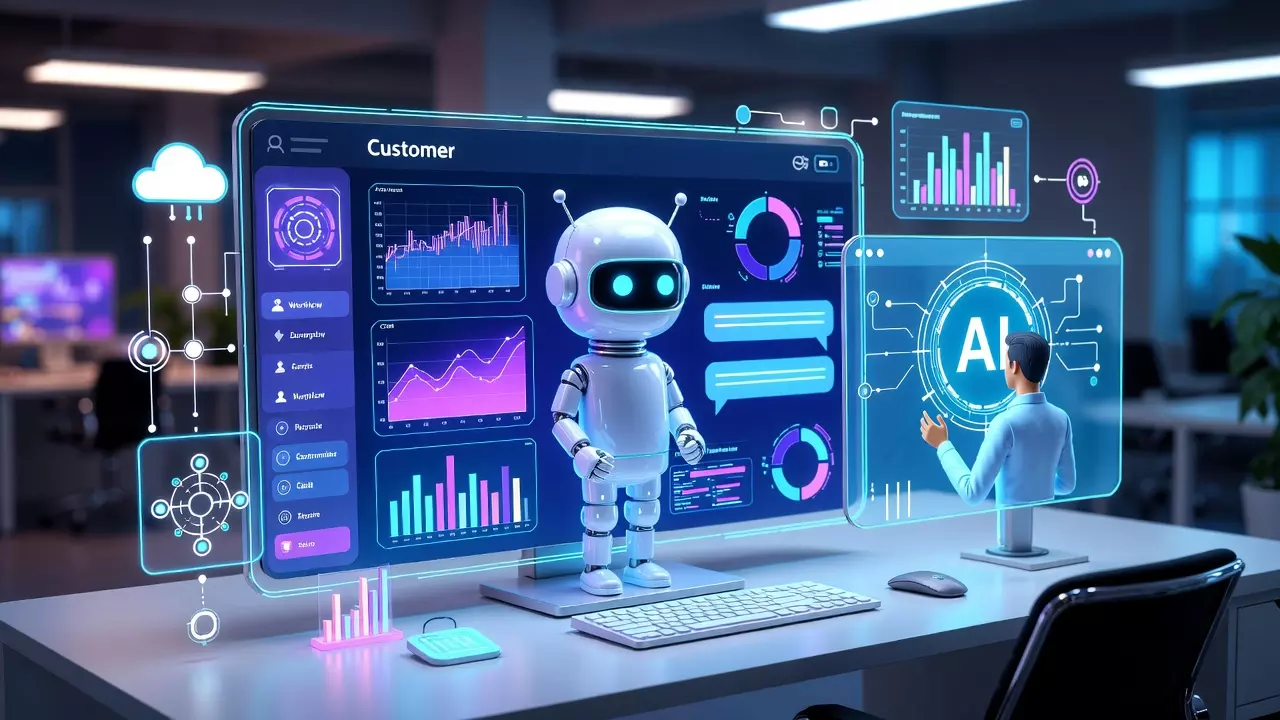
Chatbots and AI Integration in Custom CRM Software: The Ultimate Guide
In today’s fast‑moving digital landscape, businesses are no longer satisfied with traditional CRM solutions that just store customer data.
They are looking for smarter, more proactive systems that improve customer engagement, automate operations, and provide meaningful insights in real time.
This has given rise to powerful AI chatbots integrated with CRM software — a fusion that has become essential for companies aiming to scale efficiently and stay competitive.
This ultimate guide will explore everything you need to know about chatbots and AI integration in custom CRM software — from benefits and use cases to implementation strategies, challenges, and future trends.
Understanding CRM and AI Chatbots
What Is CRM Software?
Customer Relationship Management (CRM) software is a tool used by businesses to manage interactions with current and potential customers.
It centralizes customer data — including contact information, purchase history, preferences, and communications — into a unified system.
This centralized repository enables businesses to track leads, manage sales pipelines, handle support tickets, and nurture customer relationships.
CRM systems are foundational to modern business operations — but on their own, they are often reactive rather than proactive. Without intelligent augmentation, they mainly store, organize, and report on customer data.
What Is an AI Chatbot?
An AI chatbot is a software agent powered by Artificial Intelligence (AI), particularly Natural Language Processing (NLP) and machine learning, that can engage in conversational interactions with users.
These bots are no longer limited to scripted responses — they learn from interactions and can understand user intent, context, and preferences to deliver relevant and dynamic responses.
When an AI chatbot is integrated directly with a CRM, it becomes much more powerful because it has access to customer history and behavior — enabling contextual communication, richer insights, and automated workflows.
Why Integrate AI Chatbots with CRM Software?
Automated, 24/7 Customer Engagement
One of the biggest advantages of CRM systems with AI chatbot integration is their ability to engage customers round‑the‑clock without requiring human intervention.
Unlike traditional support teams, chatbots never sleep and can handle routine queries instantly, ensuring that every visitor receives immediate attention — no matter the time of day or customer location.
For example, a visitor arriving at your pricing page at midnight can interact with a chatbot, ask about product features, and get the information they need instantly — without waiting for business hours.
Smarter Lead Capture and Qualification
AI chatbots are far more than simple greeting tools — they can ask intelligent questions, evaluate responses in real time, and qualify leads based on your custom criteria.
When a qualified lead is identified, the chatbot automatically pushes the details into your CRM pipeline, assigning lead scores and flagging hot prospects for your sales team.
This speeds up follow‑up and increases conversion rates by making sure your team focuses on the most promising opportunities.
Real‑Time Data Synchronization and Accuracy
Traditionally, sales and support teams manually log interactions, notes, and customer preferences into CRM systems — a time‑consuming and error‑prone process.
AI chatbots eliminate this gap by automatically syncing every conversation, query, and behavioral cue into the CRM in real time. This ensures your CRM data is accurate, comprehensive, and constantly updated.
Accurate CRM data not only improves internal reporting but also enables predictive analytics and personalized engagements.
Personalized Customer Experiences at Scale
With CRM chatbot integration, conversational experiences can be deeply personalized. Rather than delivering generic responses, the bot can reference purchase history, past issues, service preferences, and customer segments — all drawn from CRM records.
This hyper‑personalization enhances user experience, builds loyalty, and increases the likelihood of conversions.
For example, a returning visitor could be greeted by name with follow‑up recommendations based on their previous purchases or interactions.
Operational Efficiency and Cost Savings
AI chatbots streamline workflows by automating repetitive tasks. They can schedule meetings, create follow‑up reminders, send notifications, and even trigger CRM workflows without human involvement.
The result? Your teams are free to focus on meaningful work — and your business saves on overhead costs associated with customer support and manual data handling.
Many businesses experience significant cost reductions while maintaining high quality support standards.
Omnichannel Engagement and Unified Experiences
Customers no longer interact with brands on just one platform. They engage across websites, mobile apps, WhatsApp, Facebook, and email.
An AI chatbot integrated with CRM can provide consistent, unified support across all these touchpoints by centralizing conversations and syncing them with CRM records.
This omnichannel capability ensures that customers never have to repeat themselves, no matter where the engagement begins.
Key Benefits of CRM + AI Chatbot Integration
To better understand the value, let’s break down the core benefits businesses stand to gain:
24/7 Automated Support
Customers today expect instant answers. AI‑powered chatbots deliver this effortlessly — providing help, answering questions, and guiding users without delays.
Enhanced Lead Quality and Conversion Rates
By scanning user responses, identifying intent, and validating contact data, chatbots ensure that your CRM contains only high‑quality leads worth pursuing.
Reduced Manual Work and Errors
Every conversational interaction — from support tickets to purchase questions — is recorded automatically into the CRM, minimizing mistakes and relieving your team from repetitive tasks.
Rich Customer Insights and Predictive Analytics
AI chatbots generate mountains of conversational data. When this data flows directly into the CRM, analytics tools can uncover patterns in behavior, sentiment, and purchase intent — empowering data‑driven decision‑making.
Improved Scalability
As your business grows, the volume of customer interactions naturally escalates. AI chatbots allow you to scale engagements without hiring proportionally more staff — enabling consistent, high‑quality customer experiences even during peak traffic.
Implementation Strategies for Chatbot + CRM Integration
Successfully integrating AI chatbots with CRM systems requires careful planning and execution. Here’s a step‑by‑step framework to guide you:
Define Clear Business Objectives
Before you start, identify why you need chatbot integration. Is it to improve support response times? Automate lead capture? Boost customer retention? Clear goals influence design, KPIs, and success metrics.
Assess CRM Compatibility and APIs
Check if your CRM supports native chatbot integration or API connectors. Popular enterprise CRMs like Salesforce, HubSpot, and Zoho provide robust APIs that allow bots to fetch and push data seamlessly.
If you're working with a customizable CRM software or building one with a custom crm development company, make sure your CRM is architected with a flexible API layer from the start.
Choose the Right AI Chatbot Framework
There are two main paths:
- Native chatbot capabilities: Some CRM platforms offer built‑in chatbots (e.g., Salesforce Einstein).
- Third‑party AI agents: Tools like Dialogflow or Microsoft Bot Framework can be connected via API or middleware.
Plan Conversational Flows and Training Data
Design conversational scripts that align with your business logic. Include fallback rules, escalation triggers, and personalized messaging paths based on CRM data fields.
Configure Workflows and Automation Rules
Once data flows from chatbot conversations to the CRM, define workflows:
- Create a lead
- Assign lead score
- Trigger follow‑up
- Notify sales rep
This often requires collaboration with a custom CRM development company if you are building bespoke automation tailored to your processes.
Test Extensively Before Launch
Simulate high‑traffic scenarios, malformed inputs, and edge cases. Testing ensures your integrated system performs reliably without slowing down CRM processes or producing incorrect responses.
Common Challenges and How to Overcome Them
Despite the benefits, CRM + AI chatbot integration does come with challenges — but none are insurmountable.
Technical Complexity
Some CRMs have strict API limits or complex data structures, making integration tricky. Partnering with experts or a crm development team with expertise in API integration and webhooks can smooth this process.
Data Quality Issues
AI chatbots perform poorly if CRM data is outdated or inconsistent. Before integration, audit and clean your CRM — remove duplicates and enforce standardized fields.
Security and Compliance
Handling customer data requires compliance with GDPR, CCPA, HIPAA, and other local regulations. Ensure encryption at rest and in transit, proper access controls, and periodic security assessments.
Performance Latency
Poorly optimized integrations can slow response times. Use caching strategies, efficient query patterns, and performance testing to avoid bottlenecks.
Use Cases That Showcase Real‑World Impact
E‑Commerce Platforms
AI chatbots can assist shoppers in browsing products, answering queries, and completing transactions — all while logging the entire conversation into CRM profiles for later upsells or re‑engagement campaigns.
SaaS and Subscription Companies
Subscription businesses use AI bots to assist users with onboarding, renewal reminders, and pricing questions — improving retention and lifetime value.
Lead‑Driven B2B Sales
For B2B companies, chatbots engage prospects early, qualify them based on criteria like budget and timeline, and pass warm leads directly into CRM pipelines — drastically improving sales velocity.
Customer Support and Ticketing
AI chatbots can handle FAQs, gather initial issue details, and create support tickets — while automatically updating CRM notes and routing complex cases to human agents.
Future Trends in AI Chatbot + CRM Integration
Voice‑Activated Conversational AI
Voice‑enabled assistants could transform CRM engagements by providing spoken support and logging voice interactions directly into CRM systems — bridging the gap between voice and data.
Predictive Customer Engagements
Future systems may not just react — they’ll anticipate needs by analyzing CRM behavior patterns and “nudging” customers before they ask.
Deeper Integration with Analytics and Automation
As AI chatbots become more sophisticated, they will feed richer behavioral datasets into CRM analytics engines — powering predictive segmentation, churn prediction, and dynamic automation sequences.
Read: What Free CRM Platforms Give You the Best Sales Insights?
Selecting the Right Custom CRM Development Partner
If your business needs a CRM tailored to unique workflows and deep chatbot integration, working with a reputable custom crm development company has major advantages:
✅ Build a fully customizable CRM software that reflects your processes
✅ Seamless integration with AI engines and automation tools
✅ Ongoing support and enhancements as your business grows
✅ Expertise in crm development best practices
Look for partners with experience in both CRM architecture and AI integration — not just developers but strategic tech consultants.
Conclusion
Integrating AI chatbots with CRM software isn’t just a trend — it’s a strategic transformation that empowers businesses to automate intelligently, personalize at scale, and extract meaningful insights from customer interactions.
From improving lead qualification and workflow automation to ensuring 24/7 customer engagement, this fusion of AI and CRM elevates the way companies nurture relationships and grow revenue.
Whether you’re building using a customizable crm software approach or partnering with a custom crm development company for bespoke solutions, the future of customer engagement is undeniably intelligent, conversational, and deeply data‑driven.
If you’re ready to turn your CRM into an intelligent engine that works with you — not just for you — AI chatbot integration is the next frontier.