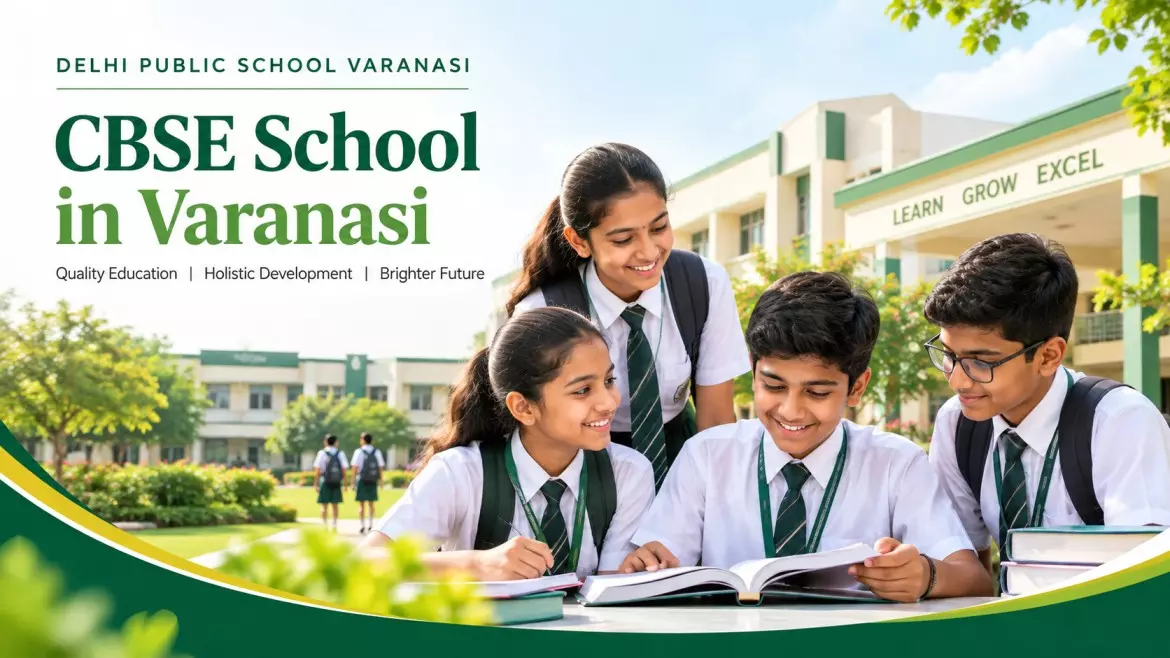
CBSE School in Varanasi: A Parent’s Guide to Choosing the Right School
Choosing a school is an important decision for every parent. In Varanasi, families have a wide range of educational options, making it important to look beyond school names, rankings and advertisements.
The right school should provide a balanced environment where children can develop academically, socially and personally.
For parents searching for a CBSE School in Varanasi, factors such as curriculum, teaching methods, learning resources, student activities, safety, transportation, senior-secondary education and future preparation deserve careful consideration.
A school should not only meet a child's current educational needs but also support their growth through different stages of schooling.
What Should Parents Look for in a CBSE School in Varanasi?
CBSE affiliation provides a useful starting point when comparing schools, but it should not be the only consideration. Schools following the same board can offer different approaches to classroom learning, student support, activities and academic development.
Parents should understand how a school puts its curriculum into practice. Consider whether students are encouraged to ask questions, participate in discussions, apply concepts, collaborate with classmates and develop independent thinking.
A well-rounded school should combine academic learning with opportunities that help students develop communication, confidence, responsibility, creativity and practical skills.
Look Beyond the CBSE Affiliation
The CBSE framework provides an academic structure, but the quality of a student's experience also depends on how that framework is implemented.
Parents can ask questions such as:
- How are lessons taught and explained?
- Are students encouraged to participate actively?
- Does the school provide experiential learning opportunities?
- How are critical thinking and problem-solving skills developed?
- What academic support is available to students?
- How does the school monitor student progress?
These questions can provide a clearer picture of the educational experience than a school brochure alone.
Consider the Complete Educational Journey
Children's educational needs change as they grow. The skills required during the foundational years are different from those needed during secondary and senior-secondary education.
Parents should therefore consider whether the school provides a consistent learning journey from the early years through primary, middle, secondary and senior secondary stages.
This approach can help families make a decision based not only on the child's current class but also on their longer-term educational requirements.
Understanding the Different Stages of CBSE Education
Foundational and Primary Education
The early years provide the foundation for future learning. Children benefit from an environment where they can develop language, numeracy, communication, curiosity, social skills and confidence.
Learning during these years should involve age-appropriate activities, interaction, exploration and practical experiences rather than relying entirely on memorisation.
Parents of preschool and primary-school children should pay particular attention to the school's approach to foundational learning and the transition into formal academic education.
Middle School Education
As children move into the middle years, subjects become more structured and academic concepts become more detailed.
This stage provides opportunities for students to develop reasoning, problem-solving, communication and independent learning skills. Interdisciplinary learning can also help students understand how concepts from different subjects connect with one another.
Secondary Education: Classes IX and X
Classes IX and X represent an important academic transition. Students encounter greater subject depth, more structured assessment and increasing academic responsibility.
Parents should consider how a school supports students during this stage. Effective academic guidance should focus on conceptual understanding, study habits, time management and confidence rather than examination preparation alone.
Senior Secondary Education: Classes XI and XII
Classes XI and XII are important years for academic specialisation and future planning. Students begin making choices that may influence their higher-education and career pathways.
When evaluating a Senior Secondary School in Varanasi, parents should consider subject options, academic guidance, career counselling, learning resources and preparation for higher education.
Students should also be encouraged to develop independent study habits, analytical thinking, communication skills and the ability to make informed academic decisions.
Read: CBSE, IB, Montessori - Which One Feels Right in Mumbai?
What Makes a Good Senior Secondary School in Varanasi?
Senior secondary education requires a different level of academic support from the earlier school years.
Students need to manage more complex subjects while preparing for board examinations and considering future courses and careers.
Parents comparing a Senior Secondary School in Varanasi can consider the following:
- Academic guidance and subject support
- Availability of relevant learning resources
- Preparation for board examinations
- Career counselling opportunities
- Opportunities for independent learning
- Development of analytical and problem-solving skills
- Guidance related to higher education
A strong senior-secondary environment should help students become increasingly responsible for their own learning while providing appropriate academic guidance.
What Parents Should Look for in a CBSE School in Varanasi
Curriculum and Teaching Approach
Parents should understand how the school approaches classroom learning.
Important questions include:
- Are students encouraged to ask questions?
- Does teaching involve practical examples?
- Are concepts explained in ways appropriate for different learning levels?
- Are students given opportunities to collaborate?
- Does the school encourage critical thinking?
Learning becomes more meaningful when students can connect classroom concepts with practical situations.
Academic Facilities and Learning Resources
Academic facilities should support the learning process rather than simply serve as a list of amenities.
Libraries, laboratories, technology-enabled classrooms and other resources can provide students with opportunities to explore subjects through different learning methods.
Parents should consider whether students actually have opportunities to use these resources as part of their education.
Co-Curricular Activities and Sports
A child's development extends beyond academic subjects. Sports, arts, music, performing arts, clubs and other activities can help students develop teamwork, communication, discipline and confidence.
A balanced school environment gives students opportunities to discover interests and develop skills that may not be measured through examinations.
Student Well-Being and Safety
Parents should also examine how the school approaches student safety and well-being.
Important areas include campus supervision, health support, communication with parents, student guidance and general safety procedures.
A supportive environment can help children feel comfortable participating in classroom and co-curricular activities.
Transportation and Accessibility
Transportation is another practical consideration for families in Varanasi.
Parents should review available routes, travel time, supervision, vehicle safety and other transportation procedures before making a decision.
Daily accessibility can have a significant impact on a child's routine and the family's overall schedule.
What Does an International Standard School in Varanasi Mean?
Parents may come across the term International Standard School in Varanasi while researching educational options. However, the phrase itself should not be the deciding factor.
Instead, parents should examine what the school actually provides in terms of teaching practices, academic resources, student development and exposure to different learning experiences.
Look at Learning Practices, Not Labels
A modern educational environment can encourage students to communicate clearly, collaborate with others, think critically, use technology responsibly and apply knowledge to practical situations.
Parents should therefore look beyond terminology and assess the actual learning experience offered by the school.
Balance Academic Knowledge with Skills
Academic knowledge remains important, but students also need communication, collaboration, creativity, adaptability and problem-solving skills.
When comparing an International Standard School in Varanasi with other options, parents can consider whether the school provides opportunities for students to develop these skills alongside their academic studies.
How to Compare CBSE Schools in Varanasi
Choosing a school becomes easier when parents create a structured comparison rather than relying on a single factor.
Questions About Academics
Parents can ask about:
- CBSE affiliation and classes offered
- Curriculum implementation
- Teaching methodology
- Academic support
- Assessment and feedback
- Senior-secondary pathways
- Career guidance
Questions About Student Development
Consider:
- Sports and physical activities
- Arts and creative opportunities
- Clubs and student activities
- Leadership opportunities
- Experiential learning
- Interdisciplinary learning
- Collaborative learning
Questions About Facilities and Safety
Parents should evaluate:
- Classrooms and academic facilities
- Laboratories
- Library and learning resources
- Sports infrastructure
- Campus safety
- Health and student support
- Transportation facilities
Questions About Admissions and School Life
Before applying, parents should understand the admission process, required documentation, age criteria, available classes, school timings and transportation options.
A campus visit can also provide valuable insight. Parents can observe the learning environment, interact with the school team and ask questions that may not be answered on a website.
Career Counselling and Future Preparation
Career planning should not begin only after Class XII. Students can benefit from age-appropriate exposure to different academic disciplines, professional fields and higher-education pathways.
Career counselling can help students understand their interests and strengths while exploring possible future options.
Schools can support this process through counselling sessions, workshops, projects, discussions and exposure to different fields.
For parents, career counselling is therefore an important factor to consider when evaluating a school, particularly for students approaching senior secondary education.
Why Delhi Public School Varanasi Can Be Considered During Your School Search
Delhi Public School Varanasi provides an educational journey extending from the Foundational Years through the Senior Secondary Years. Its academic structure covers Foundational, Preparatory, Middle, Secondary and Senior Secondary stages.
This continuity allows parents to consider how their child's educational needs can be supported as they progress through different stages of schooling.
A Progressive Approach to Learning
DPS Varanasi's educational approach places emphasis on relevance, relationships, academic rigour and reflection.
The school also highlights experiential and interdisciplinary learning, critical thinking, creativity, collaboration and reflection as part of its learning approach.
These elements can help students connect academic concepts with practical experiences while developing skills needed beyond the classroom.
Education Across Different Stages
The school's academic structure covers early education through Classes XI and XII.
For families considering long-term schooling, this provides an opportunity to evaluate the educational environment across foundational, primary, middle, secondary and senior-secondary stages rather than focusing only on one academic year.
Beyond-Classroom Learning
Student development can be supported through activities beyond regular classroom lessons.
Sports, performing arts, technology, co-curricular activities and leadership opportunities can provide students with additional experiences through which they can develop communication, teamwork, confidence and other practical skills.
Senior Secondary and Future Preparation
For students entering senior secondary education, academic preparation becomes closely connected with future study and career choices.
DPS Varanasi's senior-secondary approach focuses on areas such as analytical thinking, creativity, board preparation, career choices and higher education.
Parents should still review current subject availability, admission requirements and academic options according to their child's individual needs.
A Practical Checklist Before Choosing a CBSE School in Varanasi
Before finalising a school, parents can consider the following questions:
- Is the school appropriately affiliated with CBSE for the classes being considered?
- Does the teaching approach suit your child's learning needs?
- Does the school provide continuity across different educational stages?
- What academic and co-curricular opportunities are available?
- How does the school support student well-being and safety?
- What transportation arrangements are available for your location?
- How does the school prepare students for Classes IX–X and XI–XII?
- What career counselling opportunities are available?
- Are students encouraged to participate in experiential and interdisciplinary learning?
- Can you visit the campus before making the final decision?
- Does the school offer an environment where your child can develop academically and personally?
- Have you compared schools based on your child's actual needs rather than rankings alone?
Final Thoughts
Finding the right school involves more than searching for a school with a particular board affiliation. Parents should evaluate the complete educational experience, including teaching practices, curriculum, facilities, student development, safety, transportation, senior-secondary education and future preparation.
For families researching a CBSE School in Varanasi, a thoughtful comparison can make the decision easier. Look at how each school supports children at different stages, from foundational and primary education through secondary and senior secondary years.
Delhi Public School Varanasi can be considered by parents looking for a school environment that combines structured CBSE education with experiential learning, interdisciplinary learning, co-curricular opportunities and preparation for future academic pathways.
The most suitable choice is ultimately the school that aligns with your child's learning needs, interests, educational goals and long-term development.