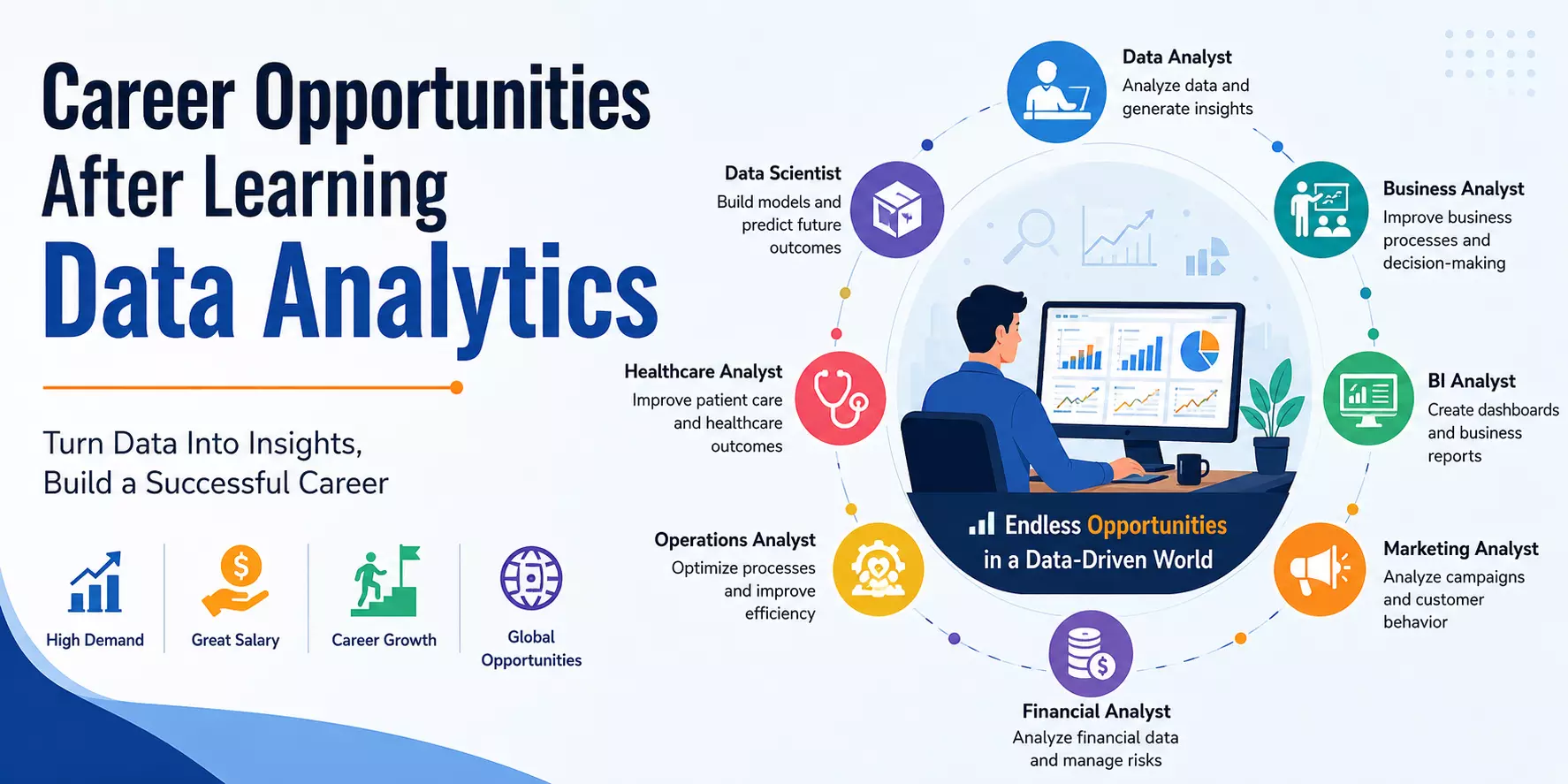
Career Opportunities After Learning Data Analytics
Data has become one of the most valuable assets for businesses worldwide.
Every click, purchase, customer interaction, and business process generates data that can help organizations make informed decisions. However, raw data has little value unless it is analyzed properly. This is where data analytics comes into play.
As industries continue to adopt digital technologies, the demand for skilled data analysts is increasing rapidly.
Companies across healthcare, finance, retail, manufacturing, education, and marketing are hiring professionals who can transform complex datasets into meaningful insights.
If you're considering a career in technology or planning to upgrade your skills, learning data analytics can open doors to numerous high-paying and rewarding career opportunities.
In this article, we'll explore the best career options available after learning data analytics, the skills employers expect, salary prospects, and tips for building a successful career.
What Is Data Analytics?
Data analytics is the process of collecting, organizing, analyzing, and interpreting data to identify patterns, trends, and useful insights.
Businesses use these insights to improve performance, understand customer behavior, reduce costs, and make smarter decisions.
A data analyst typically works with tools such as:
- Microsoft Excel
- SQL
- Python
- R Programming
- Power BI
- Tableau
- Google Analytics
- Microsoft Power BI
- Statistical techniques
Professionals in this field combine technical skills with analytical thinking to solve real-world business problems.
Why Is Data Analytics a Great Career Choice?
The demand for data professionals continues to grow because businesses rely heavily on data-driven decision-making.
Some major reasons to choose this career include:
- High demand across industries
- Attractive salary packages
- Multiple career paths
- Opportunity to work globally
- Remote and hybrid work options
- Continuous learning and career growth
- Ability to solve real business problems
With companies investing more in Artificial Intelligence (AI), Machine Learning (ML), and Business Intelligence (BI), skilled data analysts are becoming even more valuable.
Top Career Opportunities After Learning Data Analytics
1. Data Analyst
This is one of the most common career paths after completing a data analytics course.
Responsibilities
- Collect and clean data
- Create reports and dashboards
- Analyze business trends
- Present insights to management
- Support business decision-making
Required Skills
- Excel
- SQL
- Tableau
- Power BI
- Python (basic to intermediate)
- Data visualization
A data analyst is often the starting point for many professionals entering the analytics industry.
2. Business Analyst
Business analysts bridge the gap between business needs and technology.
Responsibilities
- Understand business problems
- Gather requirements
- Analyze operational data
- Recommend business improvements
- Coordinate with development teams
Skills Required
- Business communication
- Data visualization
- SQL
- Excel
- Reporting tools
- Problem-solving
Business analysts play a significant role in improving organizational efficiency.
3. Data Scientist
After gaining experience as a data analyst, many professionals move into data science.
Responsibilities
- Build predictive models
- Perform advanced statistical analysis
- Develop machine learning models
- Work with large datasets
- Automate data-driven solutions
Skills Required
- Python
- R
- Machine Learning
- Deep Learning
- Statistics
- SQL
- Big Data technologies
Data scientists are among the highest-paid professionals in the technology industry.
4. Business Intelligence (BI) Analyst
Business Intelligence Analysts focus on creating dashboards and visual reports that help organizations monitor business performance.
Responsibilities
- Design dashboards
- Analyze KPIs
- Create reports
- Improve business strategies
- Support executives with insights
Popular Tools
- Power BI
- Tableau
- SQL
- Excel
- Looker
This role is ideal for professionals interested in data visualization and business reporting.
Read: Data Analytics Training in Chennai with Placement
5. Marketing Data Analyst
Digital marketing generates enormous amounts of customer data. Marketing analysts use this information to optimize campaigns.
Responsibilities
- Analyze campaign performance
- Measure ROI
- Study customer behavior
- Improve conversion rates
- Generate marketing reports
Skills Required
- Google Analytics
- SQL
- Excel
- Power BI
- Marketing metrics
This career combines analytics with digital marketing.
6. Financial Analyst
Financial institutions use analytics to manage investments, predict market trends, and reduce financial risks.
Responsibilities
- Analyze financial reports
- Budget forecasting
- Risk analysis
- Investment planning
- Revenue prediction
Industries
- Banking
- Insurance
- Investment firms
- FinTech companies
Professionals with both finance and analytics skills are highly sought after.
7. Operations Analyst
Operations analysts improve business processes using data.
Responsibilities
- Identify inefficiencies
- Improve workflows
- Analyze production data
- Reduce operational costs
- Increase productivity
Manufacturing companies, logistics firms, and supply chain organizations frequently hire operations analysts.
8. Healthcare Data Analyst
Healthcare organizations generate massive amounts of patient and operational data.
Healthcare analysts help hospitals improve patient care while reducing costs.
Responsibilities
- Analyze patient data
- Track hospital performance
- Improve healthcare services
- Support medical research
- Generate compliance reports
Healthcare analytics is one of the fastest-growing sectors worldwide.
9. Product Analyst
Technology companies rely on product analysts to improve user experience.
Responsibilities
- Analyze user behavior
- Monitor product performance
- Conduct A/B testing
- Recommend feature improvements
- Support product managers
This role is popular in software companies and startups.
10. Data Engineer
Although data engineering requires additional technical skills, many analysts eventually move into this field.
Responsibilities
- Build data pipelines
- Manage databases
- Handle big data systems
- Prepare data for analysts and scientists
Skills
- SQL
- Python
- Apache Spark
- Hadoop
- Cloud platforms
Data engineers ensure data is accessible, accurate, and ready for analysis.
Industries Hiring Data Analytics Professionals
One of the biggest advantages of learning data analytics is that almost every industry needs skilled professionals.
Popular hiring industries include:
- Information Technology
- Healthcare
- Banking and Finance
- Retail
- E-commerce
- Telecommunications
- Manufacturing
- Education
- Government
- Logistics
- Insurance
- Digital Marketing
- Consulting
- Hospitality
- Real Estate
This wide range of opportunities gives professionals flexibility to choose an industry that matches their interests.
Essential Skills to Build a Successful Career
Learning software tools alone isn't enough. Employers also value strong analytical and communication skills.
Important technical skills include:
- SQL
- Microsoft Excel
- Python
- R Programming
- Tableau
- Power BI
- Statistics
- Data Cleaning
- Data Visualization
- Database Management
Soft skills include:
- Critical thinking
- Communication
- Problem-solving
- Attention to detail
- Business understanding
- Teamwork
- Presentation skills
- Time management
Combining technical expertise with business knowledge significantly improves career prospects.
Salary Expectations
Salary depends on your location, experience, company, and technical skills.
Typical career progression looks like this:
- Entry-Level Data Analyst: Competitive starting salary with strong growth potential.
- Business Analyst: Higher pay as you gain experience and domain expertise.
- BI Analyst: Attractive salaries, especially in large enterprises.
- Data Scientist: Among the highest-paying roles in analytics.
- Analytics Manager: Leadership positions offer excellent compensation and benefits.
Professionals who continuously upgrade their skills with cloud platforms, AI, and machine learning often see faster salary growth.
How to Start Your Career in Data Analytics
If you're new to analytics, follow these steps:
Learn the Fundamentals
Understand statistics, data types, databases, and business concepts.
Master Key Tools
Practice using:
- Excel
- SQL
- Python
- Power BI
- Tableau
Build Projects
Create projects such as:
- Sales dashboards
- Customer segmentation
- Marketing performance reports
- Financial analysis
- HR analytics
A strong portfolio demonstrates practical skills to employers.
Earn Certifications
Industry-recognized certifications can strengthen your resume and validate your expertise.
Practice Problem Solving
Participate in online challenges and work with real-world datasets to improve your analytical thinking.
Apply for Internships
Internships provide valuable hands-on experience and can lead to full-time job opportunities.
Future Scope of Data Analytics
The future of data analytics is exceptionally promising. Emerging technologies such as Artificial Intelligence, Machine Learning, Cloud Computing, and the Internet of Things (IoT) are generating unprecedented volumes of data.
Businesses increasingly need professionals who can:
- Predict customer behavior
- Automate reporting
- Build intelligent dashboards
- Improve operational efficiency
- Support strategic decision-making
As organizations continue their digital transformation, the demand for skilled data analysts is expected to remain strong, making data analytics a future-proof career choice.
Conclusion
Learning data analytics can unlock a wide range of exciting career opportunities across multiple industries.
Whether you aspire to become a Data Analyst, Business Analyst, BI Analyst, Data Scientist, Marketing Analyst, or Financial Analyst, the skills you gain in data analytics provide a strong foundation for long-term professional growth.
Success in this field requires continuous learning, practical experience, and the ability to turn data into actionable insights.
By mastering analytical tools, building real-world projects, and staying updated with emerging technologies, you can build a rewarding career with excellent growth potential and competitive salaries.
If you're looking for a career that combines problem-solving, technology, and business strategy, data analytics is one of the best choices you can make.
Frequently Asked Questions (FAQs)
1. Is data analytics a good career in 2026?
Yes. Data analytics remains one of the fastest-growing career fields due to the increasing use of data across industries.
2. Which jobs can I get after learning data analytics?
You can pursue roles such as Data Analyst, Business Analyst, BI Analyst, Marketing Analyst, Financial Analyst, Product Analyst, Healthcare Analyst, Data Engineer, and Data Scientist.
3. Do I need coding skills for data analytics?
Basic knowledge of SQL and Python is highly recommended. Many entry-level roles also require strong Excel and visualization skills.
4. Which industries hire data analysts?
Industries such as IT, finance, healthcare, retail, e-commerce, education, manufacturing, logistics, insurance, and digital marketing actively hire data analytics professionals.
5. Can freshers start a career in data analytics?
Absolutely. Fresh graduates can begin with internships or entry-level analyst roles by building a portfolio, learning industry tools, and gaining practical experience through projects.