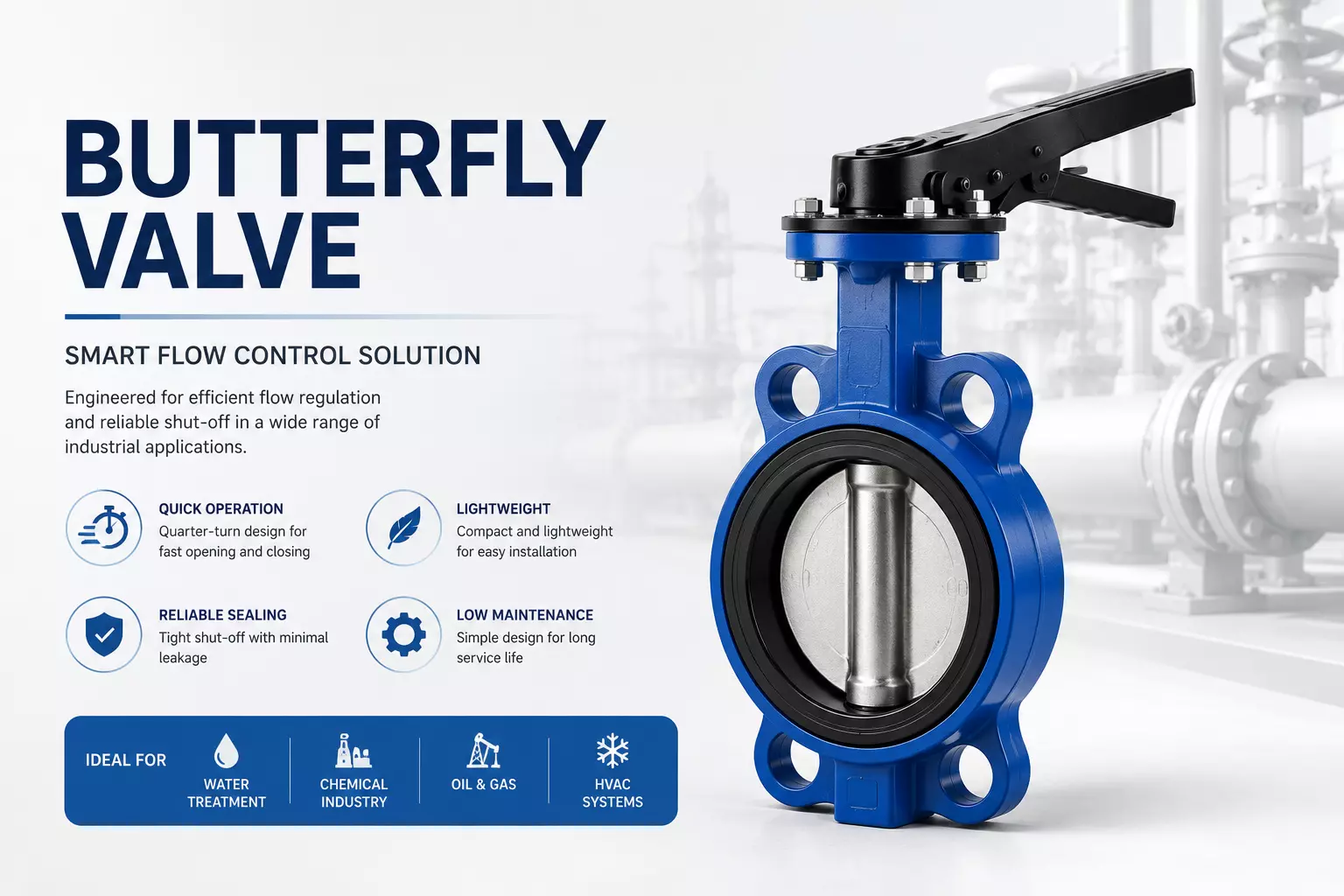
Butterfly Valve Explained: Working, Types, Materials & Applications
A Butterfly valve is one of the most widely used industrial valves for regulating or isolating the flow of liquids, gases, and slurries.
It is known for its lightweight design, compact size, quick operation, and cost-effectiveness. From water treatment plants to chemical processing facilities, butterfly valves play a crucial role in maintaining efficient fluid control.
Compared to other valve types, butterfly valves require less installation space and offer faster opening and closing, making them a preferred choice across various industries.
What is a Butterfly Valve?
A butterfly valve is a quarter-turn rotational valve that controls fluid flow through a circular disc mounted on a rotating shaft. When the handle or actuator turns the disc by 90 degrees, the valve either opens or closes.
Because of its simple construction and reliable performance, butterfly valves are commonly used in both low-pressure and high-performance industrial systems.
Key Highlights
- Quarter-turn operation for quick opening and closing
- Compact and lightweight design
- Suitable for on/off and flow control applications
- Available in manual, pneumatic, electric, and hydraulic operation
- Low maintenance and long service life
How Does a Butterfly Valve Work?
The operation of a butterfly valve is simple.
- When the valve is fully open, the disc rotates parallel to the direction of flow, allowing fluid to pass with minimal resistance.
- During partial opening, the disc regulates the flow rate.
- When the valve is closed, the disc rotates perpendicular to the flow, creating a tight seal that blocks the passage of fluid.
The valve can be operated manually using a lever or gearbox, or automatically through pneumatic, electric, or hydraulic actuators.
Main Components of a Butterfly Valve
A butterfly valve consists of several essential components that work together for efficient operation.
- Valve Body: The outer housing that holds all internal components and connects to the piping system.
- Disc: The rotating circular plate that controls the flow.
- Stem (Shaft): Connects the disc to the operating mechanism.
- Seat: Provides sealing between the disc and valve body to prevent leakage.
- Actuator or Handle: Used to rotate the disc manually or automatically.
Types of Butterfly Valves
1. Wafer Butterfly Valve
The wafer butterfly valve fits between two pipe flanges and is commonly used where space is limited.
Advantages
- Lightweight
- Cost-effective
- Easy installation
- Suitable for general-purpose applications
2. Lug Butterfly Valve
Lug butterfly valves feature threaded inserts that allow installation without disturbing the entire pipeline.
Best For
- Maintenance-friendly systems
- Isolation applications
- Industrial piping networks
3. Double Offset Butterfly Valve
Also called a high-performance butterfly valve, it reduces friction between the disc and seat during operation.
Benefits
- Longer service life
- Better sealing performance
- Higher pressure capability
4. Triple Offset Butterfly Valve
Triple offset butterfly valves are designed for demanding industrial applications involving high temperatures and pressures.
Applications
- Oil & Gas
- Petrochemical
- Power Generation
- Steam Systems
Read: Understanding Different Types of Valves Used in Industries
Butterfly Valve Applications
Butterfly valves are widely used across multiple industries because of their versatility.
Water Treatment
Used for regulating water distribution and wastewater systems.
Chemical Processing
Suitable for handling chemicals, acids, and corrosive fluids.
Oil & Gas
Used in upstream, midstream, and downstream operations.
Food & Beverage :
Designed with hygienic materials for sanitary applications.
HVAC Systems :
Controls chilled water and heating circuits.
Marine Industry :
Used in ballast systems, cooling systems, and fuel lines.
Fire Protection Systems :
Commonly installed in sprinkler and fire suppression systems.
Advantages of Butterfly Valves
Butterfly valves offer several benefits compared to other valve types.
Key Benefits
- Compact installation
- Lightweight construction
- Lower installation cost
- Fast quarter-turn operation
- Minimal maintenance
- Excellent flow control
- Energy-efficient operation
- Available in large diameters
How to Choose the Right Butterfly Valve
Selecting the correct butterfly valve depends on several factors.
Consider the following before purchasing:
- Type of fluid
- Operating pressure
- Temperature range
- Valve size
- Pipe connection type
- Required sealing performance
- Manual or automated operation
- Industry standards and certifications
Conclusion
A butterfly valve is one of the most efficient and versatile flow control valves available today. Whether used in water treatment, chemical processing, HVAC systems, or oil and gas operations, it offers reliable performance, low maintenance, and economical operation.
By understanding the different types, materials, applications, and selection criteria, businesses can choose the right butterfly valve for long-term operational efficiency and safety.
FAQs
1. What is a butterfly valve?
A butterfly valve is a quarter-turn valve used to control or stop the flow of liquids and gases.
2. Where are butterfly valves used?
They are commonly used in water treatment, HVAC, chemical, oil & gas, and food processing industries.
3. What are the types of butterfly valves?
The main types are wafer, lug, double offset, and triple offset butterfly valves.
4. What materials are butterfly valves made from?
They are typically made from cast iron, ductile iron, stainless steel, carbon steel, and PTFE or EPDM seats.
5. What are the advantages of a butterfly valve?
Butterfly valves are compact, lightweight, cost-effective, easy to operate, and require minimal maintenance.