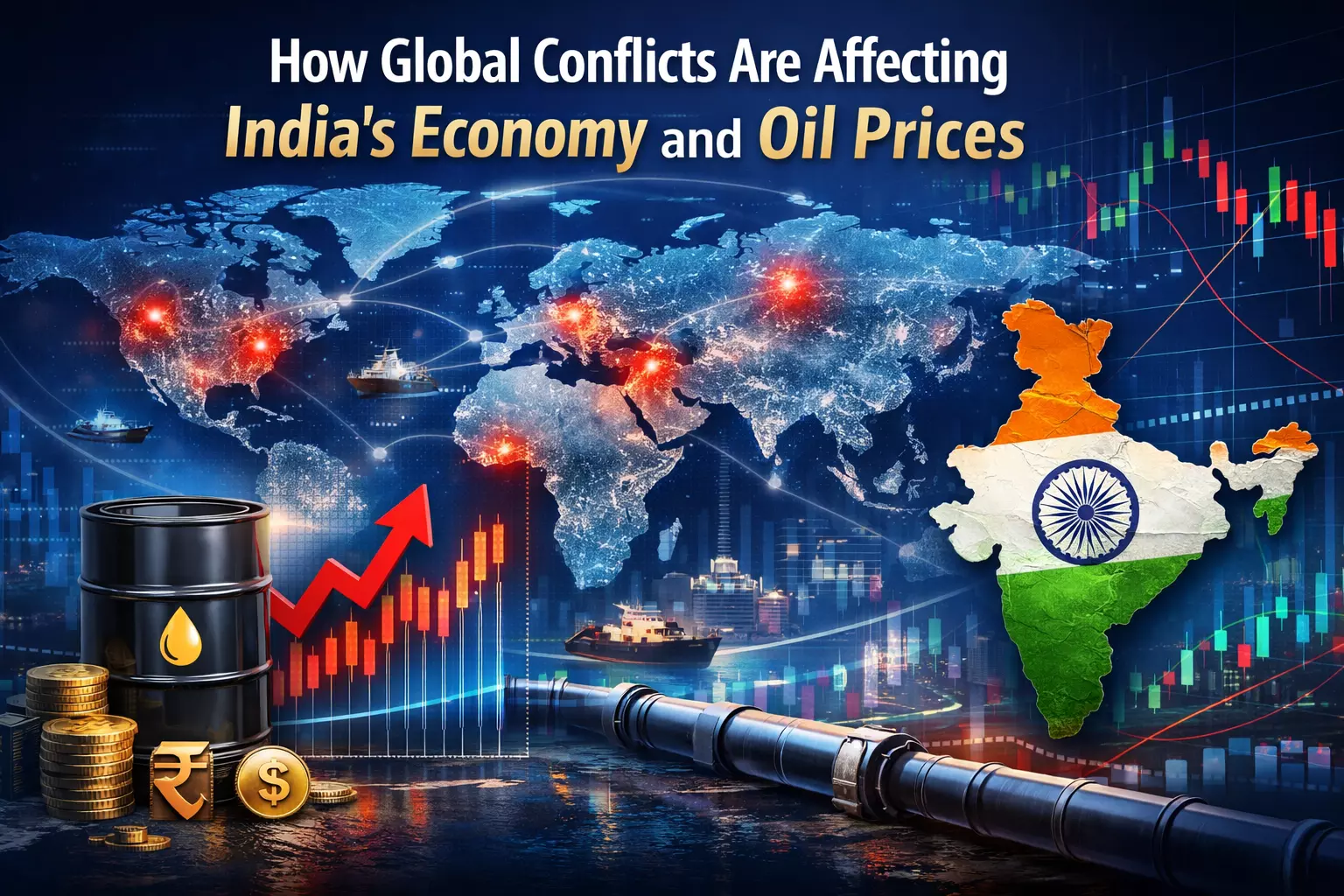
Breaking News in India Today: Global Conflicts Impact Economy & Oil Prices
Pick up your phone and scroll through breaking news in India today — somewhere between cricket scores and Bollywood gossip, you'll almost certainly find a story about oil prices or the rupee slipping against the dollar. Most people skim past it.
But that number? It's shaped by events happening thousands of miles away, in places most of us will never visit.
Wars, sanctions, trade disputes, and geopolitical tensions don't stay confined to the countries fighting them. They travel — through fuel prices, shipping lanes, inflation figures, and stock markets.
India, the world's third-largest consumer of crude oil and a country that imports nearly 85% of what it burns, is particularly exposed to this reality. When the world catches fire, India feels the heat too.
Global Conflicts and Rising Oil Prices
Let's start with the most direct hit — oil. Every time there's a serious flare-up in the Middle East or a fresh round of Western sanctions against a major oil producer, crude prices jump.
It's almost automatic at this point. Traders get nervous, supply fears kick in, and prices spike before a single barrel is even disrupted.
The Russia-Ukraine war, which entered a brutal new phase in 2022 and continues to shape markets even now, ripped through global energy supply chains.
Europe scrambled for alternatives. Oil markets went haywire. And while India quietly struck deals to buy discounted Russian crude — a pragmatic move that helped cushion the blow — the overall volatility kept prices elevated and unpredictable throughout.
More recently, the Red Sea crisis added another layer of chaos. Shipping lanes that carry a significant chunk of global trade were disrupted, rerouting tankers thousands of extra miles around Africa.
That means longer journeys, higher freight costs, and ultimately — more expensive oil landing on Indian shores. If you've been following today news headlines in English of India over the past year, you've seen this story play out in real time.
Impact on India's Economy and Inflation
Here's the thing about oil — it's not just fuel. It's the backbone of how things get made and moved. When oil gets expensive, everything gets more expensive.
Trucks cost more to run, so transporting vegetables from farms to cities costs more. Fertiliser prices climb, making farming costlier. Factories burn more money on energy. It all flows downstream into the prices ordinary people pay every day.
India's retail inflation has repeatedly been pushed upward by exactly these forces.
The Reserve Bank of India spent much of 2022 and 2023 raising interest rates — not because of anything India did wrong domestically, but largely because external shocks kept feeding into prices. For middle-class families already managing tight budgets, that translated into real pain.
People who track breaking news in India today live — especially in smaller cities and towns — often notice fuel price changes before any official announcement.
Because the moment pump prices shift, auto fares change, bus tickets change, and the cost of almost everything in the local market starts to move. That's not coincidence. That's the economy reacting.
Trade, Markets, and Economic Stability
Beyond oil, global conflicts are rewriting trade routes in ways India has to navigate carefully.
The Suez Canal disruptions effectively added weeks to delivery timelines for Indian exporters — textile manufacturers, pharma companies, engineering goods suppliers — all suddenly facing freight bills they hadn't budgeted for. Some lost contracts. Others absorbed the costs and cut margins.
On the financial side, global uncertainty tends to push investors toward safe-haven assets like US treasury bonds and gold, pulling money away from emerging markets.
The rupee has faced sustained pressure as a result, touching record lows more than once in recent years. A weaker rupee means India's import bill — already heavy with oil — gets even heavier. It's a compounding problem.
If you scan today news in English in India headlines on any given morning, chances are you'll find at least one story connecting global geopolitical developments to market movements here at home. The correlation has become almost impossible to miss.
Read: Latest National and Political News: What's Changing in
How India Is Responding
To its credit, India hasn't just been passive about all this. The government and RBI have been working through multiple strategies — some short-term, some looking decades ahead.
The sharp pivot toward Russian crude was one immediate response. It saved billions in import costs during a period when Brent crude was trading at punishing levels.
Longer term, India is investing heavily in renewables. Solar capacity has grown dramatically, and the government has set ambitious targets to reduce dependence on imported fossil fuels.
These aren't just environmental decisions — they're strategic ones, designed to insulate the economy from exactly the kind of external shocks we're discussing.
Diplomatic maneuvering has also played a role. India's carefully maintained "strategic autonomy" — refusing to get boxed in by either the Western bloc or Russia and China — has given it unusual flexibility in securing energy deals and trade partnerships.
For those following all India today news in hindi or breaking news in India today live in hindi, the government's foreign policy moves often tell the economic story just as clearly as the financial headlines.
Conclusion
Global conflicts and India's economy have never been as deeply linked as they are right now. Oil prices, inflation, the rupee, trade costs — all of it is being shaped by wars and tensions playing out in distant corners of the world.
And while India has shown real resilience and smart policy thinking, the vulnerabilities are still there.
Staying informed matters more than ever. Whether you follow breaking news in India today in hindi or rely on English news sources, understanding the connection between global events and your daily costs is genuinely useful knowledge.
The world is volatile. India is adapting. And for citizens, keeping up with reliable news — your window into these complex developments — is the best tool you have.